Feed aggregator

Nowcast Points to Steady US Growth in Q2

The Capital Spectator -

US economic growth is expected to hold steady at a 2%-plus pace in the second quarter, according to the median nowcast from several estimates compiled by CapitalSpectator.com. This early estimate for the current quarter suggests that the economy may be more resilient to the effects of the Middle East conflict than previously assumed.

The main threat is inflation, which jumped sharply in March and is expected to rise further in tomorrow’s April report from the government, based on the outlook for the year-over-year trend. The concern is that as the energy supply shock continues to reverberate, growth will suffer.

The current median nowcast for Q2, however, suggests that real (inflation-adjusted) output will be largely unchanged relative to Q1. Today’s estimate indicates a 2.2% annualized increase for Q2, modestly above the 2.0% rise reported for Q1, which marked a solid recovery from Q4’s weak 0.5% gain.

Uncertainty surrounding the Iran war—currently in a precarious state of peace—still leaves plenty of room for debate about how the remainder of the quarter will unfold, and whether the current nowcast will hold. A bright spot is the labor market. US hiring rose more than expected in April, suggesting that the economy may be more resilient to the conflict than previously estimated.

The gain in employment is “evidence of the underlying resilience of this economy and of this labor market, despite all of the slings and arrows of outrageous concerns about the Middle East and unemployment and inflation and the Fed,” said Scott Clemons, chief investment strategist at Brown Brothers Harriman. But “one month does not a new trend establish. There’s been a lot of month‑to‑month volatility in the jobs market over the past year. I’m not sure that’s completely gone away. We get another two or three months of solid job gains, then I feel a little bit more comfortable.”

Comfort will likely be in short supply as long as the threat of war hangs over the Middle East and energy exports from the Gulf remain blocked.

President Trump on Sunday rejected Iran’s latest proposal to end the war, writing on social media that it was “TOTALLY UNACCEPTABLE!”

The data may be steady, but the backdrop is anything but. The coming months will reveal whether the economy can outrun the shadows gathering overseas.

Is Recession Risk Rising? Monitor the outlook with a subscription to:
The US Business Cycle Risk Report

Book Bits: 9 May 2026

The Capital Spectator -

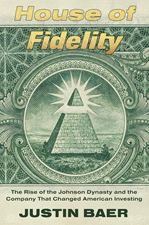
House of Fidelity: The Rise of the Johnson Dynasty and the Company That Changed American Investing
Justin Baer
Review via Financial Times
Few companies touch the lives of as many people as Fidelity. The Boston-based financial group directly manages $7tn and administers a total of $18tn, serving an estimated 57mn people, or one in five American adults through retirement plans, investment funds and brokerage accounts.
But the private group is owned and run by a publicity-shy New England dynasty that largely shuns the limelight. That has left customers and rivals to guess exactly what chief executive Abigail Johnson and her team have been up to as Fidelity embarked on a massive growth spurt and pushed well past its money management rivals in terms of employees, revenue and, crucially, profits.
In House of Fidelity, veteran journalist Justin Baer seeks to lift the lid on this enormous company, which employs more than 80,000 people and reported $12.7bn in operating income last year, dwarfing BlackRock, the world’s largest public asset manager.

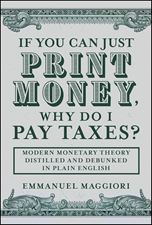
If You Can Just Print Money, Why Do I Pay Taxes?: Modern Monetary Theory Distilled and Debunked in Plain English
Emmanuel Maggiori
Summary via publisher (Wiley)
What if the government could fund anything it wanted by simply creating money out of thin air? That’s the promise of Modern Monetary Theory (MMT), a radical economic proposal gaining traction among politicians, activists, and academics. Advocates say that, with the right precautions, governments can create money to end unemployment, fight climate change, and much more – all without raising taxes. In If You Can Just Print Money, Why Do I Pay Taxes?, author Emmanuel Maggiori walks you through MMT in plain language and shows you why its arguments don’t hold water. Maggiori debunks MMT step by step, offering compelling, informed, and rigorous counterarguments against all of its foundational claims. The author explains why MMT-inspired “money printing,” far from guaranteeing prosperity, could be a recipe for inflation, instability, and stagnation.

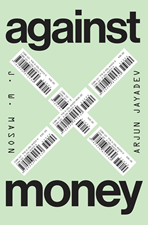
Against Money
J. W. Mason and Arjun Jayadev
Summary via publisher (Chicago U. Press)
Money is everywhere in our daily lives. It lurks in the swipe of a card at the grocery store, in looming student-loan debts, in the prices of things we want, and in our subconscious navigation of the modern world. Money is an invisible convenience that saves us, as a society, the hassle of bartering for goods and services—a reflection, in our pockets and on our phones, of the hard facts of scarcity and desire. Or is it something more? In this revelatory book, economists J. W. Mason and Arjun Jayadev explain how and why money is so deeply misunderstood by the world it dominates—as well as the dangerous social implications of this misunderstanding.

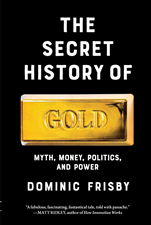
The Secret History of Gold: Myth, Money, Politics, and Power
Dominic Frisby
Review via The Telegraph
It’s true that the gold standard stops governments from recklessly printing money and inflating the economy. And this, Frisby argues, is exactly what has happened, pretty much everywhere, again and again. Crippled by the costs of the First World War and the Great Depression, Britain was the first to abandon the gold standard in 1931. But 1971 was when the rot really set in. Saddled with rising inflation, increasing trade deficits and the cost of the Vietnam War, Richard Nixon’s America abandoned the standard and took the rest of the world with it down the path of perdition; government after government has since then repeatedly devalued their currency on the world’s markets. Why else would houses cost 70 times more now than when I was born in 1965?
Frisby’s proposed cure is for the world to adopt cryptocurrency. Despite not being a material entity, like gold, a bitcoin is pure money – a bearer asset.

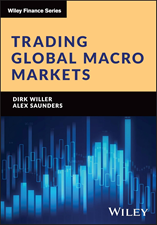
Trading Global Macro Market
Dirk Willer and Alex Saunders
Summary via publisher (Wiley)
In Trading Global Macro Markets, accomplished global macro veterans Dirk Willer and Alex Saunders deliver a complete and incisive guide to navigating global macroeconomic trends as the low volatility world of quantitative easing gives way to the post-pandemic world of increased interest rates and macro volatility. The authors offer coverage of every major asset class, from government debt and credit to equity, commodity, and foreign exchange markets, along with back-tested frameworks going back over two decades and more that illustrate how to trade each class and how to make cross-asset trading decisions.

Please note that the links to books above are affiliate links with Amazon.com and James Picerno (a.k.a. The Capital Spectator) earns money if you buy one of the titles listed. Also note that you will not pay extra for a book even though it generates revenue for The Capital Spectator. By purchasing books through this site, you provide support for The Capital Spectator’s free content. Thank you!

Geopolitics, Inflation, and a Bond‑Market Surprise in Favor Of Junk

The Capital Spectator -

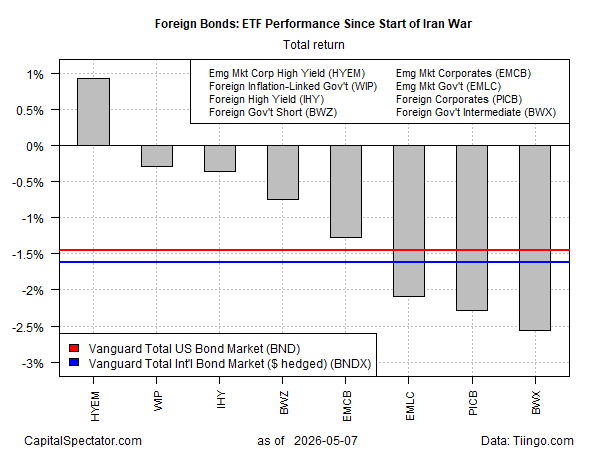
Diversifying into foreign bonds hasn’t provided much benefit to U.S. investors since the Middle East conflict began, with one exception: high‑yield corporate bonds issued by firms in emerging markets.

Bucking the trend since the conflict started on Feb. 28, the VanEck Emerging Markets High Yield Bond ETF (HYEM) is a rare bright spot in international fixed income from a US-dollar-based investment perspective. The fund is up 0.9% over this period, making it an outlier in a market otherwise marked by red ink.

HYEM’s performance stands out, though it generally mirrors the gains in U.S. junk bonds (JNK). By comparison, investment‑grade bonds—both corporate and government, in the US and abroad—are underwater since Feb. 28.

Why the disconnect? High‑yield bonds carry more risk than investment‑grade debt. One might have expected investors to flock to higher‑quality bonds as a safe haven and avoid junk bonds. Instead, the opposite has occurred.

One explanation: junk bonds have rallied as investors chase higher yields while war‑driven uncertainty eases, whereas investment‑grade bonds have lost ground amid rising interest‑rate expectations and inflation concerns.

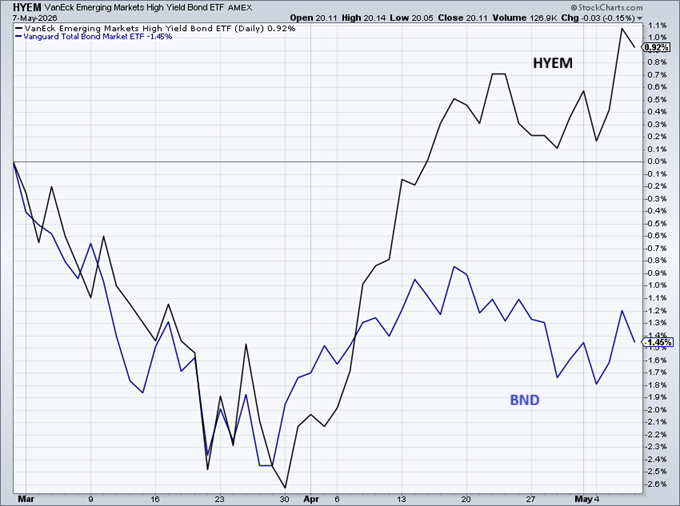
Markets broadly began to rebound in late March. Initially, most bond sectors participated, but by mid‑April high‑yield and investment‑grade debt diverged sharply.

For example, HYEM has recovered all of its war‑related losses and even reached a new high earlier this week. A broad measure of U.S. investment‑grade bonds (BND)—including Treasuries and corporates—stalled in mid‑April and remains below its pre‑war close.

Analysts say high‑yield bonds have regained appeal thanks to their sizable coupons, which provide a meaningful yield cushion against market volatility. With fears of a worst‑case geopolitical escalation easing, investors have shown a renewed appetite for risk and rotated back into these higher‑return assets.

The divergence shows how quickly fixed‑income dynamics can shift when geopolitics and inflation collide. It also underscores why diversification across bond sectors matters—because in uncertain times, markets have a way of defying even the most confident forecasts.

Learn To Use R For Portfolio Analysis
Quantitative Investment Portfolio Analytics In R:
An Introduction To R For Modeling Portfolio Risk and Return

By James Picerno

Pages