Feed aggregator

Rising Misery Index Signals Mounting Economic Pressure

The Capital Spectator -

Economic headwinds continue to reverberate from the conflict in the Middle East, but the US economy has proven relatively resilient in the wake of this macro shock. How long that resilience lasts is unclear, but the pressures are building. That’s a worrisome sign as the stalemate between the US and Iran continues and energy exports from the Gulf remain blocked.

A useful proxy for estimating the potential for economic fallout is the so‑called Misery Index, which combines the inflation rate with the unemployment rate—a measure of the economic well‑being of the average consumer. By this benchmark, the war’s blowback is rising. April’s sum of the one‑year change in the consumer price index and the jobless rate rose to 8.1%, the highest in three years.

All of the recent upturn is due to hotter inflation over the past two months. The unemployment rate, by contrast, has remained steady at a modest 4.4%. Inflation appears likely to trend higher as the supply‑side energy shock continues, and so even a modest increase in the jobless rate could intensify the Misery Index’s increase this summer.

For now, another bullet has been dodged this week. President Trump said Monday that he had canceled what he described as a planned US strike on Iran scheduled for Tuesday. He explained that he halted the operation because “serious negotiations” were underway toward a peace agreement that he claimed would satisfy the United States and its Middle Eastern partners. Yet the very fact that a military attack was being prepared—and called off only at the last moment—underscores how far the two countries remain from any durable resolution.

Unsurprisingly, inflation is expected to trend higher in the upcoming report for May. The Cleveland Fed’s nowcast indicates that headline CPI will top 4% for the annual change for this month. Assuming the jobless rate holds steady, the CPI nowcast points to another rise in the Misery Index for May.

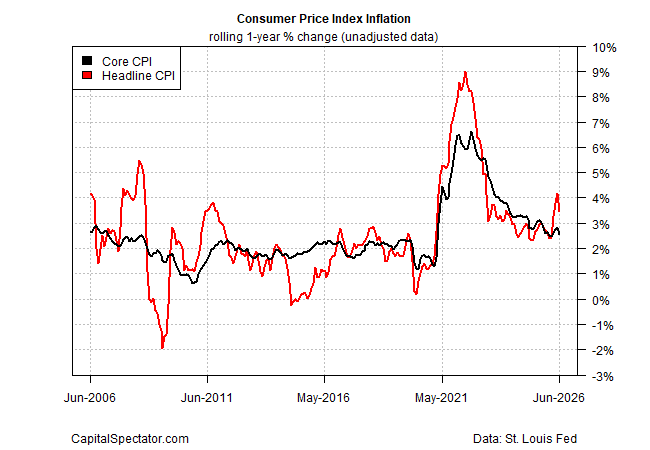
Optimists can point to core CPI, which has increased at a much softer pace, ticking up to 2.7% for the year through last month. The Federal Reserve pays more attention to core inflation metrics, which tend to provide a more robust measure of inflation’s trend compared to noisy headline indexes.

The problem is that while core CPI gives the Fed space to maintain a wait‑and‑see position on whether to tighten monetary policy, consumers are already feeling the pain of the war’s effects. In today’s hyper‑charged political climate, it’s an open question whether central bankers will remain immune to events on Main Street.

The recent history of the Misery Index suggests there are limits to that immunity. In 2021 and 2022, the index was soaring, peaking at 12.6% in May 2022, two months after the Fed started hiking interest rates.

The current Misery Index is still well below the previous peak, but the gap is narrowing, and the geopolitical news from the Gulf suggests more of the same is coming in the near term. History doesn’t repeat, but it’s getting easier to argue that it’s starting to rhyme… again.

Is Recession Risk Rising? Monitor the outlook with a subscription to:
The US Business Cycle Risk Report

As Inflation Heats Up, the Bond Market Loses Its Cool

The Capital Spectator -

The bond market will be the center of attention for investors this week as they assess how much inflation risk is lurking. Official reports already highlight accelerating pricing pressures, driven by Middle East turmoil that has lifted energy costs and raised headline measures of inflation. The debate is whether the run‑up in inflation is temporary or reflects a shift that will persist. Bound up with that question is how the Federal Reserve should respond.

The Treasury market has already decided that tighter monetary policy is necessary. The policy‑sensitive 2‑year yield soared last week, rising above 4.0% for the first time in nearly a year. The jump is a sign that the bond market expects a hawkish pivot from the Fed.

For a clearer view of how market conditions have changed, the chart below shows the spread between the 2‑year yield and the effective Fed funds rate (the volume‑weighted median of overnight Federal funds transactions). This gap has increased to a three‑year high—nearly half a percentage point.

The Capital Spectator’s rough estimate of current Fed policy suggests a neutral stance, based on a simple model that compares the target rate to unemployment and inflation—the two components of the central bank’s dual mandate. A month ago, the estimate indicated that policy was slightly tight. The key takeaway: ongoing inflation risk appears set to shift policy into a dovish stance, assuming the Fed continues to leave rates unchanged.

Fed funds futures are still pricing in high odds of no change for the next several policy meetings. The highest confidence for standing pat applies to the upcoming June 17 FOMC meeting—futures are estimating a 99% probability of keeping rates steady. A 90‑plus percent probability of no change is currently assigned to the July meeting.

The tension between the 2‑year yield and expectations for Fed funds will be closely monitored in the days and weeks ahead. A capitulation on one side or the other would be notable, although analysts seem to be leaning toward the view that expectations for a Fed rate hike are building.

“I do think there is a real fear that inflation is kind of embedded in the economy going forward,” said Peter Tuz, president of Chase Investment Counsel in Charlottesville, Virginia.

“A new inflation regime awaits [Kevin] Warsh,” the new Fed chief, writes Joseph Brusuelas, chief economist at RSM US.

“The fact that we are now seeing data backing up inflationary fears that have been in the market since the Middle East conflict started is key,” said Nick Twidale, chief markets analyst at ATFX Global.

A repricing of Fed funds futures to reflect the shift in sentiment may prove to be the decisive factor prompting a capitulation by the doves.


Book Bits: 16 May 2026

The Capital Spectator -

The New Money Strategy: The Modern Guide to Rational, Long-Term Investing
Brandon van der Kolk
Summary via publisher (Wiley)
The New Money Strategy: The Modern Guide to Rational, Long-Term Investing is the ultimate strategy guide to help a new generation of investors harness the power of value investing and the stock market. In this book, Brandon van der Kolk, founder of the popular New Money YouTube channel with more than one million dedicated subscribers, reveals the common mistakes people are making in the markets today and the time-tested strategy to build long term wealth.

Moral Economics: From Prostitution to Organ Sales, What Controversial Transactions Reveal About How Markets Work
Alvin E. Roth
Interview with author via Critical Mass podcast
Alvin Roth is a Nobel Prizewinning Economist whose work on designing markets has had real world impacts that may have saved thousands of lives around the world, while arousing strong emotions both for and against the programs he has helped put in place. Clearly not one to shy away from controversy, he represents the best of what The Origins Project is trying to promote: applying science and reason to public policy. In short, connecting science and culture! Roth’s new book, which is fantastic, and comes out the same day this podcast is released deals with issues that often raise the public’s ire, from legalizing prostitution, to assisted suicide, and finally to a rational market for kidney transplants.

Founder’s Fire: From 1776 to the Age of Trump
Arthur Herman
Review via The Wall Street Journal
This year is dedicated to the 250th anniversary of the birth of the United States. Most historians are concentrating on the birth itself, when 13 disparate colonies along the east coast of North America declared their intention to separate from Great Britain. That, to be sure, is quite a story, one without previous precedent. So is the story of the Constitutional Convention a few years later, which produced what is now the world’s oldest constitution of a complex sovereign state, amended only 27 times.
In “Founder’s Fire” Arthur Herman—whose books of popular history include “How the Scots Invented the Modern World” (2001)—gives these stories their due. But Mr. Herman sees a bigger picture here. He argues, in this entertaining and enlightening book, that the spirit—the fire—that drove the Founding Fathers to risk everything to establish something very new has animated this country ever since.

The Art and Business of Professional Trading
Ryan Wright
Summary via publisher (Wiley)
The library of trading literature falls into three largely useless categories. Pop-psychology books focus on mindset and discipline, but psychology is downstream of process. If you lack edge, no amount of mental work saves you. Paint-by-numbers manuals promise certainty through precise setups and mechanical rules, but in an adversarial, reflexive market, widely-known patterns become traps, and the playbook becomes a liability. Academic tomes provide mathematical rigor disconnected from the reality of execution under uncertainty. The Art and Business of Professional Trading occupies the void between them. It is what has been missing for the ambitious trader ready to move beyond hobbyist speculation and think with the rigor of an institutional desk.

Legacy on the Line: Overcome Blind Spots to Grow and Transfer Your Wealth
Andrea Baumann Lustig
Summary via publisher (Wiley)
In Legacy on the Line: Overcome Blind Spots to Grow and Transfer Your Wealth, sixth-generation wealth adviser and Managing Partner of Fischer Stralem Advisors, Andrea Baumann Lustig shares 30 years of insights working with families to help build and transfer wealth. With the largest wealth transfer in history—$124 trillion—underway, many families risk losing their legacy not through lack of resources, but through unexamined beliefs that quietly undermine their financial future. This book reveals 10 common blind spots that sabotage legacy planning—convictions so deeply held they go unchallenged, often leading to missed opportunities, increased risk, and unnecessary costs.

Please note that the links to books above are affiliate links with Amazon.com and James Picerno (a.k.a. The Capital Spectator) earns money if you buy one of the titles listed. Also note that you will not pay extra for a book even though it generates revenue for The Capital Spectator. By purchasing books through this site, you provide support for The Capital Spectator’s free content. Thank you!

Factor Extremes: Momentum Runs Hot as Low-Vol Stumbles

The Capital Spectator -

The US stock market surged to yet another record high on Thursday, a new milestone that suggests a rising tide is lifting all equity sectors. Yet reviewing the market through a risk-factor risk lens tells a more nuanced story, revealing a wide dispersion of trends that have emerged since the conflict with Iran began on Feb. 28, based on a set of ETFs through yesterday’s close (May 14).

The results suggest that much of the difference between equity-portfolio strategies during the war-regime period can be traced to factor allocations. For example, among the winning strategies of late there’s a good chance that the portfolios have relatively high allocations to the momentum factor, intentionally or otherwise.

The momentum factor is the clear leader, outperforming the rest of the field by a wide margin. The iShares MSCI USA Momentum Factor ETF (MTUM) has surged 21.6% since the attack started nearly three months ago. The next-strongest performer is large-cap growth (IWV) with a 16.3% rally. Both funds are posting sharply higher gains vs. the market benchmark via SPDR S&P 500 ETF (SPY), which is up 9.4% since Feb. 28.

Most equity factors are trailing the broad market (SPY), including one downside outlier. The low-volatility factor has delivered especially poor results since the start of the conflict, which has shifted to a precarious stalemate that continues to block energy exports from the Gulf. The iShares MSCI Minimum Volatility ETF (USMV) has lost 2.3% since Feb. 28.

Despite the headline strength in equities, the widening gap between factor winners and laggards underscores how uneven the market’s internal dynamics have become. Momentum’s dominance and low volatility’s slump suggest investors are rewarding exposure to persistent trends while shunning defensive positioning, even as geopolitical risk remains elevated. That divergence is a reminder that record highs can mask shifting fault lines beneath the surface—fault lines that may matter far more if the current geopolitical stalemate breaks in either direction.

Learn To Use R For Portfolio Analysis
Quantitative Investment Portfolio Analytics In R:
An Introduction To R For Modeling Portfolio Risk and Return

By James Picerno

Treasury Premium Climbs Again, Fueled by Sticky Inflation

The Capital Spectator -

The market premium for the US 10-year Treasury yield over a fair‑value estimate remained modest in April but has been edging higher after falling to a near‑equilibrium level late last year. The threat of higher inflation stemming from the Iran conflict remains a risk factor, though the repricing of the market premium has been modest so far.

The gradual shift may begin to accelerate in the months ahead as inflation risk moves to center stage in the bond market. The 10‑year yield rose to 4.47% yesterday (May 13), the highest close since last August. The recent upside bias suggests that the pickup in inflation triggered by the Middle East turmoil is starting to alter sentiment for fixed‑income securities.

The Labor Department reported this week that consumer and wholesale inflation continued to post sharp increases in April.

“Inflation is sticky and accelerating. The core reading confirms a deeper structural trend, especially in services,” said David Russell, global head of market strategy at TradeStation. “The Hormuz crisis is aggravating the problem, but this goes way beyond oil.”

The market premium relative to The Capital Spectator’s fair‑value estimate of the 10‑year yield ticked up to 35 basis points last month. That remains modest by historical standards, but if inflation stays elevated—or shows signs of rising further—the premium will likely increase in the months ahead.

What we’ve seen is investors pricing in higher long‑term inflation into what they want to receive from lending to the government,” said Luke Tilley, chief economist at Wilmington Trust.

By late 2025, the surge in the 10‑year premium associated with the 2021–2022 inflation spike had faded to nearly zero. But the calculus is changing as the conflict with Iran continues and threatens to become a protracted affair that keeps Gulf energy exports blocked and inflation elevated.

A quick resolution that allows exports to resume would likely keep the yield premium modest. But with diplomatic efforts at a standstill and US threats to resume military operations if Iran doesn’t compromise, the timeline for an end to the conflict remains unclear. As a result, the yield premium—and interest rates more broadly—appear poised to rise in the near term.

Is Recession Risk Rising? Monitor the outlook with a subscription to:
The US Business Cycle Risk Report

US–Iran Crisis Edges Toward Prolonged Stalemate

The Capital Spectator -

President Trump is warning that the US could restart strikes on Iran, a stance that reads less like a negotiating tactic and more like the opening move in a drawn‑out standoff. A few days ago, he described the fragile cease-fire as being on “massive life support.” In other words, a long, grinding stalemate appears to be taking shape. That’s a threat to the global economy because as the impasse drags on and energy exports from the Gulf remain blocked, the world’s oil supply shrinks and scarcity risks rise.

“From the point of view of energy, this is a snowball — and every week that passes, you have tighter markets,” says Jaime Brito, executive director of refining and oil products at Dow Jones Energy.

Oil prices reflect that uncertainty. The US benchmark, West Texas Intermediate, traded near $107 a barrel yesterday — a middling range following the surge since the war began.

Brent crude, the global benchmark, is trading closer to its upper range, reflecting the higher level of vulnerability for Europe and Asia related to oil imports relative to America’s domestic oil supplies. A break higher from the current $107 level for Brent would signal that the market is starting to price in a higher risk that the conflict’s stalemate will have deeper and longer‑lasting effects on the global economy, including inflation.

Recent developments behind the scenes aren’t encouraging. A troubling report suggests Iran has tightened its control over the Strait of Hormuz after establishing a new Persian Gulf Strait Authority and positioning itself as the sole gatekeeper for this strategic energy corridor.

According to Lloyd’s List Intelligence, the agency is now demanding that vessels submit application forms for passage — an effort to control transit approvals and collect tolls. Iran’s Islamic Revolutionary Guard Corps (IRGC) “has imposed a de facto ‘toll booth’ regime in the Strait of Hormuz, requiring vessels to submit full documentation, obtain clearance codes and accept IRGC‑escorted passage through a single controlled corridor.”

The immediate economic threat is inflation, which continues to rise. Headline consumer inflation increased 3.8% in April from a year earlier — a three‑year high, the Bureau of Labor Statistics reported on Tuesday. The main driver: higher energy costs.

“Inflation is the key drag on the U.S. economy now,” said Heather Long, chief economist at Navy Federal Credit Union. “This is hurting Americans. There is a real financial squeeze underway. For the first time in three years, inflation is eating up all wage gains. This is a setback for middle‑class and lower‑income households, and they know it.”

Inflation will ease once the Middle East crisis is resolved. Unfortunately, the path out of the stalemate isn’t clear, and the US — and the West — increasingly looks boxed in. A resumption of military strikes might break the gridlock, but Iran’s regime has already shown it can take a beating and still maintain its stranglehold over Gulf exports.

Meanwhile, President Trump’s summit with China’s President Xi Jinping may yield a breakthrough, according to some analysts. But before departing Washington for Beijing, Trump downplayed the potential for engaging China to persuade Iran to open the Strait.

“I don’t think we need any help with Iran,” Trump said. “We’ll win it one way or the other, peacefully or otherwise.”

Exactly what that means — and on what timeline — is unclear. In the meantime, the clock is ticking, and the risk of a deeper, longer energy shock continues to rise.


Higher Inflation is Becoming Baked Into Expectations

The Capital Spectator -

President Trump said the ceasefire with Iran is on “massive life support,” which suggests that inflation risk will remain elevated.

Oil prices continue to trade above $100 a barrel for the US crude benchmark as Trump has become increasingly frustrated with Iran’s negotiating positions to formally end the conflict that is keeping Gulf energy exports blocked. This disruption is keeping prices high and driving up headline measures of inflation. With no clear exit strategy on the horizon, markets are pricing in higher odds of persistent inflation.

One metric to watch is the ratio of the iShares TIPS Bond ETF (TIP), a portfolio of inflation‑indexed Treasuries, to a similar fund that holds conventional government bonds (IEF). As this ratio rises, it implies that the market is demanding a higher inflation premium. Notably, the ratio is trading near the peaks of recent years. A decisive break above this level (red line in the chart below) would signal stronger concern that inflation risk could run longer and higher than recently expected.

Today’s April report on consumer prices is expected to highlight another month of hotter inflation. The Cleveland Fed’s current inflation nowcast indicates that the rise in headline CPI will continue through May.

Betting markets are pricing in higher odds that inflation will top 4% this year, substantially higher than the 3.3% year‑over‑year trend reported for headline CPI through March.

The Treasury market’s implied inflation forecast is also near multi‑year highs, based on the spread between inflation‑indexed yields and their nominal counterparts. The 5‑year forecast is 2.67% as of May 11, just below last week’s 2.72% peak. A sustained push above that peak would highlight the market’s growing confidence that inflation risk will persist.

Perhaps the final straw in the repricing of inflation risk will be rising expectations that the Federal Reserve will increase interest rates to combat the shift. For now, that remains a low‑probability scenario based on Fed funds futures, which continue to price in high odds that the central bank will leave its target rate unchanged for the next several policy meetings.

That view may persist if core readings of inflation remain relatively stable, as they have recently. These measures of pricing pressure tend to hold more sway at the Fed. But the longer the Middle East conflict continues and energy exports remain blocked, the higher the odds that the status quo for Fed expectations will give way to a hawkish pivot. A sign that this shift is gaining momentum: core inflation continues to edge higher.


Nowcast Points to Steady US Growth in Q2

The Capital Spectator -

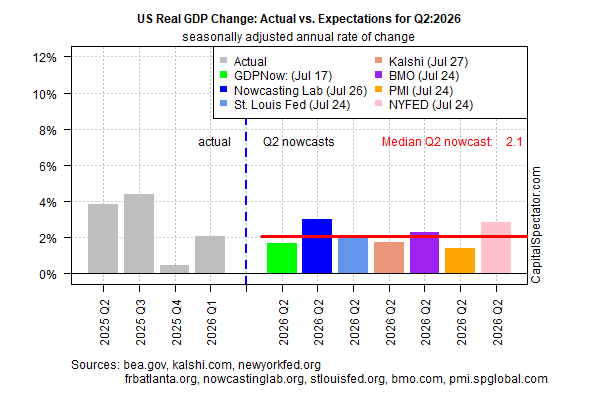
US economic growth is expected to hold steady at a 2%-plus pace in the second quarter, according to the median nowcast from several estimates compiled by CapitalSpectator.com. This early estimate for the current quarter suggests that the economy may be more resilient to the effects of the Middle East conflict than previously assumed.

The main threat is inflation, which jumped sharply in March and is expected to rise further in tomorrow’s April report from the government, based on the outlook for the year-over-year trend. The concern is that as the energy supply shock continues to reverberate, growth will suffer.

The current median nowcast for Q2, however, suggests that real (inflation-adjusted) output will be largely unchanged relative to Q1. Today’s estimate indicates a 2.2% annualized increase for Q2, modestly above the 2.0% rise reported for Q1, which marked a solid recovery from Q4’s weak 0.5% gain.

Uncertainty surrounding the Iran war—currently in a precarious state of peace—still leaves plenty of room for debate about how the remainder of the quarter will unfold, and whether the current nowcast will hold. A bright spot is the labor market. US hiring rose more than expected in April, suggesting that the economy may be more resilient to the conflict than previously estimated.

The gain in employment is “evidence of the underlying resilience of this economy and of this labor market, despite all of the slings and arrows of outrageous concerns about the Middle East and unemployment and inflation and the Fed,” said Scott Clemons, chief investment strategist at Brown Brothers Harriman. But “one month does not a new trend establish. There’s been a lot of month‑to‑month volatility in the jobs market over the past year. I’m not sure that’s completely gone away. We get another two or three months of solid job gains, then I feel a little bit more comfortable.”

Comfort will likely be in short supply as long as the threat of war hangs over the Middle East and energy exports from the Gulf remain blocked.

President Trump on Sunday rejected Iran’s latest proposal to end the war, writing on social media that it was “TOTALLY UNACCEPTABLE!”

The data may be steady, but the backdrop is anything but. The coming months will reveal whether the economy can outrun the shadows gathering overseas.

Is Recession Risk Rising? Monitor the outlook with a subscription to:
The US Business Cycle Risk Report

Book Bits: 9 May 2026

The Capital Spectator -

House of Fidelity: The Rise of the Johnson Dynasty and the Company That Changed American Investing
Justin Baer
Review via Financial Times
Few companies touch the lives of as many people as Fidelity. The Boston-based financial group directly manages $7tn and administers a total of $18tn, serving an estimated 57mn people, or one in five American adults through retirement plans, investment funds and brokerage accounts.
But the private group is owned and run by a publicity-shy New England dynasty that largely shuns the limelight. That has left customers and rivals to guess exactly what chief executive Abigail Johnson and her team have been up to as Fidelity embarked on a massive growth spurt and pushed well past its money management rivals in terms of employees, revenue and, crucially, profits.
In House of Fidelity, veteran journalist Justin Baer seeks to lift the lid on this enormous company, which employs more than 80,000 people and reported $12.7bn in operating income last year, dwarfing BlackRock, the world’s largest public asset manager.

If You Can Just Print Money, Why Do I Pay Taxes?: Modern Monetary Theory Distilled and Debunked in Plain English
Emmanuel Maggiori
Summary via publisher (Wiley)
What if the government could fund anything it wanted by simply creating money out of thin air? That’s the promise of Modern Monetary Theory (MMT), a radical economic proposal gaining traction among politicians, activists, and academics. Advocates say that, with the right precautions, governments can create money to end unemployment, fight climate change, and much more – all without raising taxes. In If You Can Just Print Money, Why Do I Pay Taxes?, author Emmanuel Maggiori walks you through MMT in plain language and shows you why its arguments don’t hold water. Maggiori debunks MMT step by step, offering compelling, informed, and rigorous counterarguments against all of its foundational claims. The author explains why MMT-inspired “money printing,” far from guaranteeing prosperity, could be a recipe for inflation, instability, and stagnation.

Against Money
J. W. Mason and Arjun Jayadev
Summary via publisher (Chicago U. Press)
Money is everywhere in our daily lives. It lurks in the swipe of a card at the grocery store, in looming student-loan debts, in the prices of things we want, and in our subconscious navigation of the modern world. Money is an invisible convenience that saves us, as a society, the hassle of bartering for goods and services—a reflection, in our pockets and on our phones, of the hard facts of scarcity and desire. Or is it something more? In this revelatory book, economists J. W. Mason and Arjun Jayadev explain how and why money is so deeply misunderstood by the world it dominates—as well as the dangerous social implications of this misunderstanding.

The Secret History of Gold: Myth, Money, Politics, and Power
Dominic Frisby
Review via The Telegraph
It’s true that the gold standard stops governments from recklessly printing money and inflating the economy. And this, Frisby argues, is exactly what has happened, pretty much everywhere, again and again. Crippled by the costs of the First World War and the Great Depression, Britain was the first to abandon the gold standard in 1931. But 1971 was when the rot really set in. Saddled with rising inflation, increasing trade deficits and the cost of the Vietnam War, Richard Nixon’s America abandoned the standard and took the rest of the world with it down the path of perdition; government after government has since then repeatedly devalued their currency on the world’s markets. Why else would houses cost 70 times more now than when I was born in 1965?
Frisby’s proposed cure is for the world to adopt cryptocurrency. Despite not being a material entity, like gold, a bitcoin is pure money – a bearer asset.

Trading Global Macro Market
Dirk Willer and Alex Saunders
Summary via publisher (Wiley)
In Trading Global Macro Markets, accomplished global macro veterans Dirk Willer and Alex Saunders deliver a complete and incisive guide to navigating global macroeconomic trends as the low volatility world of quantitative easing gives way to the post-pandemic world of increased interest rates and macro volatility. The authors offer coverage of every major asset class, from government debt and credit to equity, commodity, and foreign exchange markets, along with back-tested frameworks going back over two decades and more that illustrate how to trade each class and how to make cross-asset trading decisions.

Please note that the links to books above are affiliate links with Amazon.com and James Picerno (a.k.a. The Capital Spectator) earns money if you buy one of the titles listed. Also note that you will not pay extra for a book even though it generates revenue for The Capital Spectator. By purchasing books through this site, you provide support for The Capital Spectator’s free content. Thank you!

Geopolitics, Inflation, and a Bond‑Market Surprise in Favor Of Junk

The Capital Spectator -

Diversifying into foreign bonds hasn’t provided much benefit to U.S. investors since the Middle East conflict began, with one exception: high‑yield corporate bonds issued by firms in emerging markets.

Bucking the trend since the conflict started on Feb. 28, the VanEck Emerging Markets High Yield Bond ETF (HYEM) is a rare bright spot in international fixed income from a US-dollar-based investment perspective. The fund is up 0.9% over this period, making it an outlier in a market otherwise marked by red ink.

HYEM’s performance stands out, though it generally mirrors the gains in U.S. junk bonds (JNK). By comparison, investment‑grade bonds—both corporate and government, in the US and abroad—are underwater since Feb. 28.

Why the disconnect? High‑yield bonds carry more risk than investment‑grade debt. One might have expected investors to flock to higher‑quality bonds as a safe haven and avoid junk bonds. Instead, the opposite has occurred.

One explanation: junk bonds have rallied as investors chase higher yields while war‑driven uncertainty eases, whereas investment‑grade bonds have lost ground amid rising interest‑rate expectations and inflation concerns.

Markets broadly began to rebound in late March. Initially, most bond sectors participated, but by mid‑April high‑yield and investment‑grade debt diverged sharply.

For example, HYEM has recovered all of its war‑related losses and even reached a new high earlier this week. A broad measure of U.S. investment‑grade bonds (BND)—including Treasuries and corporates—stalled in mid‑April and remains below its pre‑war close.

Analysts say high‑yield bonds have regained appeal thanks to their sizable coupons, which provide a meaningful yield cushion against market volatility. With fears of a worst‑case geopolitical escalation easing, investors have shown a renewed appetite for risk and rotated back into these higher‑return assets.

The divergence shows how quickly fixed‑income dynamics can shift when geopolitics and inflation collide. It also underscores why diversification across bond sectors matters—because in uncertain times, markets have a way of defying even the most confident forecasts.

Learn To Use R For Portfolio Analysis
Quantitative Investment Portfolio Analytics In R:
An Introduction To R For Modeling Portfolio Risk and Return

By James Picerno

Risk-On Returns, but Cracks Still Show Beneath the Surface

The Capital Spectator -

A few days before the war with Iran began on Feb. 28, The Capital Spectator reported that “Bullish Momentum Holds Firm in Global Asset Allocation,” based on a set of ETFs targeting multi-asset strategies. The risk‑on profile quickly evaporated as investors ran for cover in the wake of hostilities. But more than two months later, risk appetite is looking resilient once more.

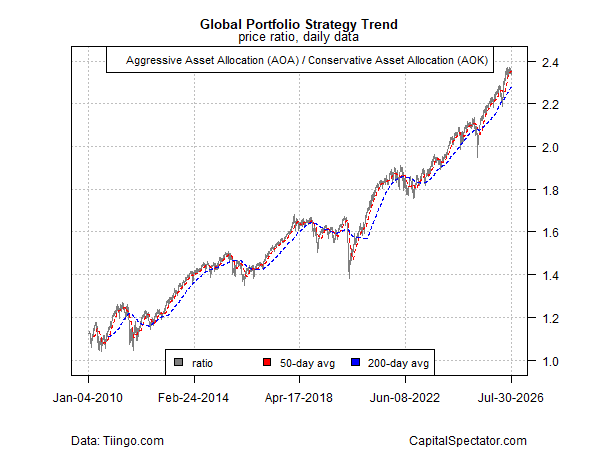
A big‑picture measure of the trend in global asset allocation has rebounded to a positive bias, based on the ratio of two global asset‑allocation ETFs: an aggressive strategy (AOA) versus its conservative counterpart (AOK). After taking a hit in April, the ratio has recovered and climbed to a new high in yesterday’s trading (May 6).

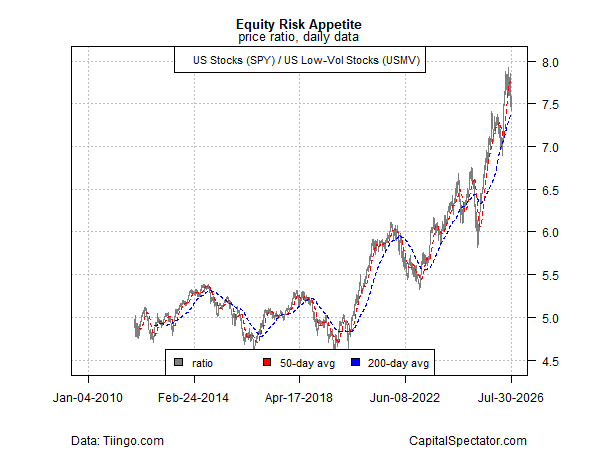
The recovery in risk‑on signaling is even stronger for US equities, based on the ratio of a conventional measure of the U.S. stock market (SPY) to a low‑volatility counterpart (USMV), which serves as a relatively conservative proxy for holding American shares. This ratio has surged in recent weeks, reaching a new high yesterday.

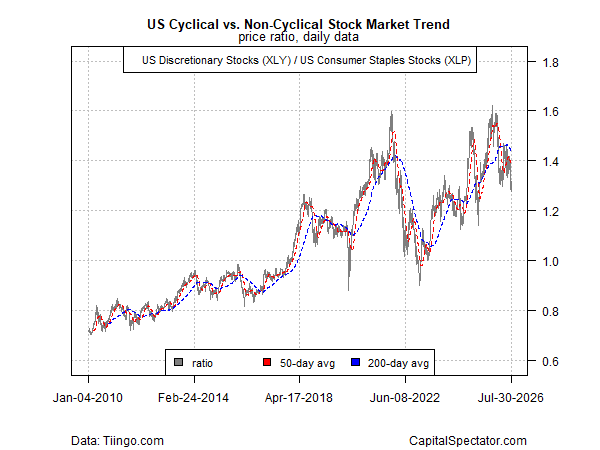
A possible warning sign that the rebound in animal spirits is driven more by speculation than by confidence in the business cycle: the ratio of US cyclical stocks (XLY) to defensive shares (XLP) remains stuck in a middling range, closing yesterday’s session well below where it began the year.

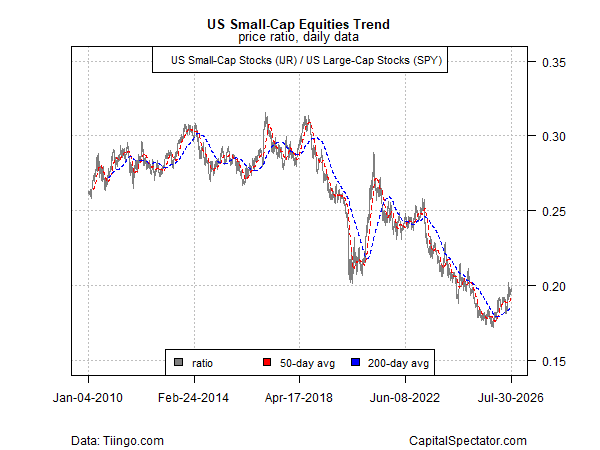
Another area not participating in the risk‑on revival, at least in relative terms, is small‑cap stocks. The ratio of small caps (IJR) to large caps (SPY) is near its lowest level of the year following the runup late last year.

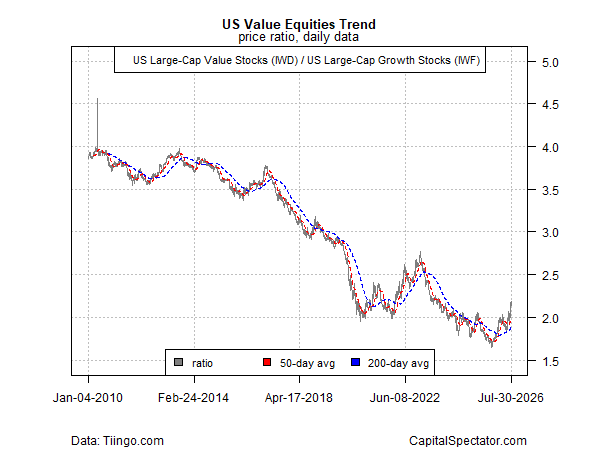
Meanwhile, the late‑2025 revival of value stocks (IWD) relative to growth shares (IWF) has faltered since the war began and has yet to recover.

From a top‑down perspective, the case for risk‑on once again looks solid. Beneath the surface, however, the outlook is mixed. That’s hardly surprising, given the uncertainty hanging over the global economy due to the ongoing Middle East turmoil. But from a global asset‑allocation perspective, the crowd is betting that any turbulence will be short‑lived.


Momentum Factor Roars As War Fears Fade On Wall Street

The Capital Spectator -

War? What war?

The effects of the Middle East conflict continue to reverberate through the global economy, but for the strongest performers among US equity factors, the war has been little more than an afterthought.

Momentum and high‑beta have rallied sharply since the war started and are outperforming the broad market by a wide margin, based on a set of ETFs through yesterday’s close (May 5). The iShares MSCI USA Momentum Factor ETF (MTUM) is the top performer, rallying more than 14% since the war began on Feb. 28 — far above the broad equity market’s 5.3% increase over that span, based on the SPDR S&P 500 ETF (SPY).

If anything, the war seems to have accelerated the risk‑on effect for MTUM, which closed at a record high yesterday. The momentum factor, in short, is running hot with bullish momentum.

In second place: high‑beta shares (SPHB), followed by micro‑cap stocks (IWC). Several factor ETFs are trailing the broad market since the war’s start but continue to post gains. The lone downside outlier is low volatility (USMV), which has shed 3.0% since the start of hostilities more than two months ago.

Analysts cite several reasons for the tailwind in US equities generally. One is America’s near self‑sufficiency in energy. Although the US isn’t immune to the energy shock from the war (as a trip to the gas station these days will remind), the blowback has been muted relative to much of Europe and Asia, where dependence on imported oil and gas is high.

Strong earnings reports are another bullish driver. FactSet reports that for the first quarter so far, with 63% of S&P 500 companies reporting, 84% “have reported a positive [earnings per share] surprise and 81% of S&P 500 companies have reported a positive revenue surprise.”

The year‑over‑year results are strong, too: “For Q1 2026, the blended (year‑over‑year) earnings growth rate for the S&P 500 is 27.1%. If 27.1% is the actual growth rate for the quarter, it will mark the highest earnings growth rate reported by the index since Q4 2021 (32.0%).”

Spending on artificial intelligence (AI) is said to be another bullish driver. Wall Street analysts project that AI‑related capital spending will top $1 trillion by 2027.

“Cap‑ex continues to soar as demand outpaces supply and pricing increases,” analysts for Jefferies wrote in a note to investors last week.

Some skeptics are wondering if the huge bets will pay off. “The moment one of those hyperscalers doesn’t succeed … you break a link in the chain,” says PitchBook’s Harrison Rolfes.

Meantime, in a market that keeps shrugging off headlines related to the war, the real story isn’t about the Middle East — it’s how unstoppable risk appetite has become.


Latest Middle East Turmoil Revives Inflation Worries

The Capital Spectator -

The US–Iran conflict has entered its third month, and the prospects for a quick solution remain low after a fragile ceasefire briefly broke down in the Gulf on Monday. Oil and gas prices remain elevated, all but ensuring that inflation will continue to rise, or at least remain elevated, in the near term.

An already-precarious US–Iran ceasefire looked close to collapsing after Iranian drones and missiles struck targets in the United Arab Emirates, and Washington said its forces had destroyed Iranian vessels in the Strait of Hormuz. The exchange underscored how quickly tensions were sliding back toward open confrontation.

Tehran avoided directly claiming responsibility, but Iran’s foreign minister warned on X that both Washington and Abu Dhabi “should be wary of being dragged back into quagmire.”

With energy infrastructure under threat and shipping lanes unsettled, the risk of prolonged disruption to oil supplies loomed large — setting the stage for higher prices that could feed into headline inflation the longer the turmoil persists.

Energy costs seep into everything — transportation, manufacturing, even the price of getting food onto store shelves. When crude stays elevated, it acts like a slow‑burn fuse running straight into the broader consumer price index. The longer oil holds at the current higher levels, the more those cost increases stop looking temporary and start embedding themselves into the prices households face every day.

Comparing the year‑over‑year percentage changes for headline consumer inflation and oil illustrates the point. Although many factors influence the Consumer Price Index (CPI), oil remains a key driver, as the chart below highlights.

Analysis by RBC Wealth Management’s head of investment strategy estimates that a persistent rise in inflation triggered by an oil shock must last at least three months. “We’re not quite there in that window,” but “we [will be] soon,” predicts Frederique Carrier.

The price of oil for the US benchmark (West Texas Intermediate) has been holding above $100 a barrel in recent days, near the upper end of its range since the war began on Feb. 28.

Some central banks are raising interest rates and citing Middle East–related inflation as a risk factor. Australia’s central bank lifted its policy rate today to 4.35%, noting: “As expected, developments in the Middle East are having an impact on inflation. Higher fuel prices are adding to inflation and there are indications that this is likely to have second‑round effects on prices for goods and services more broadly.”

The US economy isn’t immune to a global oil shock, but the country’s near-self sufficiency on energy production helps. That’s a factor for why the Federal Reserve left its policy rate unchanged last week at a 3.50%–3.75% range. Fed funds futures are pricing in high odds of keeping rates steady at the next several FOMC meetings.

The Treasury market, however, is starting to price in higher odds of rate hikes. The policy‑sensitive 2‑year yield closed at 3.96% on Monday, close to its highest level since the war began. Notably, the 2‑year yield is consistently trading above the upper end of the Fed funds target range, suggesting that the bond market expects a rate increase in the near term.

A key test awaits in next week’s April report on consumer prices (May 12). Another 3%-plus annual change looks likely, which is to say that the Fed’s 2% inflation target will look like ancient history for a second straight month.

The path ahead largely depends on whether the recent flare‑up in the Gulf fades or settles in as a lasting strain. If tensions ease, markets may find some room to breathe; if not, the global economy could face continued pressure from higher energy costs. For now, the best anyone can do is keep an eye on the oil markets—and hope that inflationary pressures don’t intensify further.

Is Recession Risk Rising? Monitor the outlook with a subscription to:
The US Business Cycle Risk Report

Total Return Forecasts: Major Asset Classes | 4 May 2026

The Capital Spectator -

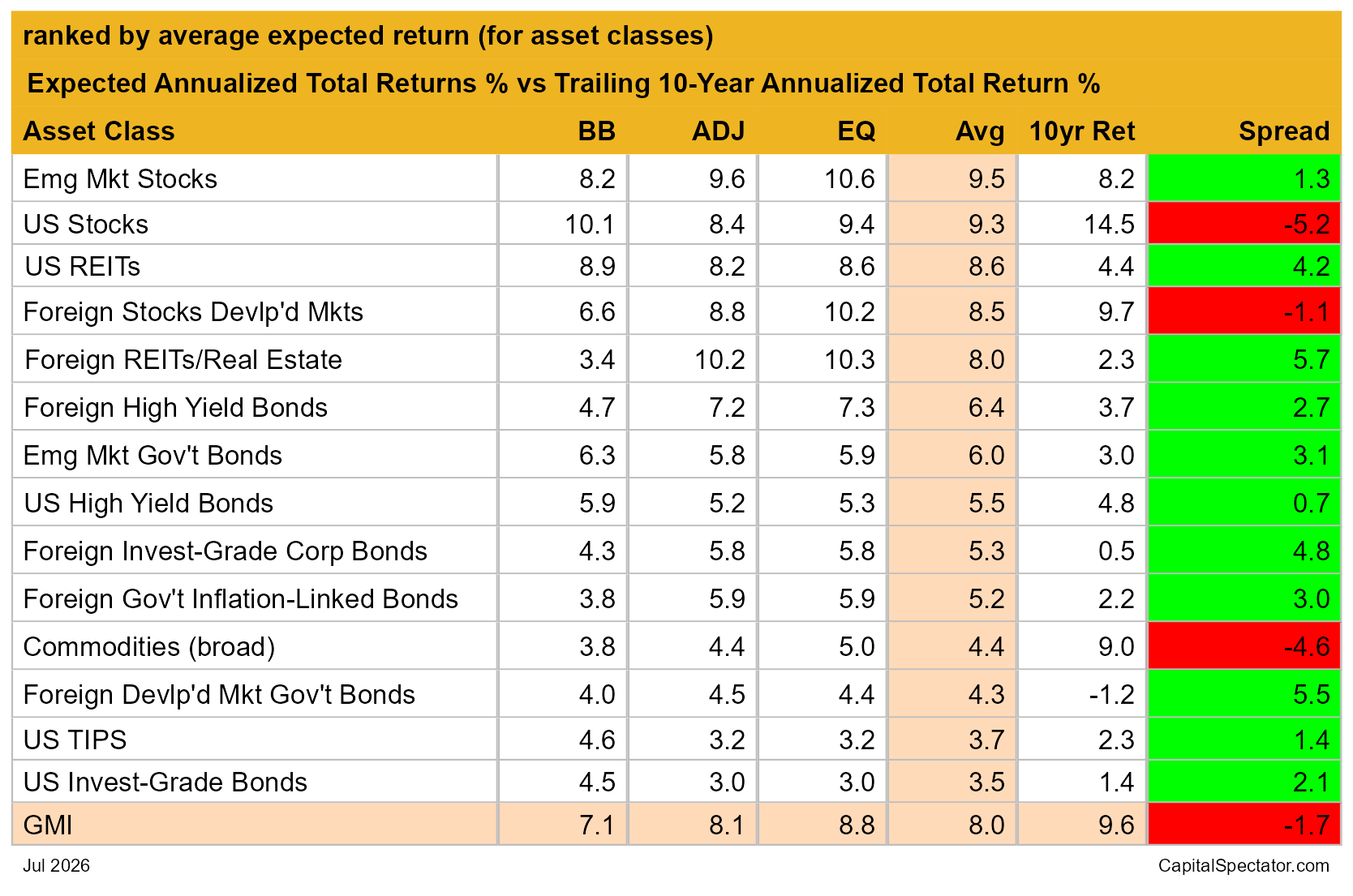
The long-term performance outlook for the Global Market Index (GMI) edged higher in April. The current 7%-plus estimate for the benchmark’s annualized return is at the top end of recent forecasts. Relative to the trailing 10-year result, however, GMI is still on track to post substantially softer results in the years ahead.

GMI is a market-value-weighted mix of the major asset classes (excluding cash) via ETF proxies. Today’s forecast is calculated as the average of three models (defined below). The current 7.4% annualized estimate for GMI ticked up from last month’s estimate, but remains well below the trailing 9.7% annualized return that GMI has generated over the past decade.

The conflict with Iran has roiled markets over the past two months, but the effects on our ex ante estimates has been slight, which isn’t surprising, given the model design, as explained below. The goal for these projections is to develop a set of first approximations of future long-run returns for the major asset classes and a passive benchmark for a global portfolio.

Roughly a third of GMI’s components are projected to generate softer returns relative to their respective results over the past ten years (indicated by the red boxes in the far-right column below). The same subpar performance applies to GMI, which is currently projected to earn a materially weaker return compared with its realized performance for the trailing ten-year window through April.

GMI represents a theoretical benchmark for the “optimal” portfolio that’s suited for the average investor with an infinite time horizon. Accordingly, GMI is useful as a starting point for customizing asset allocation and portfolio design to match a particular investor’s expectations, objectives, risk tolerance, etc. GMI’s history suggests that this passive benchmark’s performance will be competitive with most active asset-allocation strategies, especially after adjusting for risk, trading costs and taxes.

It’s likely that some, most or possibly all of the forecasts above will be wide of the mark in some degree. GMI’s projections, however, are expected to be somewhat more reliable vs. the estimates for its  components. Predictions for the specific markets (US stocks, commodities, etc.) are subject to greater variability compared with aggregating the forecasts into the GMI estimate, a process that may reduce some of the errors through time.

Another way to view the projections above is to use the estimates as a baseline for refining expectations. For instance, the point forecasts above can be adjusted with additional modeling that accounts for other factors and assumptions not used here. Customizing portfolios for a specfic investor, to reflect risk tolerance, time horizon, and so on, is also recommended.

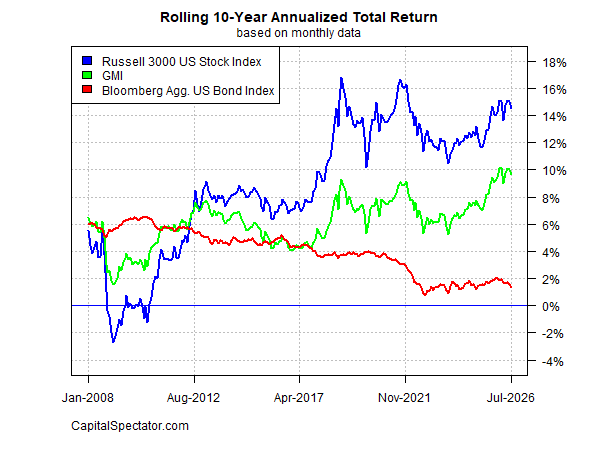
For perspective on how GMI’s realized total return has evolved through time, consider the benchmark’s track record on a rolling 10-year annualized basis. The chart below compares GMI’s performance vs. ETFs tracking US stocks and US bonds through last month. GMI’s current return for the past ten years is a robust annualized 9.7%.

Here’s a brief summary of how the forecasts are generated and definitions of the other metrics in the table above:

BB: The Building Block model uses historical returns as a proxy for estimating the future. The sample period used starts in January 1998 (the earliest available date for all the asset classes listed above). The procedure is to calculate the risk premium for each asset class, compute the annualized return and then add an expected risk-free rate to generate a total return forecast. For the expected risk-free rate, we’re using the latest yield on the 10-year Treasury Inflation Protected Security (TIPS). This yield is considered a market estimate of a risk-free, real (inflation-adjusted) return for a “safe” asset — this “risk-free” rate is also used for all the models outlined below. Note that the BB model used here is (loosely) based on a methodology originally outlined by Ibbotson Associates (a division of Morningstar).

EQ: The Equilibrium model reverse engineers expected return by way of risk. Rather than trying to predict return directly, this model relies on the somewhat more reliable framework of using risk metrics to estimate future performance. The process is relatively robust in the sense that forecasting risk is slightly easier than projecting return. The three inputs:

* An estimate of the overall portfolio’s expected market price of risk, defined as the Sharpe ratio, which is the ratio of risk premia to volatility (standard deviation). Note: the “portfolio” here and throughout is defined as GMI

* The expected volatility (standard deviation) of each asset (GMI’s market components)

* The expected correlation for each asset relative to the portfolio (GMI)

This model for estimating equilibrium returns was initially outlined in a 1974 paper by Professor Bill Sharpe. For a summary, see Gary Brinson’s explanation in Chapter 3 of The Portable MBA in Investment. I also review the model in my book Dynamic Asset Allocation. Note that this methodology initially estimates a risk premium and then adds an expected risk-free rate to arrive at total return forecasts. The expected risk-free rate is outlined in BB above.

ADJ: This methodology is identical to the Equilibrium model (EQ) outlined above with one exception: the forecasts are adjusted based on short-term momentum and longer-term mean reversion factors. Momentum is defined as the current price relative to the trailing 12-month moving average. The mean reversion factor is estimated as the current price relative to the trailing 60-month (5-year) moving average. The equilibrium forecasts are adjusted based on current prices relative to the 12-month and 60-month moving averages. If current prices are above (below) the moving averages, the unadjusted risk premia estimates are decreased (increased). The formula for adjustment is simply taking the inverse of the average of the current price to the two moving averages. For example: if an asset class’s current price is 10% above its 12-month moving average and 20% over its 60-month moving average, the unadjusted forecast is reduced by 15% (the average of 10% and 20%). The logic here is that when prices are relatively high vs. recent history, the equilibrium forecasts are reduced. On the flip side, when prices are relatively low vs. recent history, the equilibrium forecasts are increased.

Avg: This column is a simple average of the three forecasts for each row (asset class)

10yr Ret: For perspective on actual returns, this column shows the trailing 10-year annualized total return for the asset classes through the current target month.

Spread: Average-model forecast less trailing 10-year return.

Learn To Use R For Portfolio Analysis
Quantitative Investment Portfolio Analytics In R:
An Introduction To R For Modeling Portfolio Risk and Return

By James Picerno

Book Bits: 2 May 2026

The Capital Spectator -

Finishing the Inflation Job and New Challenges for Monetary Policy
Michael D. Bordo (editor), et al.
Summary via publisher (Hoover Institution Press)
How should the Fed finish the inflation-reduction job and prepare for the changing world ahead? And exactly how did one of Hoover’s most influential living economists assist scholars in thinking about where we go from here? Finishing the Inflation Job and New Challenges for Monetary Policy collects essays and discussions from the annual Hoover Institution Monetary Policy Conference, held on May 9, 2025, exploring these themes and considering other big-picture issues that affect monetary policy in this volatile international environment. Each year, the conference brings together academics, policymakers, media members, and others to consider the issues affecting monetary policy, both in the United States and worldwide. In the chapter sharing her welcoming remarks to the conference, Hoover Director Condoleezza Rice sets the tone, stating that the United States is “experiencing an avalanche of uncertainty,” with everything about the international order in question, including the United States’ role in it.

How to Get Rich in American History: 300 Years of Financial Advice That Worked (& Didn’t)
Joseph S. Moore
Review via Publishers Weekly
“Getting ahead has never been easier than it is today,” contends historian and investor Moore (Founding Sins) in this sweeping history of financial advice in the U.S. Moore takes readers through case studies of financial success and failure, debunking commonly held beliefs and extrapolating lessons that can be applied now. Demonstrating that “the story of a cash-only, debt free, rugged-individualist America is entirely fictional,” he describes how Benjamin Franklin got his start in the printing business by going thoroughly into debt. Elsewhere, he demonstrates that supposedly new phenomena have historical precedents. Women, for example, have always been active investors; Abigail Adams, wife of the second U.S. president, began buying government bonds after the American Revolution and ultimately achieved a lifetime annualized return of 18%, almost equaling that of billionaire Warren Buffett.

Profit vs. Progress: Why Socially Responsible Investment Doesn’t Work and How to Fix It
Brad Swanson
Summary via publisher (MIT Press)
Wall Street thrives by telling investors that clever financial strategies can reverse the trade-off between corporate profits and social progress. But the link between greater corporate social responsibility and improved financial performance is an illusion. Profit vs. Progress dissects the massive $30 trillion “socially responsible” or “sustainable” finance industry—and finds the emperor has no clothes. At best, sustainable investing typically delivers average rates of financial and social returns. But it makes social and environmental crises harder to overcome, by using financial gimmickry to distract our attention from real solutions. Author Brad Swanson argues that corporations in competitive markets act without moral values, and ethical investment can’t prod them to take greater social responsibility. The only way to change the outcome of the game is to change the rules. The solutions will have to come from legislatures, not corporate boardrooms.

How Currency Markets Work: An Insider’s Guide to a System Driven by Geopolitics and Trader Psychology
Andrew Nissenbaum and Patrick Cullen
Summary via publisher (Wiley)
In How Currency Markets Work, a veteran currency trader and a geopolitical risk analyst deliver a comprehensive and street-smart guide for understanding currency markets. The authors combine insights from the worlds of trading, economics, and geopolitics to create an eye-opening and original new take on how currency prices are determined. This book bridges the gap between how currency markets are taught and how they actually trade, using character-driven narratives built on real-world market events and data to explain currency trading successes and failures in intuitive and practical ways.

Please note that the links to books above are affiliate links with Amazon.com and James Picerno (a.k.a. The Capital Spectator) earns money if you buy one of the titles listed. Also note that you will not pay extra for a book even though it generates revenue for The Capital Spectator. By purchasing books through this site, you provide support for The Capital Spectator’s free content. Thank you!

Major Asset Classes | April 2026 | Performance Review

The Capital Spectator -

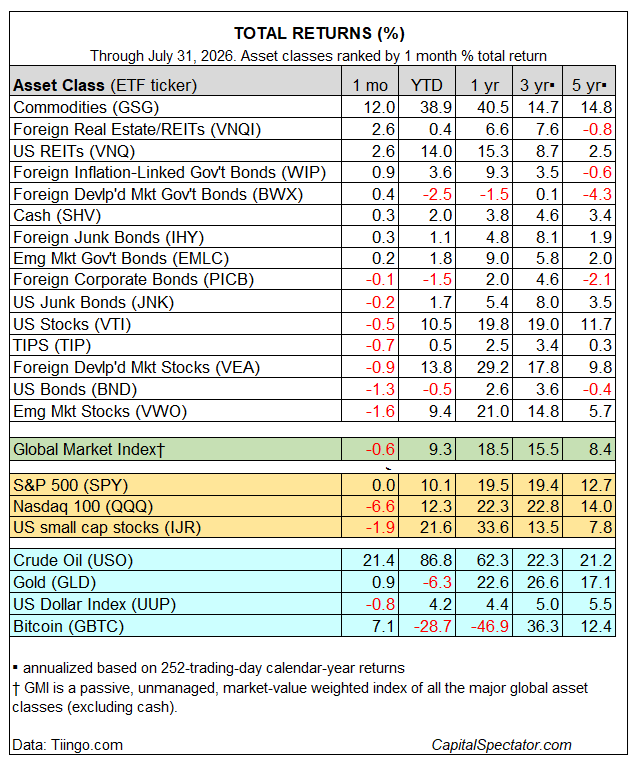
Markets rebounded in April following the selloff in March. In some cases, you have to squint to see a recovery, but April’s gains were broad, lifting all the major asset classes to some degree, based on results for a set of ETFs.

US stocks led the way. The Vanguard Total US Stock Market ETF (VTI) surged 10.4% last month. The rally left US equities comfortably in the black year to date, with a 6.0% advance.

Stocks in emerging markets (VWO) and US real estate investment trusts (VNQ) were the second- and third-best performers last month. The weakest increase in April came from US bonds (BND), which edged up a thin 0.1%.

Commodities (GSG) extended their rally, rising for a fourth straight month, propelled by turmoil in the Middle East that has raised energy costs. Gold (GLD), however, didn’t participate, and edged down 1.5%.

Year to date, nearly every slice of global markets is posting an advance through April’s close. The downside exceptions: foreign corporate bonds (PICB), government bonds in developed markets ex-US (BWX), and bitcoin (GBTC).

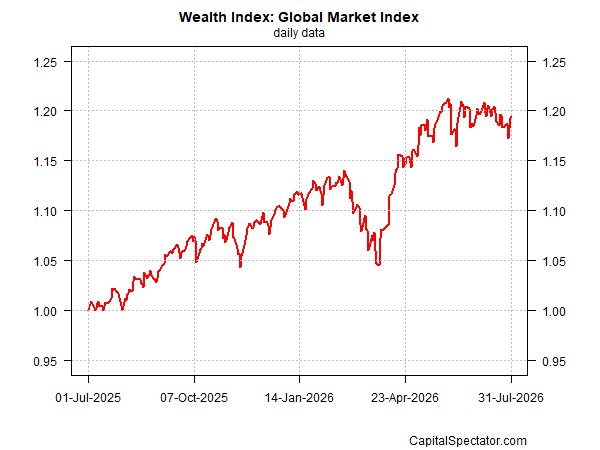
The Global Market Index (GMI) recovered its losses from the previous month, jumping to a new record high in April. GMI is an unmanaged benchmark (maintained by The Capital Spectator) that holds all the major asset classes (except cash) in market-value weights via ETFs and serves as a competitive benchmark for globally diversified, multi-asset-class portfolio strategies.

GMI rallied 8.1% last month and is now up 6.0% for the year to date. It has enjoyed a strong winning streak over the past year, advancing in 12 of the past 13 months—its strongest bull run in a decade.


Why You Need Good Personal Credit to Start Your Business

Money Under 30 -

When you are starting a business and need funding, you can’t just ask a bank for a loan on good faith. Before your business builds its own financial history, lenders are going to look at your credit report to approve or deny your business loan. If you have strong credit, you will have access to […]

Inflation Alarms Starting To Ring in the Bond Market

The Capital Spectator -

The bond market is losing faith that inflation risk from the Middle East conflict will be contained and fade quickly. The Federal Reserve’s monetary policy is still in wait‑and‑see mode, but several key Treasury yields aren’t waiting to see what happens.

Jerome Powell, in his appearance yesterday as Fed chair, presided over the central bank’s widely expected announcement that it would leave its target rate unchanged at a 3.50%–3.75% range. The Fed, in its policy statement, noted that “inflation is elevated, in part reflecting the recent increase in global energy prices.”

Powell, responding to a question about war‑driven price surges at Wednesday’s press conference, said “it hasn’t even peaked yet.” He added: “I think we’d want to see the backside of that and progress on tariffs before we even thought about reducing rates. If we need to hike, we will; we will certainly signal that,” but not now.

The Treasury market is starting to move on from waiting. The 2‑year yield, which is widely monitored as a market‑based outlook on policy, shot up to just under 3.97%, close to the wartime peak set early in the conflict.

The benchmark 10‑year yield also rose, jumping to 4.34%, which is likewise close to its wartime peak.

The Treasury market’s implied inflation forecasts are also rising again, based on the spread between nominal rates and their inflation‑indexed counterparts. Notably, the forecast via the 5‑year maturity increased to 2.67% yesterday, setting a new peak since the war began and widening the gap further relative to the Fed’s 2% inflation target.

Despite the mounting inflation worries in the Treasury market, the Fed is expected to keep rates steady through the end of the year, based on Fed funds futures.

Meanwhile, oil prices remain elevated. The U.S. benchmark (West Texas Intermediate) traded well above the $100‑a‑barrel mark for a second day and remains close to its wartime peak. Energy costs have already lifted consumer inflation in March due to surging energy prices, and a repeat performance is expected for the April data.

The growing mismatch between a Fed sitting on its hands and a worried bond market won’t last. The question is which side will blink first. Only one side gets to be right about inflation. The key variable, of course, is how the Iran conflict plays out, and for the moment a stalemate endures as the US and Iran hold fast to their respective views that they can wait each other out. Meantime, the inflation clock is ticking.

Is Recession Risk Rising? Monitor the outlook with a subscription to:
The US Business Cycle Risk Report

Middle East Turmoil Fuels Inflation Fears, Testing Fed’s Patience

The Capital Spectator -

The Federal Reserve is expected to keep its target interest rate unchanged in today’s policy announcement, but the stable outlook belies the unsettled inflation picture that’s keeping the bond market on edge.

Visibility for the rate outlook at today’s Fed meeting, by contrast, is clear as a bell. Fed funds futures are pricing in a 100% probability that the target rate will remain at its current 3.50%–3.75% range. After that, the clarity fades.

The bond market is struggling to price in the twin threats of higher inflation and slower economic growth—the dual effects of the Middle East turmoil that has elevated energy costs. The odds of a quick resolution remain low, a calculus reaffirmed after President Trump on Tuesday told aides “to prepare for an extended blockade of Iran, U.S. officials said,” according to The Wall Street Journal.

U.S. Treasury yields have increased recently but have pulled back from the peak that followed the start of the war on Feb. 28. The market is still flirting with the possibility of rate hikes, based on the policy‑sensitive 2‑year yield, which continues to trade above the effective Fed funds rate. That’s an indication that investor sentiment is pricing in modest odds that the central bank will be forced to raise interest rates at some point in the near term.

But not yet—and perhaps not for the next several FOMC meetings, or so Fed funds futures suggest.

The inflation bump has already begun and will likely persist in the near term. The Consumer Price Index (CPI) surged in March to a 3.3% year‑over‑year pace, up sharply from February’s 2.4%, driven by spiking energy costs. It’s unclear whether inflation will continue rising, but a safer bet is that it holds steady above 3% for now.

The Fed still still has some leftover ammunition in its policy toolkit in the form of a mildly hawkish bias, based on a simple model that compares the target rate to unemployment and inflation—the two components of the central bank’s dual mandate. On that basis, policy is slightly tight. The question is whether that will suffice in the months ahead, as the inflationary effects of the war—and now stalemate—in the US–Iran conflict endure.

A complicating factor is that the blowback from Middle East turmoil will weigh on global economic activity, which will spill over into the U.S. to some degree. If output slows enough, that could offset the need to hike rates.

Exactly how the twin shocks of higher inflation and slower growth will play out remains uncertain, thanks to the fog of war (stalemate), which is why the bond market—and the Fed—are playing a wait‑and‑see game.

“On the dual mandate, they’d say we’re roughly at a stable labor market,” Roger Ferguson, an economist and former Fed vice chair, told CNBC. “On the inflation side of the mandate, [there’s] a lot more work to be done with a sticky 3% [inflation rate], and I hope they argue, ‘we’re going to sit tight for a little while to see how this all plays out.’”

Two real‑time proxies on my short list for monitoring these risks are the 10‑year Treasury yield and the price of crude oil. The 10‑year yield closed yesterday at 4.35%, still comfortably below the intraday peak of nearly 4.50% since the war’s start, but the benchmark rate is drifting higher again. As it moves closer to the previous peak—and certainly if it breaks above it—that will signal that the market is demanding a higher inflation premium, which in turn will put more pressure on the Fed to hike.

A similar calculus applies to crude oil, based on the US benchmark (West Texas Intermediate). The price closed yesterday above $103 a barrel. That’s still below the $120 peak set in the early days of the war, but prices are trending up again. If the market begins to test the upper range set during the war, that should be viewed as a sign that inflation pressures will persist, if not intensify, for longer than expected.

In the end, the Fed may be standing still, but the markets certainly aren’t. With inflation simmering and geopolitical tensions refusing to fade, investors are left navigating a landscape where every data point feels like a potential turning point. The calm of today’s decision may not last long.


A Perfect Storm Awaits Warsh At The Fed

The Capital Spectator -

Winning Senate approval may be the easy part.

The path has been cleared for Kevin Warsh to become the next chairman of the Federal Reserve in mid-May, when Jerome Powell’s term ends. Sen. Thom Tillis cancelled his obstruction to Warsh after the Department of Justice closed its criminal investigation of Powell, clearing the way for approval. The Senate Banking Committee has scheduled a vote on Warsh for tomorrow, and a greenlight is likely, which would allow the nomination to proceed to the full Senate. At that point, the real challenge begins.

Warsh arrives at the Fed during what looks like a perfect storm of challenges for monetary policy. The macro threats include turmoil from the Middle Eastern conflict, energy shocks, rising inflation pressures, and tariff‑strained effects on global trade. He will also oversee policy at a time of massive and growing federal debt. And then there’s President Trump’s demand for rate cuts. All of these factors will test Warsh’s resolve far more than anything he’ll face during the upcoming confirmation hearing.

For now, markets expect the Fed to keep rates steady. At tomorrow’s policy meeting, Fed funds futures are pricing in a virtual certainty of no change. In fact, futures anticipate that the current Fed funds target rate will remain at the 3.50%–3.75% range through the end of the year.

Defending a steady policy stance if inflation heats up will be difficult in the current environment. Making the case for rate cuts will be even harder at a time when energy costs have surged, pushing up headline inflation measures. An early sign of what’s coming appeared in the March consumer price report, which showed a 3.3% annual increase—a two‑year high and a sharp jump from February’s 2.4% pace. Spiking energy prices are the culprit.

The optimistic view is that the energy shock will be temporary and that, while prices have risen, the pace of increase will soon moderate. Perhaps—but with the Middle East crisis settling into a stalemate and energy exports still blocked, a quick resolution seems unlikely. There’s also the institutional memory lurking that the Fed predicted that the inflation shock of 2021-2022 would be temporary and modest, which turned out to be one of the biggest policy errors in decades. Arguing that it’s different this time will be a rough position to defend.

What is clear is that the longer energy prices remain elevated, the greater the risk that higher inflation becomes embedded in the economy.

For context on what may be developing, The Capital Spectator generated a forecast using a basic ensemble model to project the near‑term outlook. Unsurprisingly, the modeling indicates that headline CPI inflation is likely to edge higher and hold above 4% for the foreseeable future.

Core CPI is expected to follow a similar path, though at a lower level of roughly 3%‑plus.

In other words, the inflation shock moving through the global economy is being driven by energy, food, and commodities more broadly. Central banks often struggle with inflation rooted in these factors, which is why the Fed prioritizes core inflation as its target.

Given the war‑driven shifts in the inflation backdrop, cutting rates will be a difficult case for Warsh to make to his fellow policymakers on the Fed board. That may set up a new conflict with Trump, who has been publicly pushing for rate cuts.

One scenario in which rate cuts could become pragmatic is if the energy shock weakens growth more than it raises inflation. In that case, the Fed may lean on its mandate to maximize employment as justification for easing policy.

The only certainty at the moment is that a resolution to the Fed’s dilemma appears unlikely anytime soon. The Strait of Hormuz remains closed, blocking roughly 20% of global oil supply flows.

In short, the real test for the Fed isn’t the upcoming vote—it’s the storm waiting for Kevin Warsh on the other side of it, when he steps into a Fed facing the fiercest crosswinds in a generation.


Pages