Feed aggregator

Disinflation Stalls and the Fed’s Margin for Error Just Got Thinner

The Capital Spectator -

The July inflation report wasn’t surprising, but it was revealing.

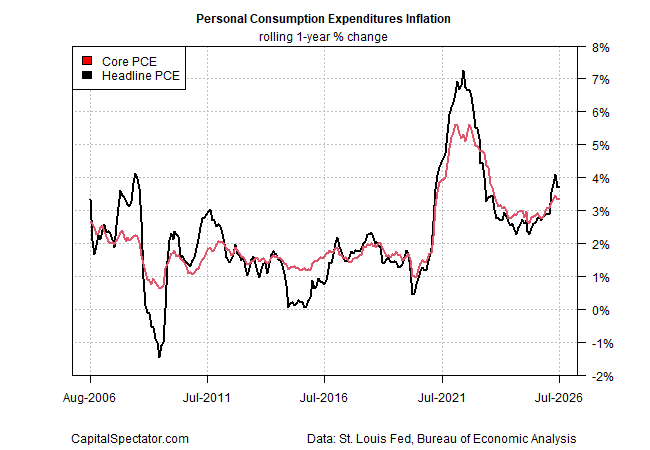
The Personal Consumption Expenditures Price Index (PCE), reportedly the Federal Reserve’s preferred inflation yardstick, was steady last month, rising at a 3.7% year‑over‑year rate. Core PCE, which strips out food and energy for a cleaner read on the trend, held at a slightly softer 3.3%.

Overall, no surprises. PCE inflation continues to print at the pace that has prevailed recently. Economists expected as much, and on that basis one is tempted to conclude: nothing to see here — move on.

Yet that view is too glib. The PCE results may be calm relative to recent months, but the report suggests that counting on disinflation to prevail in the near term — and do some, if not most, of the Federal Reserve’s work — looks a bit more remote.

In short, inflation isn’t accelerating, but neither is it cooling. That could change, of course, and there are several reasons to make that case. One is the possibility that economic activity is slowing. But the data is mixed at the moment, and it may take several months to develop a cleaner reading on the macro trend.

What is clear is that recession risk remains low, and so expecting a substantial downshift in the economy to materially soften inflation is, for now, a bridge too far.

My analytics suggest that while there is reason to expect inflation could downshift in the near term based on economic conditions and trend, several offsetting factors may slow or even reverse a disinflationary impulse.

One of those offsetting factors is the Iran conflict. With no end in sight, this gray‑zone risk looks set to continue well into the future, keeping energy prices elevated and delaying meaningful disinflationary relief that would likely arrive once the Middle East crisis is genuinely resolved.

The latest sign that a U.S.–Iran stalemate remains the path of least resistance: Iran and Oman on Wednesday announced an agreement to temporarily reopen the Strait of Hormuz, according to an Iranian official. Such a deal won’t fly at the White House — President Trump has warned against this type of arrangement and has threatened to bomb Oman, a U.S. ally, if it “gets in the way.”

A potentially bigger problem for inflation is the bond market’s growing concern over U.S. government debt and the lack of political efforts in Congress to tackle the mounting red ink.

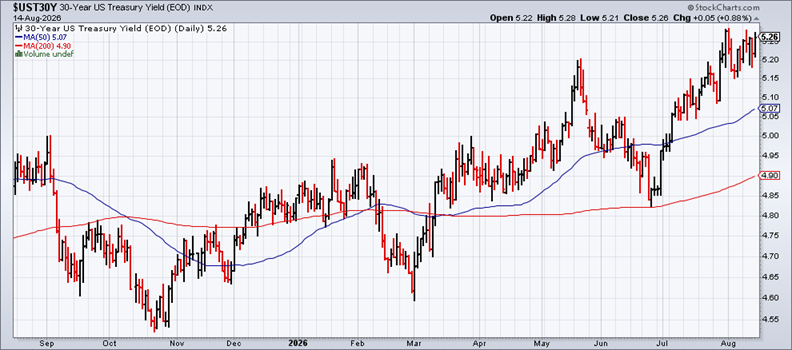
The Treasury Department’s recent plans to increase buybacks of government securities in an effort to lower yields have had some effect. The 30‑year Treasury yield has pulled back from its recent peak, but only modestly, and it’s unclear whether further declines are likely.

Another issue that could keep Treasury yields higher, or rising, for longer: uncertainty about how, when, or if the Federal Reserve will tame inflation, which has been running above the Fed’s 2% target for more than five years.

Tomorrow’s speech by Fed Chairman Kevin Warsh at the Jackson Hole meeting is an opportunity to clarify how the central bank will operate with regard to its mandate to keep inflation near 2% over the long run. But given his recent comments downplaying the case for forward guidance, it’s possible — if not likely — that Warsh won’t offer any new details on Friday.

In that case, the bond market’s reaction (or non‑reaction) next week could be pivotal for setting the tone in markets for the fall.

Is Recession Risk Rising? Monitor the outlook with a subscription to:
The US Business Cycle Risk Report

A Mixed Year For Bonds Ahead of Warsh’s Jackson Hole Speech

The Capital Spectator -

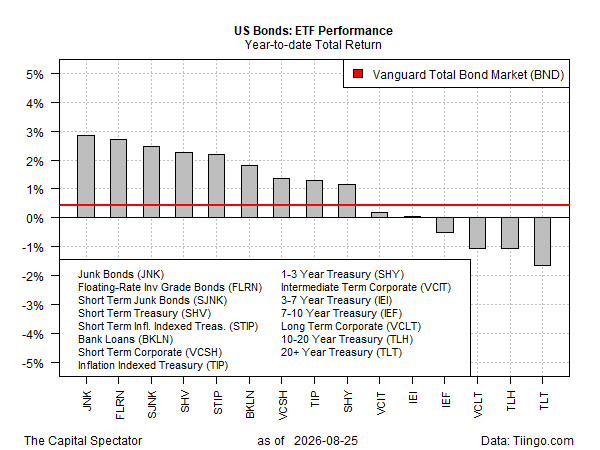
The bond market has had a rocky year, but several fixed‑income sectors are posting gains so far in 2026, based on a set of ETFs through Tuesday’s close (Aug. 25). The main downside exceptions: medium‑ and long‑term Treasuries, which are modestly in the red this year.

Junk bonds (JNK) and floating‑rate securities (FLRN) continue to lead in 2026, logging gains of 2.9% and 2.7%, respectively — modest advances, but well ahead of the US investment‑grade fixed‑income benchmark’s fractional 0.4% rise, based on the Vanguard Total Bond Market ETF (BND).

The losers are concentrated in Treasuries, ranging from a 0.5% decline for a portfolio of 7–10‑year maturities (IEF) to a 1.7% slide in long‑term governments (TLT).

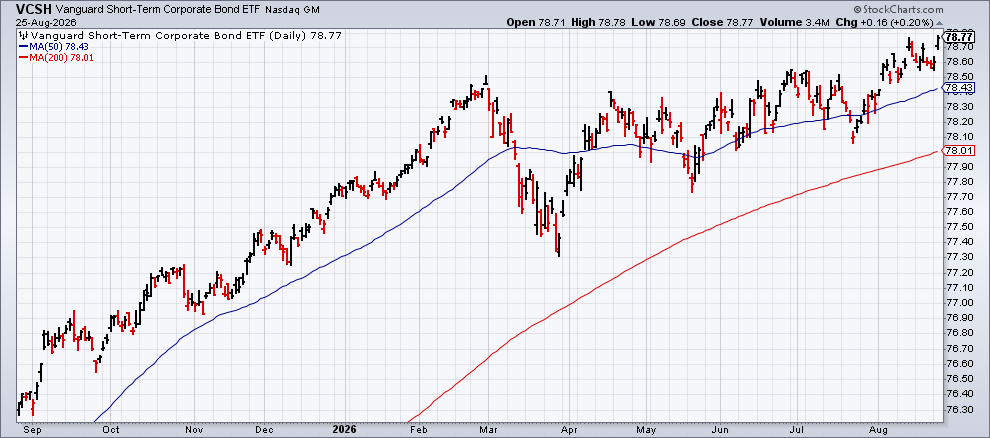
Recent history highlights a clear split in bond‑market performance. The winners have enjoyed an ongoing rally lately. Short‑term corporates (VCSH), for example, jumped to a new record high yesterday.

Bond‑market strength is no mean feat these days as a variety of risk factors swirl, including ongoing uncertainty about inflation and the Federal Reserve’s plans for when and how to maintain price stability — a goal Fed Chairman Warsh has repeatedly emphasized sans details.

Speaking of Warsh, bond investors will be listening closely to his speech on Friday at the Fed’s Jackson Hole meeting. The market is looking for some degree of clarity about the Fed’s so‑called reaction function in an environment where long‑term Treasury yields are already doing part of the tightening for him. In other words, what is the Fed’s playbook for responding to incoming data and market conditions vis‑à‑vis inflation risk?

Warsh has been less than forthcoming on this point, preferring to dial back forward guidance and urging investors to look to market signals for context. But a market‑based framework is getting complicated at a time when the Treasury Department is becoming more interventionist — Treasury Secretary Bessent in recent days has discussed plans to increase purchases of government bonds to lower yields, which have been rising amid inflation worries.

By some accounts, Warsh and Bessent have muddied the policy message. It doesn’t help that the Fed and Treasury now appear to be a cross purposes — manipulating yields (Treasury) and telling investors to focus on market signals for guidance (Fed).

It’s unclear whether the Fed chairman’s speech will bring new clarity to his “less‑is‑more” communication strategy. Forthcoming or not, Warsh could set the tone for the bond market in the weeks ahead, for good or ill. The crowd is looking for direction on rates, more transparency with communication, and reassurance that the Fed has a coherent plan for navigating rising yields and persistent inflation pressures. The question is how the market reacts if those points are left vague or ignored.


Treasury Raises the Stakes in a Battle to Cap Long‑Term Yields

The Capital Spectator -

Treasury Secretary Scott Bessent is escalating the government’s campaign to cap, if not lower, long‑term yields. After last week’s expanded buyback plan failed to sway the bond market, the government raised the stakes again on Monday, floating the prospect of a dramatically larger pool of funds to step up purchases of government debt.

This is a high‑risk game of chicken. If it works, and long yields stabilize or fall, the strategy could go into the history books as a grand success. On the flip side is the possibility that the market calls the government’s bluff and yields keep rising. In that latter case, the Treasury Department’s credibility will take a blow, which could trigger even higher yields.

For now, it’s just talk, starting with last week’s announcement by Treasury to double the size of buybacks of 10‑ to 30‑year maturities to $4 billion—a drop in a $30 trillion‑plus bucket of the U.S. government bond market, of which nearly $6 trillion is estimated in long‑dated securities.

When that plan fell flat and long yields continued to rise, Bessent hinted on Friday that the buyback program could exceed $4 billion. On Monday, the government escalated the rhetoric, noting that Treasury could spend as much as $1 trillion to finance buybacks, according to two senior Treasury officials, CNBC reports. The Treasury General Account is the U.S. government’s central checking account at the Federal Reserve Bank of New York, used for receiving federal revenues and making all official government payments.

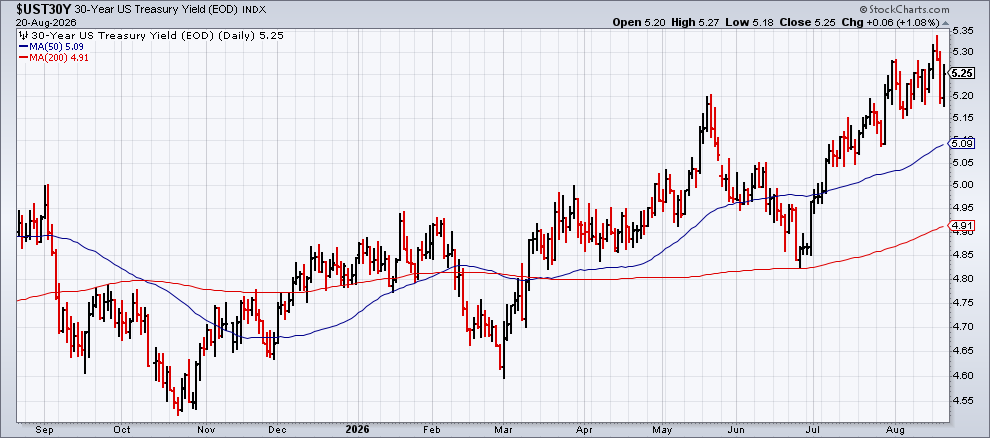
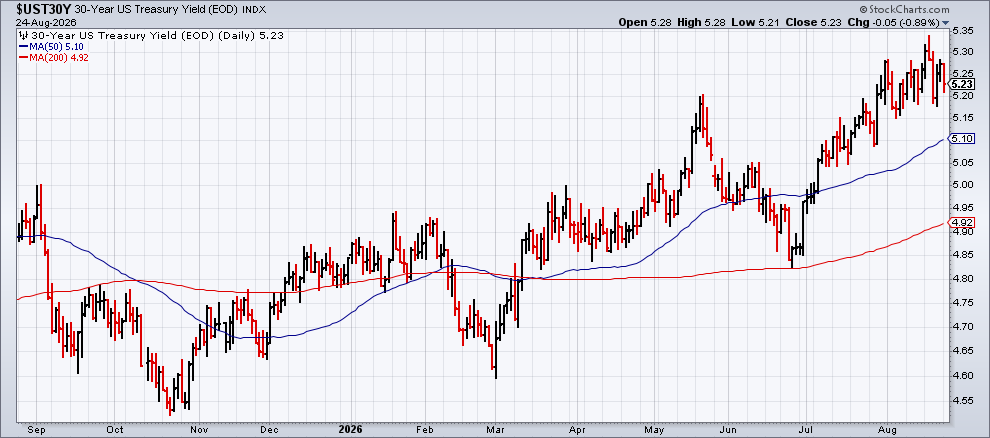
News that the government could dramatically increase buybacks seemed to have a calming effect on the bond market yesterday. The 30‑year Treasury yield, for example, fell to 5.23%, near the lower range of trading in recent days. But the outcome of the government’s efforts to talk down yields—perhaps backed up with real money—remains a work in progress with an unclear result.

A government attempt to cap yields faces strong headwinds from several fundamental factors. Long‑term rates are climbing as energy‑driven inflation from the Iran war, a post‑election government debt surge, and massive AI‑related corporate bond issuance squeeze the fixed‑income market. Together, these forces support inflation expectations, flood the market with Treasury debt, and heighten competition for capital.

Fueling the bond market’s selloff, which has been lifting yields, is last week’s news that the U.S. national debt reached $40 trillion and the annual deficit is expected to hit $2 trillion this year. The truly big guns needed to wage a war to lower yields require fiscal reform in the form of legislation. Congress or the White House, alas, appears unlikely to even discuss the issue, much less forge a path to craft a credible package to start a national conversation and lay the groundwork for tackling a growing threat.

Bond investors know all this, of course, and so the question is whether Treasury can convince the market that it has the firepower—and, crucially, the will—to spend enormous amounts of public money to suppress yields.

Treasury has another lever to pull to raise the ante further: directing the Federal Reserve to increase its purchases of Treasury bonds and revive the controversial quantitative easing (Q.E.) program. But that would put Fed Chairman Kevin Warsh in an uncomfortable position, given his sharp criticism of Q.E. in the past.

The danger here is that the bond market continues to raise yields, effectively telling the government that fundamental reform of spending and debt management is the only game in town.

For now, it’s unclear whether the bond market bears can be tamed. If investors remain skeptical and continue to raise yields by selling fixed‑income securities, the potential for a much deeper bond‑market rout could be lurking.

Cue up this Friday’s speech by Fed Chairman Warsh at the central bank’s Jackson Hole meeting. His speech won’t just be a policy update—it may be a pivot point when the bond market decides who’s really in charge, and perhaps the defining moment, for good or ill, of Warsh’s tenure at the Fed.


Q3 Growth Still Firm, But Fresh Headwinds Cloud the Outlook

The Capital Spectator -

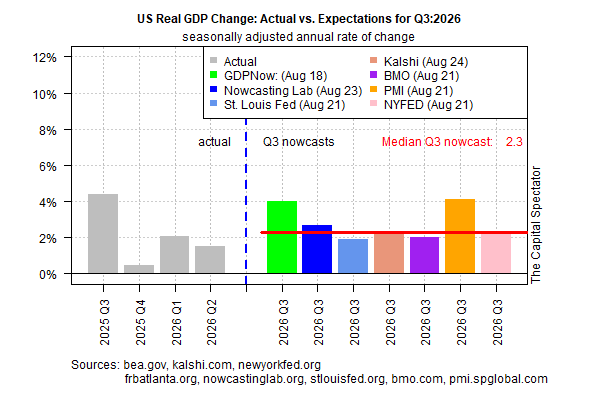
US economic activity remains on track to strengthen in the third quarter, based on the latest nowcasts compiled by The Capital Spectator. But the degree of the estimated rebound has softened lately amid recent hints that headwinds are building.

The good news is that our median 2.3% Q3 nowcast, drawn from inputs via several sources, continues to track well above the sluggish 1.5% annualized increase reported for Q2. Encouraging, but the government is scheduled to publish third-quarter data on Oct. 29, a reminder that a lot can happen to the economic profile over the next two months.

Using the latest nowcasts suggests that the current Q3 estimate reflects a high degree of confidence that a strong run of economic activity is in the works. All the estimates in the chart above are running above Q2’s 1.5% increase. The median 2.3% estimate represents a best guess at the moment based on available numbers.

One of the inputs—PMI survey data—highlights a robust pickup in growth in August, based on the US Composite PMI Output Index, a GDP proxy. “US business activity growth accelerated sharply for a second successive month in August to reach the fastest since April 2022,” S&P Global advised on Friday. “A surge in service-sector business activity helped offset a marked slowing of growth in the manufacturing sector.”

Yet the PMI report also highlights a possible source of vulnerability for the economy in the months ahead. To the extent that economic activity is becoming more reliant on consumer spending, the ongoing rise in Treasury yields could pressure households by lifting borrowing costs and squeezing discretionary income.

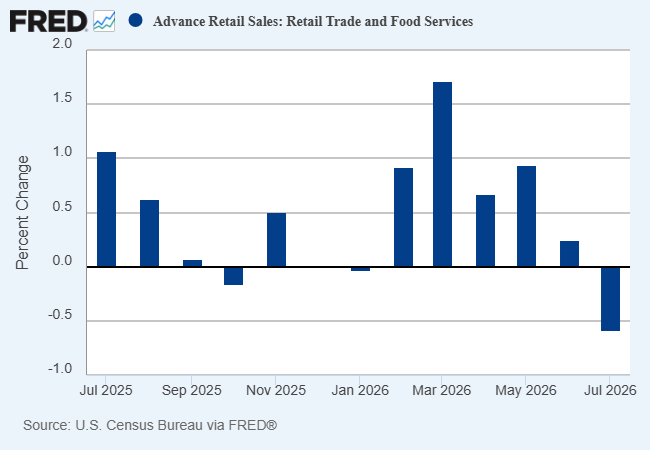
One sign of that risk: retail sales posted a 0.6% drop in July—the first monthly decline since January and the deepest in over a year. The slowing year-over-year trend in the Redbook Index, a measure of same-store sales, may also reflect softening demand on Main Street.

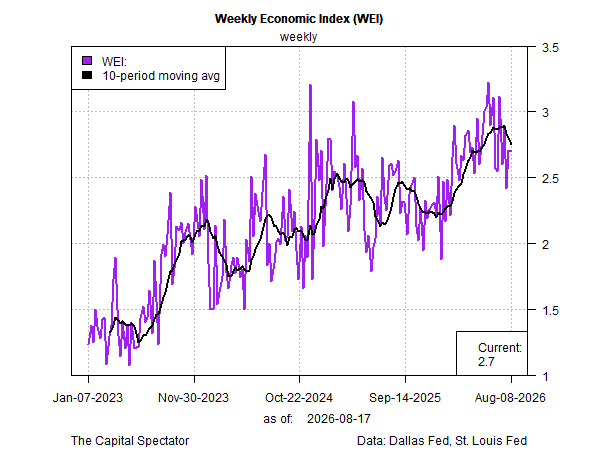
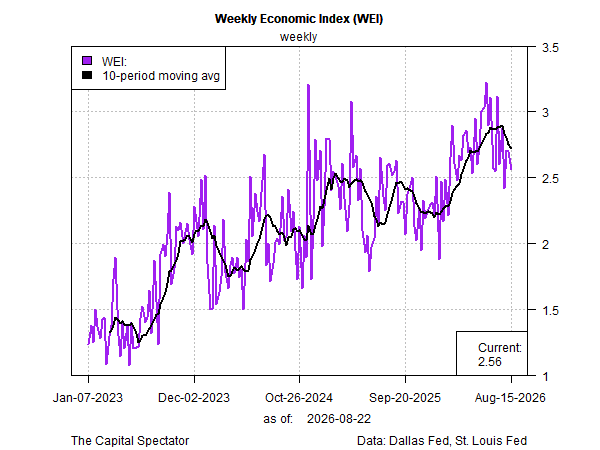
Another possible warning that economic activity is downshifting: the Dallas Fed’s Weekly Economic Index (WEI), continues to ease, based on the 10-period moving average. The latest data point still equates with a 2.6% year-over-year increase in GDP through Aug. 15, which is modestly above the one-year rise through Q2, but the tide appears to be turning.

WEI data can be noisy from week to week, which suggests the 10-period average offers a more reliable measure of the bias in economic activity. On that basis, the ongoing deceleration in growth, although mild so far, could be an early sign that a recovery in Q3 may be short-lived.

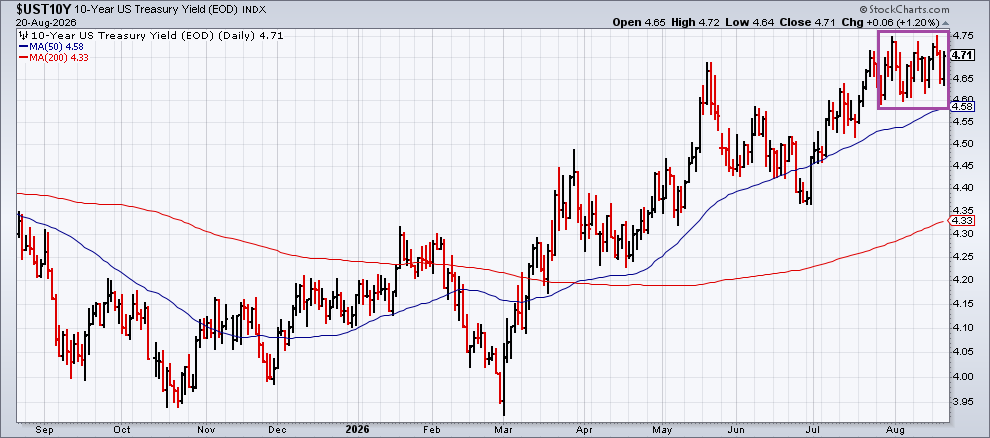
A key risk factor in the weeks ahead is how the bond market evolves. The recent rise in Treasury yields suggests a possible headwind brewing for the economy. The 10-year yield, for example, closed at 4.74% on Friday, marking a rebound to just a few ticks below a one-year-plus high reached a few weeks earlier. If yields continue to rise from current levels, consumer spending will come under more pressure—a risk that will come into sharper focus in Q4.

Is Recession Risk Rising? Monitor the outlook with a subscription to:
The US Business Cycle Risk Report
Book Bits: 22 August 2026

The Capital Spectator -

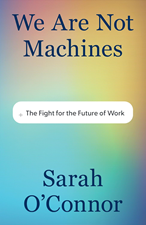
We Are Not Machines: The Fight for the Future of Work
Sarah O’Connor
Review via The Guardian
It’s never been easy to land and keep a decent job. But it feels like it’s getting harder. In June, the number of job vacancies in the UK fell to a five-year low; headlines warn of a looming AI-employment shock. What might the future of work look like – and who or what will shape its terms? In her new book, Sarah O’Connor goes looking for answers in the modern collision of artificial intelligence, automation, and human labor.

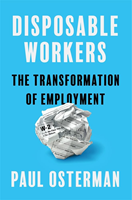
Disposable Workers: The Transformation of Employment
Paul Osterman
Review via MIT Press
Accounting for about one in six U.S. jobs, it’s a huge category of people, who are going nowhere fast in the workplace — and don’t really have much say about that.
“Marginal workers are employees who have no career prospects at their organizations,” says MIT Professor Emeritus Paul Osterman, author of a new book on the subject. “They are employees of the organization for whom they work, but the organization does not intend to keep them, and these workers are much less attached to any career ladder.”
As such, marginal workers are part of a larger trend in U.S. employment. According to Osterman’s analysis, 35 percent of U.S. workers are either marginal employees, freelancers, contractors, or gig employees finding work on online platforms like ridesharing services.

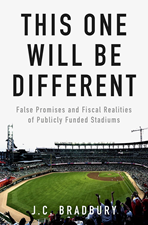
This One Will Be Different: False Promises and Fiscal Realities of Publicly Funded Stadiums
J.C. Bradbury
Interview with author via Reason.com
This week, guest host Eric Boehm is joined by J.C. Bradbury, an economist at Kennesaw State University and one of the leading critics of taxpayer-funded sports stadiums. Bradbury is the author of a new book, This One Will be Different, on the “false promises and fiscal realities” of stadium subsidies.
Boehm and Bradbury discuss why stadiums rarely deliver on the economic benefits touted by team owners and local politicians, and how public officials, media outlets, and hired consultants help create the illusion that these projects pay for themselves. Bradbury explains why these deals often amount to a reallocation of existing local spending rather than genuine economic growth, and why taxpayers end up footing the bill for facilities that primarily benefit private sports franchises.

Please note that the links to books above are affiliate links with Amazon.com and James Picerno (a.k.a. The Capital Spectator) earns money if you buy one of the titles listed. Also note that you will not pay extra for a book even though it generates revenue for The Capital Spectator. By purchasing books through this site, you provide support for The Capital Spectator’s free content. Thank you!

Buybacks vs. Bond Bears: The High‑Stakes Standoff Continues

The Capital Spectator -

The brinkmanship between the U.S. government and the bond market continued on Thursday following the Treasury Department’s announcement the day before that it would double repurchases of longer‑dated Treasuries in a bid to lower yields. The statement worked—briefly—as yields dipped in early trading on Thursday, but by the end of the session rates snapped higher.

The question now is whether the government is playing a game of chicken with the bond market. After Treasury said Wednesday that the buyback program would increase to $4 billion from $2 billion, Treasury Secretary Bessent appeared to up the ante on Thursday, telling CNBC that the program “could be more than the $4 billion per issue.”

Asked whether the amount of money allocated to buybacks could rise, Bessent said: “We’ll see what the conditions are, and you know we will analyze them.” He added: “All we’re trying to do is get people to focus on the fundamentals and not trade the headlines during a quiet period in a thin market.” In a pointed reminder to traders, he emphasized: “We have a big toolkit, so we’ll see. Part of it is signaling here and to show that we believe that the yields don’t reflect the underlying fundamentals.”

Two days isn’t enough to reliably judge how the bond market will react to the government’s efforts to cap—if not suppress—yields. Arguably the results since Wednesday’s buyback announcement amount to a stalemate. The real test will play out in the bond market in the weeks ahead and how the recent upward trend in yields evolves.

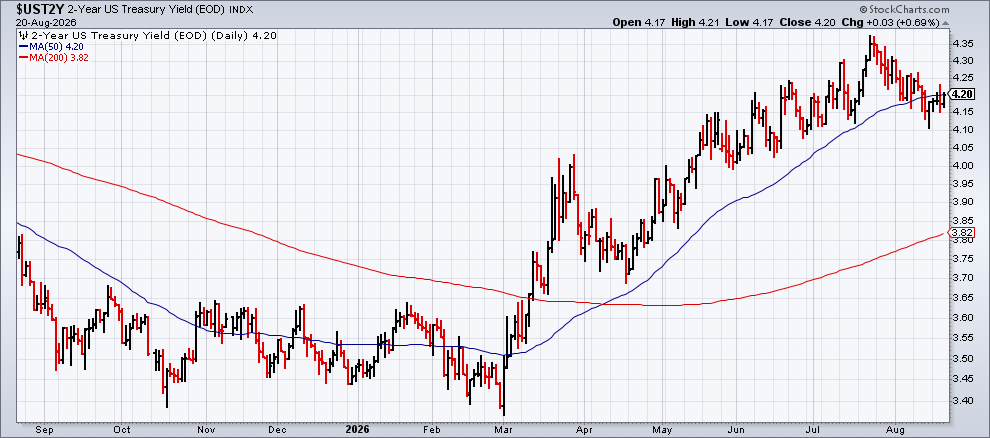
For context, here’s the current state of play for three key maturities: 2‑, 10‑, and 30‑year yields.

The 2‑year yield, widely watched as the market’s outlook for near‑term Federal Reserve policy, is relatively insulated from the tug‑of‑war at the long end of the curve. Still, its recent slide from the July peak has stabilized in recent days, closing Thursday at 4.20%. That remains well above the Fed’s 4.50%–4.75% target range, meaning the market is still pricing in a rate hike. The key question ahead: Will the uncertainty at the long end spill into the 2‑year and push it higher? If so, pressure on the Fed to lift its policy rate will intensify.

The benchmark 10‑year yield, by contrast, continues to trend higher by comparison, though recent sessions show a shift toward range‑bound trading. A breakout—above or below the recent range—will be a critical signal for where the market is headed for the rest of the year.

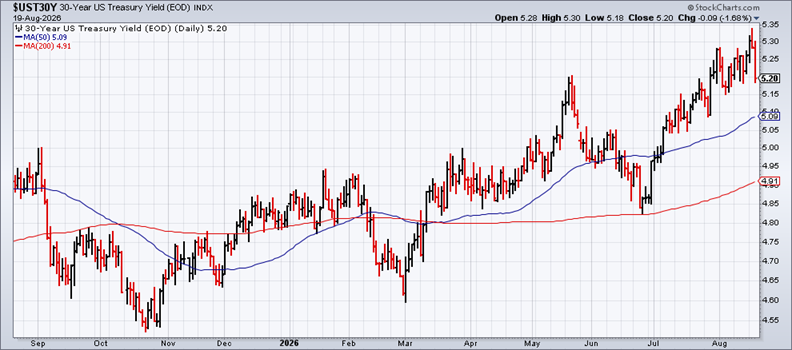
The main event for judging Treasury’s success or failure in capping, or even lowering, yields will likely unfold with the 30‑year maturity. The long bond is trading below Monday’s brief push toward 5.34%, but it’s unclear whether the market will be persuaded by Treasury’s jawboning and expanded repurchase plans. A breakout above Monday’s peak would send a strong message that traders remain unconvinced Treasury can influence, much less control, the long end of the curve.

The government’s challenge is that the forces driving long yields higher can’t be resolved with press releases or TV interviews, at least not for very long. Markets remain focused on ballooning federal debt, persistent inflation uncertainty—fueled in part by the conflict with Iran—and unsettled monetary‑policy expectations as new Fed Chairman Kevin Warsh finds his footing and refines his public messaging.

A risk for Treasury is that its effort to nudge the market toward a less hawkish outlook could backfire. The worst‑case scenario is that Bessent and company repeatedly escalate buyback plans while the market shrugs and pushes yields higher. That outcome would embolden bond bears and potentially unleash a deeper, more prolonged selloff in fixed-income markets.

These are still early days, and the feedback loop between markets and policymakers remains fluid. Even if yields stabilize or decline in the near term, the underlying risk factors that brought us here remain firmly in place: rising federal debt and an unstable Middle East that could trigger fresh spikes in energy prices—and inflation—at any moment.

For now, the Treasury may be talking tough, but the bond market is still deciding whether to blink—or bare its teeth.

Is Recession Risk Rising? Monitor the outlook with a subscription to:
The US Business Cycle Risk Report
US Treasury Tries to Slow Surging Yields with a Band‑Aid Fix

The Capital Spectator -

The Treasury tried to put a lid on rising yields this week, doubling the size of its bond‑buyback program in a bid to steady the market. The move triggered an immediate rally—the price of Treasury bonds jumped and yields fell. But the relief will likely be fleeting. The same powerful economic and financial forces that have been driving yields higher remain firmly in place, and a larger buyback program won’t change market sentiment.

The size of the buyback program increased to $4 billion from $2 billion “per operation,” effective from Sep. 9 through Nov. 4 for longer‑dated securities. But that’s a drop in a very large Treasury‑market bucket, which is valued at well over $30 trillion.

While the increase in repurchases won’t move the needle, it’s a clear sign of the government’s growing unease with rising Treasury yields. Yet the forces lifting yields are still in play, and it remains to be seen whether the government can meaningfully shift market expectations.

By the standards of Wednesday’s trading, the government scored a win. The 30‑year Treasury yield fell sharply, dropping to 5.20% after trading near 5.34% in the previous session. The days ahead will test how the market interprets the longer‑term consequences of the larger buyback program.

The key factors that won’t change: the government’s mounting pile of debt and deepening budget deficit, elevated energy prices linked to the war with Iran, and expectations that inflation will continue to run well above the Federal Reserve’s 2% target.

In a sign of the times, the Treasury Department also reported that total U.S. national debt reached $40 trillion for the first time, rising $3 trillion over the past year. To put that into perspective, total debt is now about 25% higher than the size of the U.S. economy.

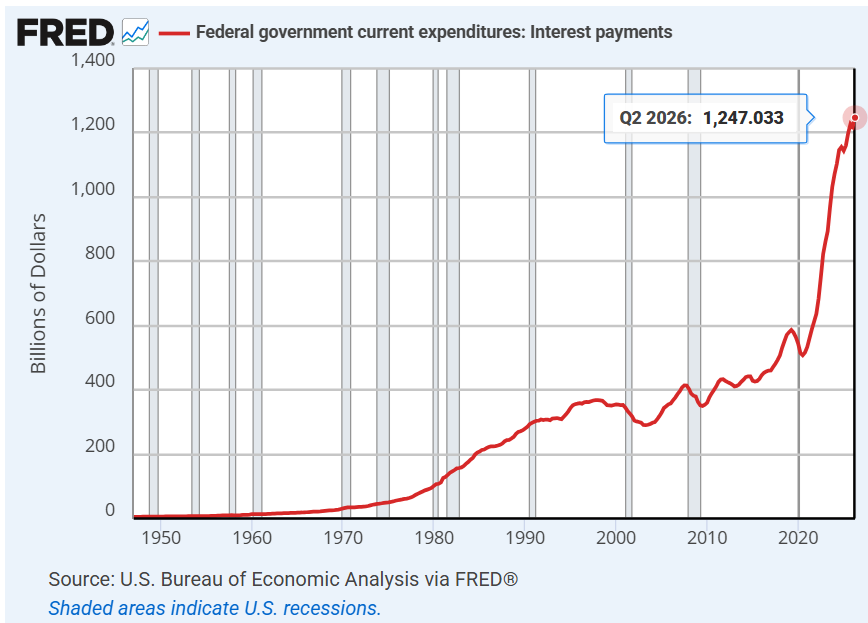
One of the more problematic aspects of the ballooning debt is that higher bond yields are forcing the government to pay more interest to service the government’s liabilities, which in turn increases the red ink. It’s a troubling feedback loop that’s on track to become increasingly painful in the years ahead.

Over the past six years, federal interest payments have surged more than 140% to $1.247 trillion in the second quarter. That upward trajectory is likely to continue, given the state of fiscal affairs and the rise in Treasury yields.

Corporate bond yields are also rising, driven higher by hyperscalers who are flooding the market with debt to finance the AI buildout. The surge in AI‑related borrowing has impacted investment‑grade credit, creating a clear supply‑demand imbalance. Goldman Sachs estimates that nearly $500 billion of AI‑related debt has been issued so far this year.

Perhaps the most concerning aspect of the rising tide of fiscal red ink is that it’s unfolding at a time of U.S. economic strength. Although a recession isn’t on the horizon, if the economy stumbles, the budget deficit will deepen further, which could be a new catalyst that drives yields substantially higher.

The hope is that an AI‑fueled economy will become more productive and deliver a windfall for the U.S. Meanwhile, there are hints that the war‑driven inflation surge is ebbing, giving the Federal Reserve more time to forgo rate hikes.

But minutes for the last Fed meeting reveal that central bank officials are becoming anxious about inflation running above target. “Many participants assessed that policy tightening would likely be necessary if inflation did not decline,” the summary reported for the policy meeting held on July 28–29. “Some participants commented that financial conditions might not currently be sufficiently restrictive to facilitate a return of inflation to 2 percent.”

Fed funds futures estimate roughly a 67% probability of no change in the target rate at next month’s FOMC meeting, but a hike is considered likely by year‑end.

The long‑term solution to capping—and lowering—Treasury yields is an engaged Congress and White House crafting legislation to rein in the government’s debt spiral. But even discussing such plans barely registers in Washington at the moment.

Announcing relatively minor increases in bond repurchases is easier and quicker. But if yields continue to rise and the Treasury again increases the size of its buybacks, the market will see that as a sign of desperation—potentially a trigger for even higher yields.

Is Recession Risk Rising? Monitor the outlook with a subscription to:
The US Business Cycle Risk Report
Equities Hit a Speed Bump as Semis Slide and Yields Climb

The Capital Spectator -

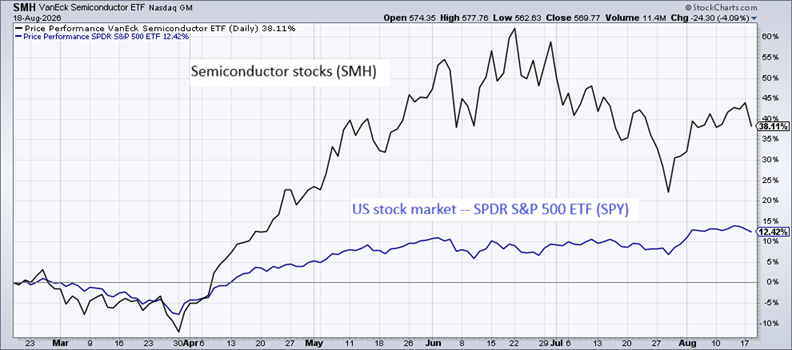
Stocks extended their decline for a third straight session on Tuesday (Aug. 18), renewing debate over the durability of the equity rally at a moment when rising Treasury yields, persistent inflation concerns, and a still‑simmering conflict with Iran threaten to keep pressure on risk assets. Short‑term market direction is unknowable, but several indicators are worth watching to gauge how resilience is evolving and if the current setback is an early clue of deeper trouble ahead.

The S&P 500 remains near record territory, but yesterday’s pullback was driven by weakness in semiconductor stocks (SMH), a leadership group that has powered much of the market’s advance. Investors will be watching this sector closely for signals on the broader risk appetite.

The AI‑driven surge in chip stocks has been a central pillar of bullish sentiment. Any sustained deterioration in this corner would likely weigh on equities more broadly.

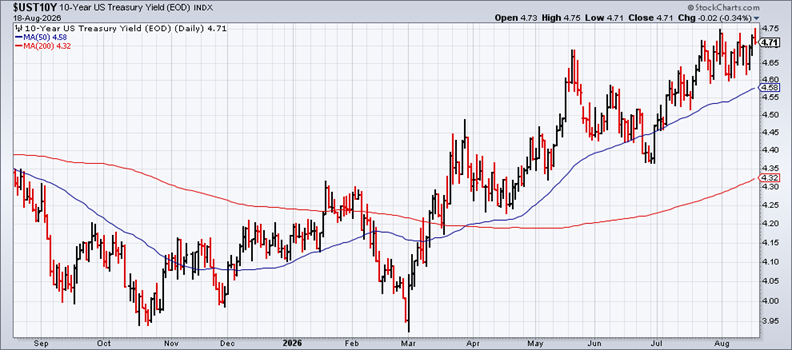
A second critical factor shaping the outlook is the relentless rise in U.S. Treasury yields, which is becoming increasingly difficult for Wall Street to ignore. The 10‑year yield eased slightly yesterday, but at 4.71% it is up sharply from March and increasingly attractive as an alternative to a richly valued equity market that’s jumped more than 20% over the past year.

If higher yields represent a headwind for stocks, that headwind does not appear poised to fade. The forces pushing rates higher — including the Iran conflict and a widening U.S. fiscal deficit — are unlikely to resolve quickly, suggesting upward pressure may persist.

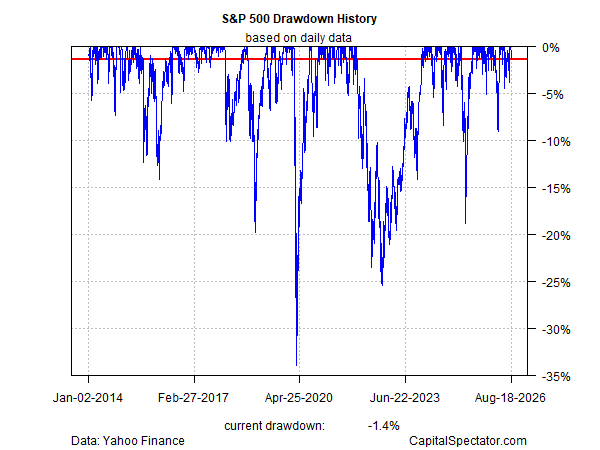
For now, the S&P 500’s 1.4% drawdown as of Tuesday’s close remains trivial by historical standards, leaving room for debate about how to interpret the recent weakness. A deeper slide that pushes the peak‑to‑trough decline beyond 5% would raise more harder questions heading into autumn.

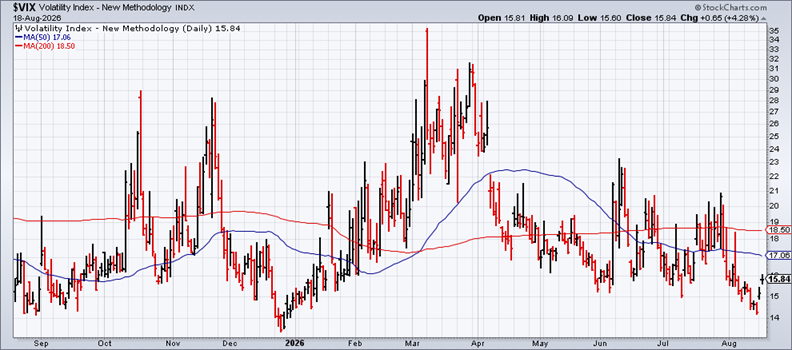
Sentiment is likely to stay cautious, in part because the recent rally has been unusually smooth. Equity volatility fell to its lowest level of the year as of Friday’s close, and historically low VIX readings can coincide with overbought conditions. From a technical perspective, the market looked stretched.

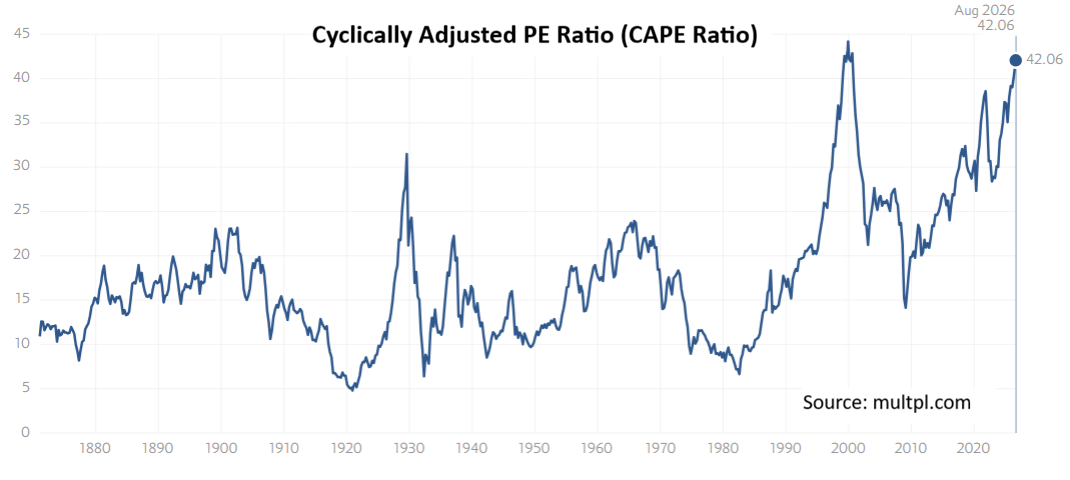
Valuation adds another layer of complexity. Bears have long warned that elevated metrics such as the CAPE ratio leave equities vulnerable, while bulls have countered that strong earnings and, more recently, the promise of AI‑driven growth, are the dominating factors.

The question now is whether rising Treasury yields will force a reassessment. It is easier to dismiss valuation concerns when the 10‑year yield is relatively stable. But if the benchmark rate approaches 5%, Wall Street will face a tougher challenge justifying premium multiples.

To be fair, the fundamental drivers of the rally remain intact — notably strong earnings growth supported by AI‑related capital spending. That backdrop is not disappearing. But as long as Treasury yields continue to trend higher, equities may be stuck in a holding pattern while investors digest an increasingly complicated macro environment.


Treasury Yields Spike as Fiscal Drift and Global Risks Pile Up

The Capital Spectator -

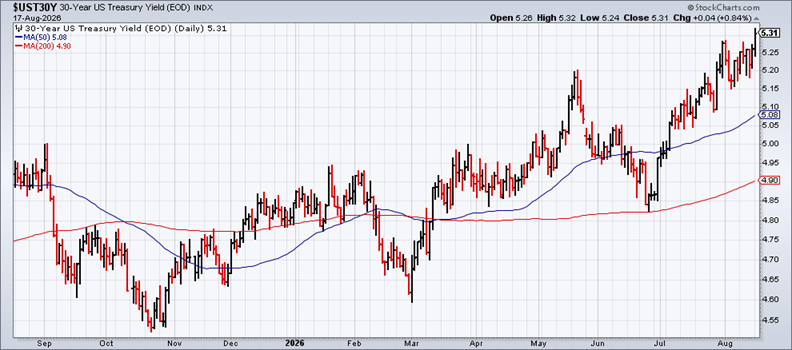
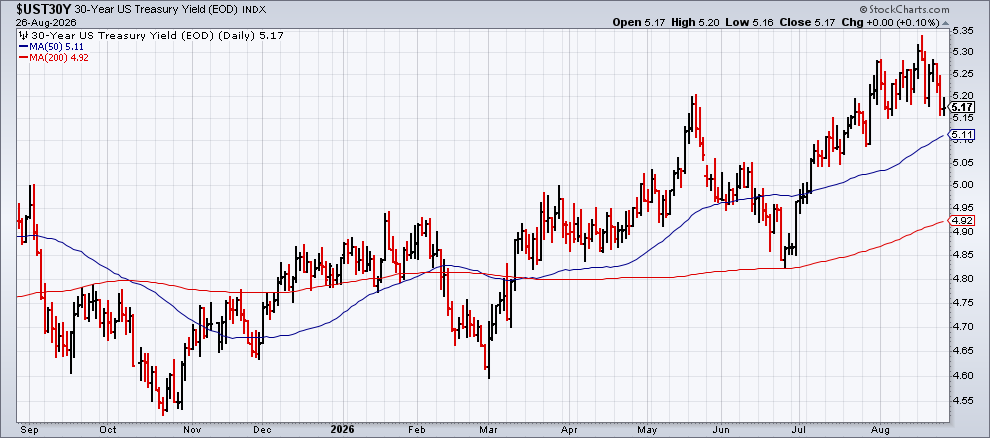
The US 30‑year Treasury yield rose sharply on Monday, breaking higher after spending the first half of August in a tight range. The move signals the bond market’s growing unease with several risk factors, including inflation and government debt.

The 30‑year rate jumped to 5.31%, the highest since 2007, underscoring mounting concern about macro conditions and the stalemate in the Iran conflict, which continues to keep energy prices elevated as shipping traffic through the Strait of Hormuz remains near a standstill after a temporary ceasefire expired on Monday without an extension.

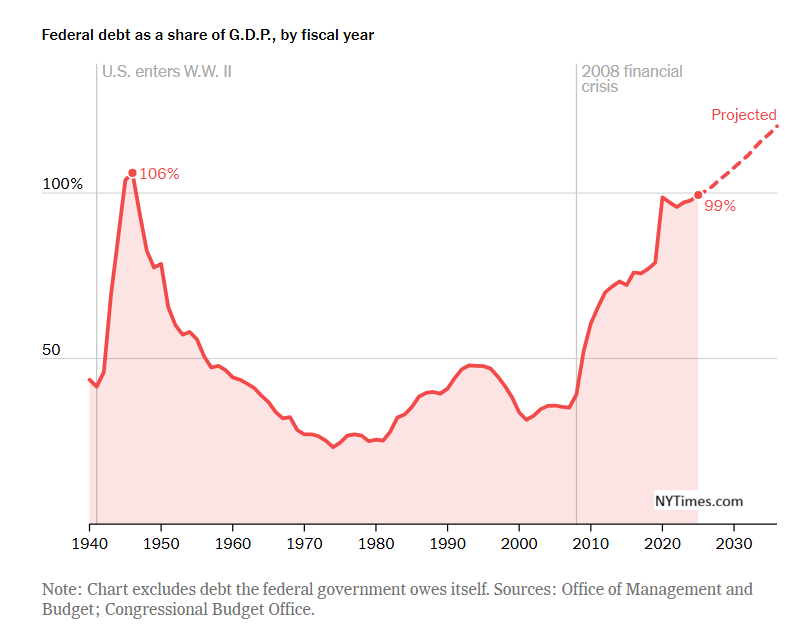
Higher oil prices are adding pressure to headline inflation, but investors are also focused on rising federal debt levels and a widening budget deficit. Congressional Budget Office estimates show federal debt as a share of GDP is on track to exceed the previous 106% peak set during World War II, while the gap between spending and revenue is projected to deepen in the years ahead.

Compounding the deterioating fiscal outlook is the absence of any meaningful policy discussion in Washington to address the runaway debt train. Debt risk is increasingly conspicuous, yet lawmakers treat the issue like background noise, if not ignore it outright. That will work, until it doesn’t, and the bond market may be signaling that the time for tolerance is running short.

Another pressure point pushing yields higher is the surge in long‑dated corporate borrowing tied to AI. The Financial Times reports that “Barclays expects total investment‑grade issuance in 2026 to hit a record $1.9 trillion, compared with last year’s $1.44 trillion.”

Despite the warning signs, US debt likely hasn’t reached a tipping point, in part because the dollar’s reserve‑currency role, the depth of the Treasury market, and longstanding institutional credibility continue to act as buffers. But the structural nature of the red ink ensures the problem will worsen without significant reform in spending and budgeting—reform that only a fully engaged Congress and President can deliver. Part of the issue issue is the feedback loop: as Treasury yields rise, the trend raises the government’s burden of paying interest to finance the debt, a process that puts more upward pressure on yields. Rinse and repeat.

More immediately, the bond market will be looking to the Federal Reserve, and Chair Kevin Warsh, for guidance. Rightly or wrongly, investors are questioning the Fed’s credibility—if only at the margins—after Warsh’s recent public comments sparked skepticism about the central bank’s commitment to returning inflation to its 2% target.

Warsh’s speech on Aug. 28 at the Fed’s Jackson Hole Economic Policy Symposium offers an opportunity for a reset. It’s a high bar, given the structural forces driving the fiscal outlook and the ongoing uncertainty surrounding the Iran conflict. The larger question may be whether Warsh is even interested in resetting market perceptions.

Ultimately, the bond market will win a game of chicken. Warsh cannot control the government’s mounting deficit, nor can the Fed control long rates, which is set by markets. But he can shape expectations for how the Fed plans to manage inflation.

Whether he chooses to do so later this month remains an open question. With Treasury yields rising, the stakes are climbing, making Warsh’s Jackson Hole remarks a potentially pivotal moment for defining the bond market’s risk calculus for the rest of the year and beyond.

Is Recession Risk Rising? Monitor the outlook with a subscription to:
The US Business Cycle Risk Report
What Indian Founders Learn About Money Management Too Late

Money Under 30 -

Indian founders often learn how to build a product, attract customers, and raise capital before they learn how to manage the money flowing through the business. Early success can hide that gap. Revenue is growing, investors are interested, and the bank balance looks healthy enough to keep moving. The problem appears when growth slows, or […]

The post What Indian Founders Learn About Money Management Too Late appeared first on Money Under 30.

Does the July Retail Decline Mark the Start of a Growth Downshift?

The Capital Spectator -

The surprisingly weak retail sales data for July could be an early sign that the recent slowdown in U.S. economic activity will continue in the second half of the year. One monthly report should be viewed cautiously, but a broader review of the latest economic numbers hints that growth may be softer than recent GDP nowcasts imply.

Let’s start with the backdrop that favors an optimistic view. Several estimates of GDP for the current quarter point to a rebound following the modest rise in Q2. The Atlanta Fed’s GDPNow model is especially bullish at the moment, nowcasting that economic output will accelerate to a strong 4.3% annualized pace from Q2’s 1.5% advance.

In the wake of recent consumer data, however, the case for expecting a sizzling recovery in Q3 has weakened. Recent revisions to GDPNow estimates for the quarter have dropped sharply—a trend likely to continue as new numbers for July and August are published.

The decline in retail sales last month is one reason to manage expectations down. Spending fell 0.6% in July, the first monthly decrease since January and the biggest slide in more than a year.

The control group for retail sales—the subset used to calculate GDP, excluding food services, auto dealers, building materials stores, and gasoline stations—also fell, dropping 0.4%, the first decrease in ten months.

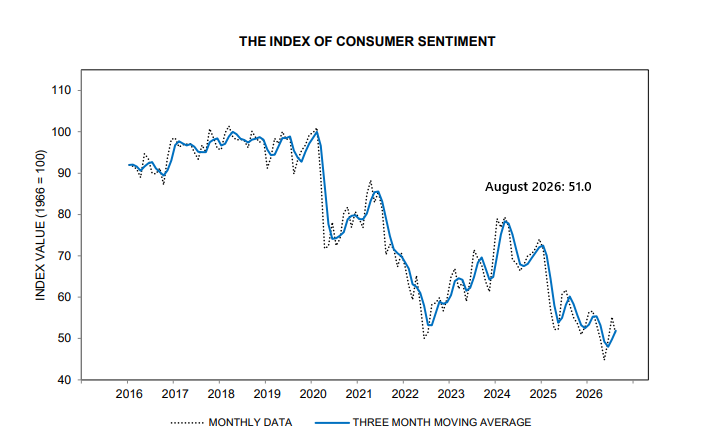
Weaker retail activity isn’t terribly surprising at a time when consumer sentiment has been soft. Sentiment fell 8% in early August, ending two consecutive months of improvement, according to the University of Michigan’s widely watched survey. “Decreases in sentiment were seen across the political spectrum, with Republicans exhibiting the strongest month-to-month decline in August.”

The slowdown in hiring is another factor to consider. The private sector added a sluggish 30,000 jobs in June and July, a sharp downshift from the 200,000‑plus peak in March. Historically slow hiring is less threatening for the economy when immigration drops sharply because weaker labor‑force growth drives the payroll breakeven point toward zero, meaning far fewer monthly job gains are needed to keep unemployment from rising. That, at least, is the theory. But if the economy is creating substantially fewer jobs each month, ripple effects could still roll through the consumer sector—the main engine of U.S. growth.

Hints of deceleration in broader economic growth are also showing up in the Dallas Fed’s Weekly Economic Index (WEI). The 10‑period moving average eased for a third straight week (black line in chart below), based on data through Aug. 8. WEI’s implied year‑over‑year GDP growth in early August still points to a firmer trend relative to the Q3 profile, but the downside bias could be an early sign that growth will continue to soften.

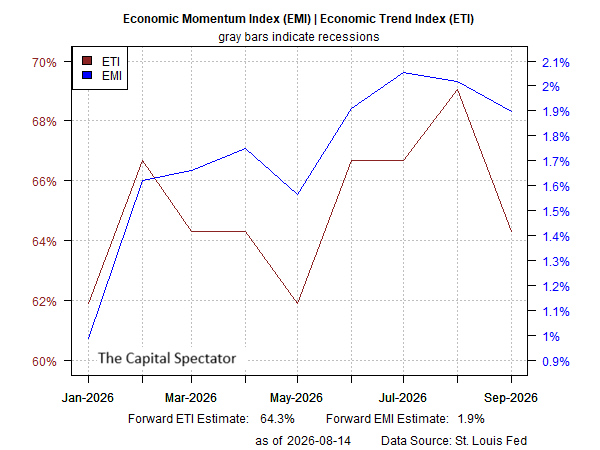
A pair of proprietary business‑cycle indicators I track are also picking up signs of decelerating growth. Forward estimates through September suggest that the recent pickup in economic activity has peaked.

To be clear, the U.S. economy is still poised to expand in the near term, and recession risk remains low. But the latest numbers may be an early sign that the resilience that has surprised and dazzled this year is fading. If this analysis is accurate, there are some positive implications—such as diminishing inflation pressure in the short run, which would allow the Federal Reserve to forgo rate hikes.

The wild card is the bond market, particularly at the long end of the yield curve. A key test centers on the 30‑year Treasury yield, which continues to trend higher. The long bond closed at 5.26% on Friday, near a two‑decade high.

A slower pace of economic activity implies that the recent spike in inflation will continue to ease. If so, the 30‑year yield should begin to stabilize, if not decline. But several complicating factors remain. One is the Iran conflict, which continues to simmer, raising the possibility that headline inflation could stay elevated due to ongoing Middle East energy‑supply disruptions.

A more fundamental issue is U.S. fiscal risk, which may be starting to resonate in the bond market. Surging national debt and massive Treasury issuance may be driving long‑term yields higher as investors demand greater compensation for inflation and credit risks.

The economy isn’t stalling, but it may be losing altitude, a transition that could get messy if long-term inflation worries accompany a short-term downshift in growth.

Is Recession Risk Rising? Monitor the outlook with a subscription to:
The US Business Cycle Risk Report
10‑Year Yield Premium Rises on Inflation Risk and Fed Uncertainty

The Capital Spectator -

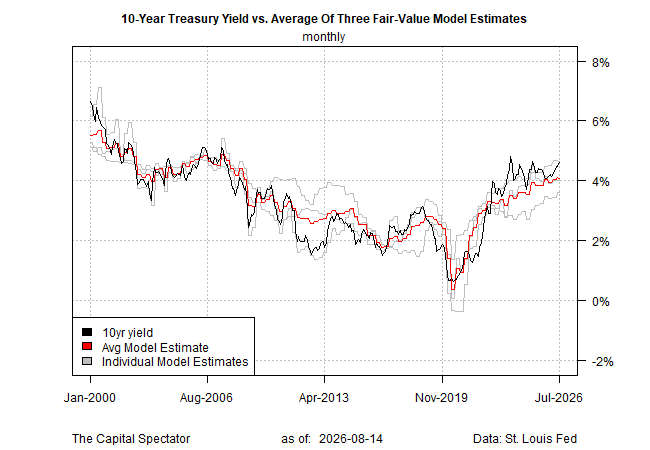
The market premium for the U.S. 10‑year Treasury continued rising in July, increasing to the highest level in a year. A key catalyst: inflation uncertainty related to the simmering Iran conflict and ambiguity about the Federal Reserve’s plans for monetary policy.

The 10‑year yield premium over The Capital Spectator’s estimate of “fair value” has increased persistently since bottoming in October 2025 at roughly equilibrium—i.e., the market yield and fair‑value estimate more or less matched. In the ensuing months, the market rate has increased while the fair‑value estimate has remained stable, a setup that lifted the premium last month to 51 basis points—the highest since July 2025. (The fair-value estimate is calculated as the average of three models that use a variety of economic and financial-market inputs.)

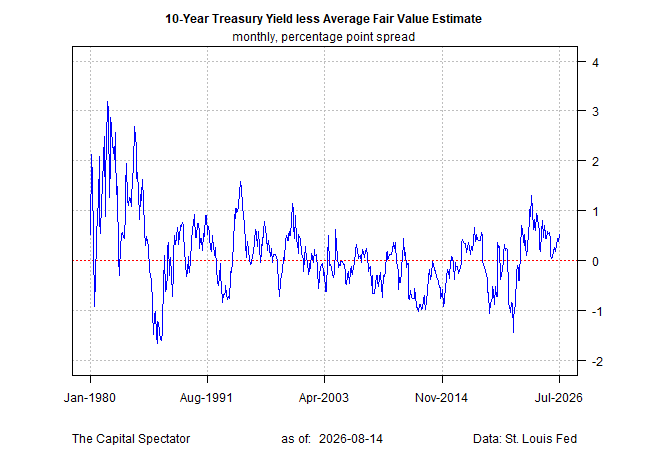
For a clearer view of how the 10‑year market premium and discount have changed through time, the next chart highlights the variability across the decades. From a historical perspective, the current premium is modest and within a typical range. The question is whether the recent upturn in the premium will continue.

One of the key factors that could drive the premium higher is inflation. If the bond market perceives that inflation is gaining traction and the Federal Reserve isn’t responding sufficiently to cool pricing pressure, the 10‑year premium could rise further.

From an investment perspective, a relatively high yield premium is attractive, providing an opportunity to lock in a rate that’s elevated relative to underlying fundamentals. History suggests that the market often moves to relative extremes, and so there’s a possibility that a hefty premium will become available in the near term.

From an economic perspective, by contrast, a high market premium is a macro headwind. In the previous premium spike in 2022–2023, the spread peaked at roughly 130 basis points, a period that coincided with a sharp slide in the stock market in 2022.

History doesn’t repeat, but it can rhyme. The yield premium for the 10‑year is still modest. The key factors that will likely determine whether the premium stays modest or continues to climb are bound up with policy decisions at the Federal Reserve and the course of the Iran conflict.

The bond market isn’t ringing alarm bells, but the rising trend in the 10‑year yield highlights that investors are becoming increasingly sensitive to inflation and Fed policy decisions.

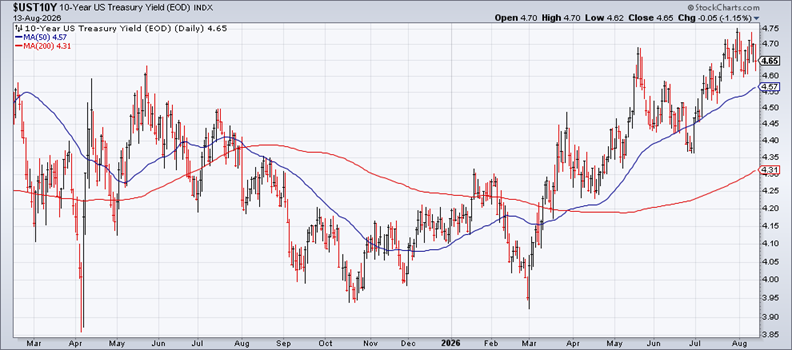
The technical profile of the 10‑year rate continues to reflect an upward bias. A durable peace in the Middle East crisis and/or clear signals from the Fed that it will decisively act to tame inflation will be key variables that could stabilize, if not lower, Treasury yields. At the moment, however, both of those policy goals remain in flux, which suggests that the 10‑year yield will continue to test the upside.

Is Recession Risk Rising? Monitor the outlook with a subscription to:
The US Business Cycle Risk Report
Is Forex Trading Right for You? Here’s What Traders Should Know Before Starting

Money Under 30 -

Are you a young forex trader looking to grow your bank account? Trading on the currency market can be rewarding, but it involves risk. The plain truth is that many young traders lose money at the outset. As a result, new traders need to make two considerations: never use money you can’t afford to lose […]

The post Is Forex Trading Right for You? Here’s What Traders Should Know Before Starting appeared first on Money Under 30.

Disinflation Gains Traction, but the Bond Market Isn’t Buying It

The Capital Spectator -

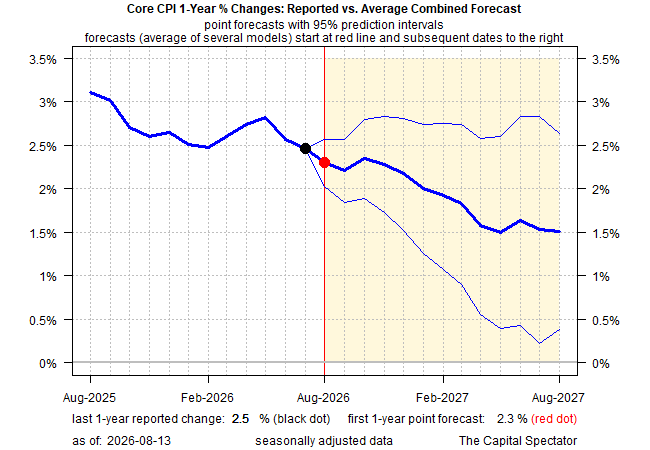
Consumer inflation eased in July, providing the Federal Reserve with a fresh round of data to stay patient on the decision of whether to raise interest rates. The bond market remains skeptical, but yesterday’s Consumer Price Index (CPI) for last month, along with readings from alternative CPI benchmarks, suggests that pricing pressure is, at worst, stabilizing if not easing. Looking ahead to the next update, a pair of CPI nowcasts for August point to ongoing disinflation this month.

The main risk factor is (still) Iran, but if the conflict remains relatively calm, the foundation for a softer pricing trend appears to be in place.

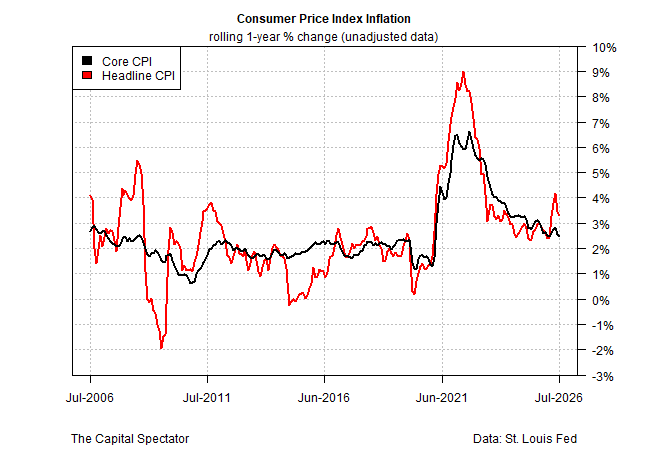
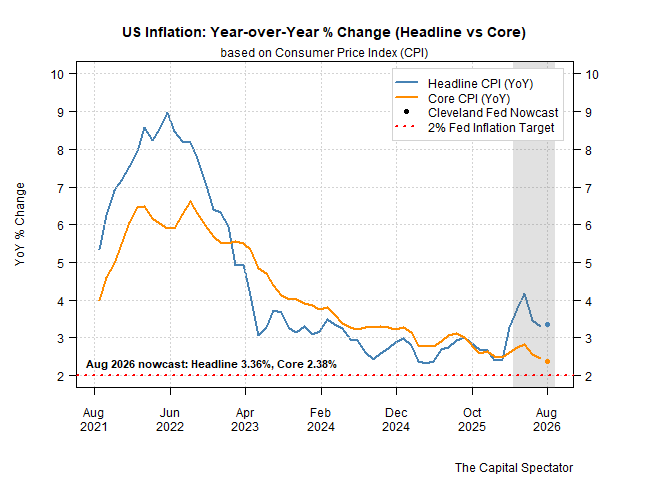
Let’s start with the standard CPI data on a rolling one‑year basis. Headline and core measures eased in July, suggesting that the war‑driven inflation spike has peaked. Notably, core CPI continues to moderate, dipping to a 2.5% year‑over‑year pace, which matches the pre‑war trend in January and is close to the Fed’s 2% target.

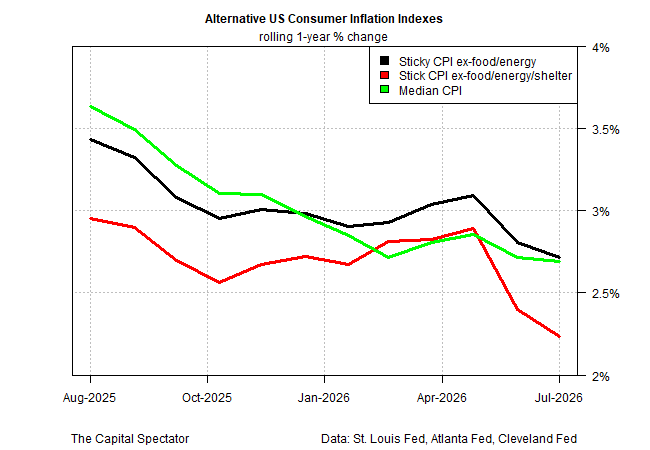
Three alternative measures of CPI (published by the Cleveland Fed and Atlanta Fed) that attempt to minimize noise and emphasize the inflation signal also highlight ongoing disinflation through July.

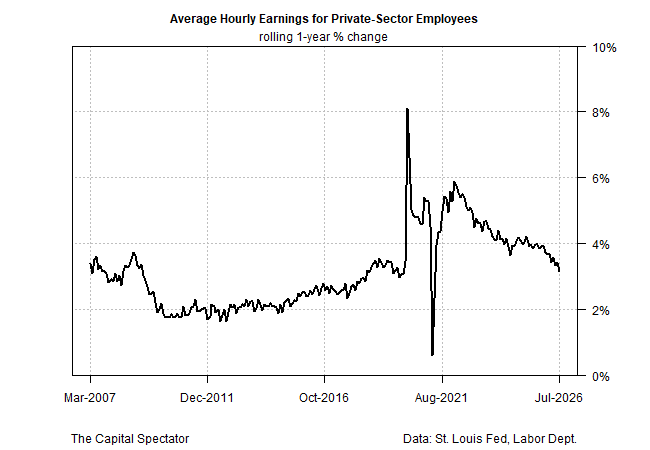
The one‑year trend in wages is also pointing to disinflation. Combined with the sluggish increase in private‑sector payrolls lately, this data suggests that the labor market’s influence on near‑term inflation is easing.

The Cleveland Fed’s nowcast for CPI in August indicates that disinflation will continue in the next update.

The Capital Spectator’s proprietary nowcasting model for core CPI also highlights ongoing disinflation for the near term. This model’s estimates have been generally correct in recent months in terms of nowcasting the directional bias (see here, for example). The fact that the August outlook mirrors the Cleveland Fed’s nowcast strengthens the case for anticipating that inflation pressure will ease further.

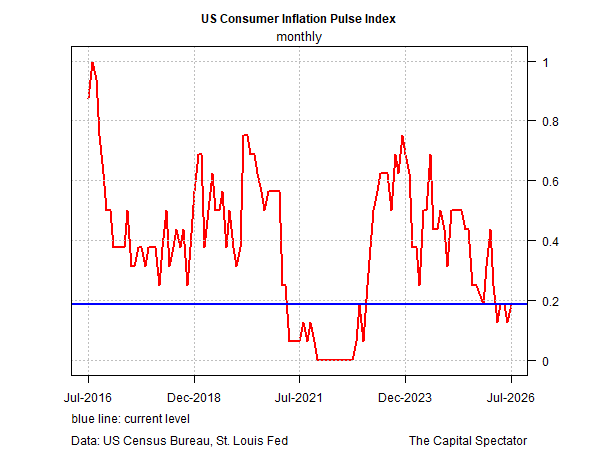
Another proprietary model run by The Capital Spectator also points to softer inflation pressure after the spike earlier in the war. The Inflation Pulse Index aggregates the 12‑month percentage changes for all 32 components of the Consumer Price Index and scores each benchmark. The master score — the Inflation Pulse Index — reflects the overall inflation bias. Readings range from 0 (a strong disinflation/deflation bias) to 1.0 (a strong inflation bias).

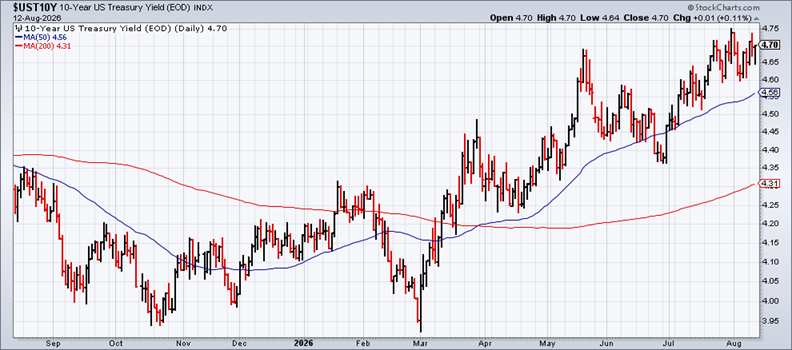
There are several caveats to consider that could spoil the disinflationary party. In addition to the uncertainty surrounding the Middle East conflict, the bond market remains skeptical that inflation risk is easing. The U.S. 10‑year Treasury yield, for example, rose yesterday to 4.70%, trading near its highest level since early 2025.

Until the bond market is persuaded that the worst of the war‑related inflation threat has passed, and that disinflation is the path of least resistance, the outlook for Fed rate hikes will remain unsettled. Although yesterday’s CPI data looks encouraging, if only on the margins, the Federal Reserve does’t operate in a vacuum and will remain in a tug-of-war with bond yields for setting monetary policy.

Is Recession Risk Rising? Monitor the outlook with a subscription to:
The US Business Cycle Risk Report
Copper’s Rise Continues As Gold Tries to Claw Back Lost Ground

The Capital Spectator -

After correcting through much of the Iran conflict to date, precious metals are starting to revive based on a set of ETFs through Tuesday’s close (Aug. 11). Meanwhile, copper’s resilience during the war has endured as the metal continues to set new highs.

Year to date, copper is the standout winner among the main exchange‑traded products offering a pure play on metals. The US Copper Index Fund (CPER) is up 15.1% so far in 2026, ahead of its counterparts and two ETF benchmarks that track mixes of base (DBB) and precious (DBP) metals.

Copper has become the critical wiring behind the entire AI buildout. A tightening copper market — driven by slow mine development, declining ore grades, and surging demand from electrification and AI infrastructure — has created a supply shortage that’s pushing prices higher.

“The underpinning story of elevated copper prices has been data‑center and power‑grid demand to support the rapid AI industry expansion,” says William Osnato, Barchart’s director of commodity data research and analysis.

Meanwhile, gold and other precious metals have rebounded from recent lows, raising the possibility that the correction in this corner may have run its course in the near term. High oil prices have helped push bond yields sharply higher in recent months — a key drag on gold — but renewed prospects for negotiations with Iran could stabilize or even trim crude prices, easing inflation pressure, pulling yields lower, and giving gold room to recover.

Betting markets highlight cautious expectations that gold’s recent upswing will carry it to materially higher levels by year‑end from the current $4,409 spot price (Aug. 11), according to Kalshi data. The odds of a close at $4,500 or higher by Dec. 31 are currently 48%, the same probability assigned to a close at $4,600 or higher.


Affordable Ways to Create a Lasting Memorial After Losing a Loved One

Money Under 30 -

When you lose a loved one, it’s natural to want to preserve their memory in a tangible way. Many people automatically go the traditional route and opt for ornate headstones or create private backyard memorials. Fancy monuments are impressive, but that’s not the only way to create a meaningful tribute. The most powerful memorials reflect […]

The post Affordable Ways to Create a Lasting Memorial After Losing a Loved One appeared first on Money Under 30.

Foreign Stocks Lose Their Edge as US Momentum Roars Back

The Capital Spectator -

Foreign equities continue to outperform U.S. stocks this year, but there are signs that international leadership is faltering, based on a set of ETFs through Monday’s close (Aug. 10).

Thanks to a strong rally earlier in the year, the global equity market ex‑U.S. is still ahead of American shares. Vanguard International (VXUS) is up 15.7% year to date, maintaining a moderate premium over the U.S. stock market’s 14.0% gain via the SPDR S&P 500 ETF (SPY). But the return spread is narrowing, and the recent surge in U.S. stocks could be an early sign that international equities will soon fall behind in relative terms.

A regional breakdown shows that Asia ex‑Japan (AAXJ) is the top performer, rallying 21.5% this year. But the fund has stumbled lately. Japan (EWJ) is the second‑best performer in 2026 and is trading near a record high, offsetting some of the weakness elsewhere in Asia.

Zooming out and comparing a broad measure of global equities ex‑U.S. (VXUS) with U.S. shares (SPY) suggests that relative strength in international stocks has peaked. The rally favoring foreign over U.S. equities that began more than a year ago has recently reversed, based on the ratio of the two funds. The implication: the long‑running underperformance of foreign stocks may again become the norm.

The second chart below zooms in on the VXUS:SPY ratio’s recent performance. For the first time since the war with Iran began, the 50‑day average for the ratio has slipped below its 200‑day average, indicating that relative weakness in foreign shares may continue in the near term.

The recent soft patch is also evident in emerging markets (VWO).

In a market obsessed with AI‑powered momentum, foreign equities suddenly look like they’re running out of runway. If the crowd keeps betting on America’s tech engine, international leadership may prove to be just another brief detour in a long U.S. bull narrative.


Will the Bond Market Verify the Stock Market’s Revived Optimism?

The Capital Spectator -

Last week’s stock market surge sends a message that all is well, but that’s only half a loaf until the bond market confirms the recovery in expectations.

Treasury yields eased last week, although rates remain elevated relative to where they were when the war with Iran started on Feb. 28. The surprisingly weak jobs report for July takes some of the near-term pressure off the Federal Reserve to lower rates to tame inflation. But it’s unclear if the bond market is set to unwind the yield premium that has accrued over the past four-and-a-half months.
Inflation and pinched energy exports due to the war are key drivers behind the rise in yields, but there are other factors that could keep the bond market wary in the weeks and months ahead. One is the federal budget deficit, which continues to deepen. As federal borrowing expands to fill the gap between what the government spends and what it takes in from tax revenue, the growing supply of Treasuries can outstrip investor demand, pressuring prices lower and driving yields higher.

That’s a mounting risk, but one that the bond market has shrugged off for years. No one knows when or if investors will demand a higher yield premium because of the government’s red ink, but as the deficit deepens, as many projections say it will, the red ink may become harder to ignore.

The threat to Fed independence may move back to the fore, too, which could shake bond market stability. President Trump has revived his effort to remove Fed Governor Lisa Cook, giving her 21 days to respond to uncharged mortgage fraud allegations — claims she attributes to clerical errors. The move follows a June Supreme Court ruling that blocked her immediate firing because she was denied procedural due process. Because the Court did not define legal “cause” for removal or rule on the fraud claims, however, it left the door open for Trump to issue proper notice and restart the process to end her term, which runs through 2038.

A more immediate concern for the bond market is inflation, which has been running above the Fed’s 2% target for over five years. The war with Iran exacerbated the overshoot, although inflation’s trend eased in June, suggesting that pricing pressure is starting to cool.

Wednesday’s report on consumer prices in July will be closely read for reassessing how much inflation risk is still pulsing through the economy, and whether the Fed needs to tighten policy at next month’s FOMC meeting. Economists are expecting a relatively tame update, forecasting that year-over-year measures of headline and core inflation will tick lower to 3.4% and 2.5%, respectively, based on Econoday.com’s consensus forecasts.
Even if consumer prices ease again in July, the question is whether the Fed will continue to tolerate inflation running well above its target. A crucial input for answering that question may lie with the bond market, and how it prices inflation risk leading up to the September FOMC meeting.

The front line for gauging bond‑market sentiment is the 30-year yield, the most inflation-sensitive maturity. The long yield eased last week, but it’s unclear if that’s a temporary pause in an ongoing trend that will push rates higher.

Negotiations with Iran will likely remain a crucial variable for market sentiment. In line with recent developments on this front, the news flow is choppy. Depending on the hour or day, the outlook for a resolution to the crisis alternates between optimism and pessimism and many shades in between.

Rising Treasury yields, in sum, could act as a brake on the stock market’s revived confidence until it’s clear that a durable peace deal has been hammered out. The final verdict, in short, still belongs to the bond market.


Book Bits: 8 August 2026

The Capital Spectator -

United States of Oligarchy: How America’s Wealthiest Ally with Dictators, Weaken the U.S., and Destroy Democracy
Casey Michel
Summary via publisher (Macmillan)
For years, a small group of billionaires has amassed increasing power, steering American politics for their own benefit. Many of these figures are familiar. There’s Elon Musk, who has used his wealth to help place Donald Trump back in the White House. There’s Mark Zuckerberg, who has used his resources to transform America into his own digital playground. There’s Jared Kushner, who has used family connections to gain more political power than he ever dreamed of. There is only one word to describe such extreme levels of wealth, avarice, and political control: Oligarchy.

Reining in the Bulls: How to Stop Corporate Abuse in an Age of Unbridled Greed
Michael Marx
Summary via publisher (Island Press)
Major corporations exercise enormous control over our lives. They influence how we think, what we buy, who we vote for, and how our society evolves. They are key drivers of the wealth that fuels our economic system, and their power insulates them from strict government regulations and accountability. In this setting, corporate abuses—pollution, toxic and inhumane work environments, defective products—go unchecked. When the government refuses to corral industry’s misdeeds, advocacy groups turn to corporate campaigns to expose and change harmful behavior.

Untamed Unicorns: Why Startup Finance Is Broken and How to Fix It
Renée M. Jones
Review via Boston College Law School Magazine
Much of what is happening with startup companies, from governance to financing to culture, has Professor Renée Jones concerned. The nationally renowned expert in securities law, who served as director of the Securities and Exchange Commission’s Division of Corporation Finance from 2021 to 2023, is calling out the danger being posed by rapid deregulation of securities markets.
The term “unicorns” was originally coined to convey just how rare and extraordinary these businesses were, but the startup ecosystem has since changed dramatically. Whereas there were just an estimated 40 such companies in 2013, that number has ballooned to an estimated 1,500 today, a number that also includes so-called “decacorns,” valued at over $10 billion, and even “centicorns,” valued at over $100 billion.

Please note that the links to books above are affiliate links with Amazon.com and James Picerno (a.k.a. The Capital Spectator) earns money if you buy one of the titles listed. Also note that you will not pay extra for a book even though it generates revenue for The Capital Spectator. By purchasing books through this site, you provide support for The Capital Spectator’s free content. Thank you!
Pages