The Capital Spectator

Nowcast Data Suggest US Growth Is Accelerating In Q2

The Middle East crisis appears no closer to resolution, underscored by Tuesday’s US military strikes on Iran. If recent history is a guide, the effects on the U.S. economy will be minimal, as today’s update on nowcasts for second‑quarter GDP suggests.

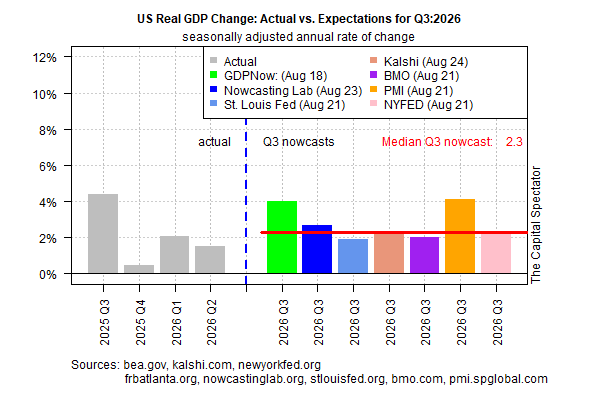
Growth for the April‑through‑June period continues to track at a 2.5% annualized rate, based on the median nowcast from several sources compiled by CapitalSpectator.com. The estimate points to a pickup in output over Q1’s modest 1.6% increase.

Today’s update is unchanged from last week’s estimate and suggests that the economy continues to accelerate following stall‑speed conditions in Q4, when GDP rose just 0.5%.

The history of the US economy since the war started on Feb. 28 has been a study in resilience. Over the past three months, economic activity has been largely unaffected by the Middle East conflict, with one glaring exception: inflation. It’s unclear whether rising pricing pressure will begin to unleash a deeper round of demand destruction, particularly in the consumer sector, but the effects so far have been modest.

One of the clearest signs of the economy’s strength: US payrolls rose at a robust pace for a third straight month in May.

“I think the job market, for the first time in a while, is moving in the right direction,” says Guy Berger, chief economist at small‑business payroll firm Homebase. “I wouldn’t call this a job market that’s quite ‘booming’—it’s certainly not as hot as the job market in ’21 and ’22—but it’s warming.”

The question is whether inflation will spoil the party in the second half of the year, forcing the Federal Reserve to raise interest rates and take initial steps toward removing the proverbial punch bowl, per the famous analogy by former Federal Reserve Chair William McChesney Martin to describe the central bank’s role in the economy.

Goldman Sachs reports: this week: “Our economists have not yet seen signs that the inflation shock from the war is broadening out — their composite indicator of the risk of more persistent inflation is still at a low level, although a jump in University of Michigan long‑term inflation expectations has pushed it slightly higher.”

The Fed is expected to leave its target rate unchanged at the upcoming meeting later this month, and again in July, based on Fed funds futures. Looking further out is as cloudy as ever and will remain so until something approximating a resolution to the Middle East crisis emerges.

For now, the numbers tell a story of an economy that refuses to flinch. The Q2 nowcast holds firm, signaling renewed momentum even as geopolitical risks swirl. Whether that strength endures into the second half will hinge on inflation’s next move — and on how long global tensions keep the outlook shrouded in fog.


Safe Havens No More? Treasuries Sink While Riskier Debt Rallies

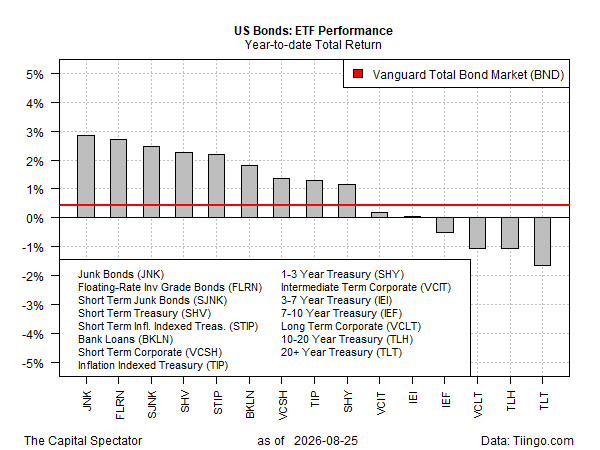
The search for higher yields continues to elevate the riskier facets of the bond market since the Iran conflict started. By contrast, most slices of the Treasury market remain underwater, based on a set of ETFs.

The leading performer by far since the crisis started on Feb. 28 is bank loans. The Invesco Senior Loan ETF (BKLN) is up 2.8% during this period, well ahead of the rest of the field.

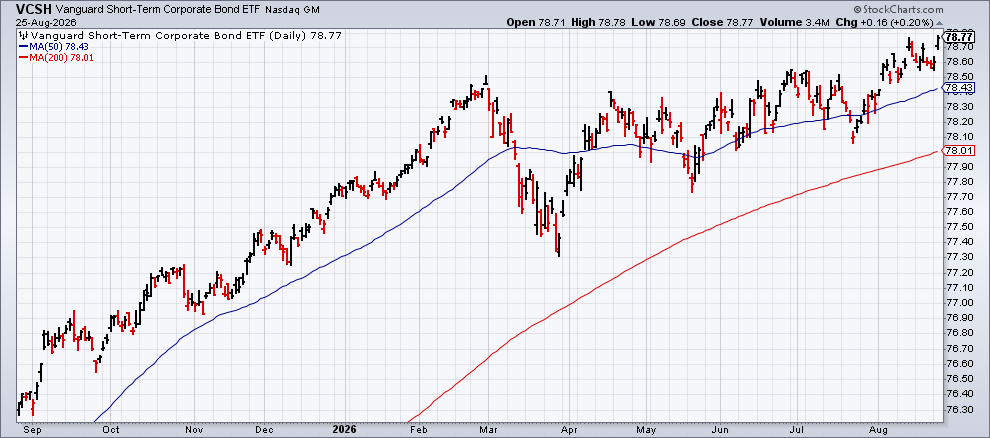
The rest of the winners since Feb. 28: floating-rate securities (FLRN), a cash proxy (SHV), standard “junk” bonds (SJNK and JNK), and short-term inflation-indexed Treasuries (STIP). The remainder of the market is nursing losses, led by long Treasuries (TLT), which are currently posting a loss in excess of 5%.

What explains the performance divide? Treasuries are under pressure as inflation concerns lurk due to the run-up in the cost of energy. This spike has raised headline measures of prices and prompted forecasts that the Federal Reserve will be forced to raise interest rates later this year.

That’s hardly a bullish backdrop for fixed-income securities, yet bank loans and junk bonds have managed to post gains. One reason: private credit fundamentals remain strong despite recent market stress, according to Goldman Sachs. Defaults have been low and borrower performance solid. “The fundamentals of private credit still appear strong,” says Vivek Bantwal, global co-head of private credit at Goldman Sachs Asset Management.

Add in the higher yields and the package has been too good to ignore for investors. BKLN’s distribution yield is 6.61% (as of June 9), or nearly two percentage points above the long-bond’s current yield.

But the easy gains may be in the rearview mirror as the lingering inflationary effects of the Iran conflict continue to resonate. With no easy solutions on the horizon for a crisis that continues to keep Gulf energy exports low, the odds still look slim for a return to pre-war pricing pressure in the near term.

BKLN appears to be pricing in the shifting sentiment, driven by fading optimism for a quick end to the conflict and the macro blowback. The ETF is still comfortably ahead of the field since Feb. 28, but the recent peak looks like a ceiling for the foreseeable future without a material change in the outlook for a resumption in shipping through the Strait of Hormuz.

While markets are currently betting against a prolonged conflict, the latest news flow continues to challenge this forecast for the near term. Despite former President Trump’s calls for restraint, Israel and Iran’s recent strikes suggest that a resolution is still nowhere on the horizon.


Is a Prolonged Middle East Conflict Becoming the Base Case?

Starting a war is easy; ending one is hard. That simple calculus is increasingly resonating in financial markets as the backlash from the Middle East conflict persists and evolves. The economic effects have varied, but the recent optimism that the US would remain largely insulated is fading. Markets are beginning to demand higher risk premia as compensation.

The latest sign that ending the conflict will be messy and take longer than expected came on Sunday, when Iran and Israel resumed fighting—exchanging missile strikes for the first time since the April cease-fire. President Trump said he would demand that Israel not retaliate, but that effort has failed as renewed fighting continues into Monday. As the Times of Israel reports: “The Israeli military says it is prepared for at least a few more days of fighting against Iran, and potentially a full resumption of the war.”

Unsurprisingly, oil prices spiked, rising 4% in early Monday trading. Crude remains below its peak since the war began on Feb. 28, but a return to pre-war prices looks unlikely anytime soon.

The renewed conflict between Iran and Israel may not be shocking, nor is it likely to radically shift expectations relative to recent history. But this hydra-headed conflict has momentum on multiple fronts, suggesting that the crisis, even if it doesn’t deepen, will endure in one form or another. The macro risk, as a result, is becoming chronic rather than actute.

Depending on one’s view, markets have developed either a degree of acceptance or complacency about the conflict and its macroeconomic implications. Christopher Smart, a former trade adviser and Treasury official in the Obama administration, noted: last week: “With every passing day, the world is learning to live without the Gulf’s seaborne exports.”

True—but that tolerance has always been precarious, built on the assumption that normalcy in the Middle East would soon return. As the crisis drags on, the logic behind that assumption weakens, and the fallout is increasingly spilling into the U.S. economy.

Friday’s upbeat payrolls report is a case in point. In ordinary times, news of solid hiring for a third consecutive month would be celebrated on Wall Street. But in the current climate, good economic news is bad news for the bond market: a robust labor market suggests the Federal Reserve will face growing pressure to raise interest rates to offset the supply‑side energy shock pushing headline inflation higher.

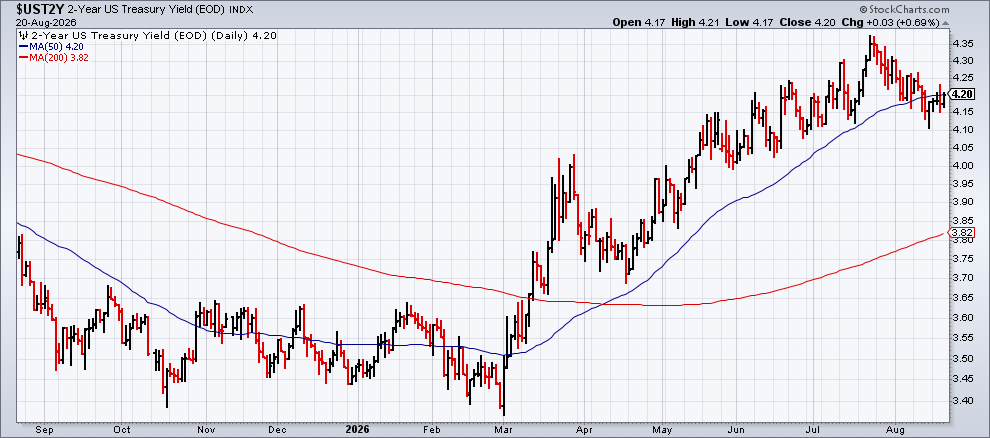
Fed funds futures still price in no change at the next several policy meetings, including the June 17 FOMC gathering, when new Fed Chair Kevin Warsh makes his public debut at the post‑meeting press conference. But the Treasury market is becoming increasingly anxious—the policy‑sensitive two‑year yield continues to climb well above the median Fed funds rate, underscoring the bond market’s expectation that a rate hike is near.

The conflict is becoming harder to end because violence is spreading across multiple fronts, major powers’ goals are diverging, and the political conditions needed for de‑escalation are eroding rather than improving. A key factor that will be difficult to minimize: Iran has discovered that controlling the world’s most important energy chokepoint gives it strategic leverage that even great‑power military pressure cannot fully neutralize. This has emboldened Tehran and reshaped regional deterrence dynamics.

Markets have only partially priced in this risk, assuming that a return to normal was close at hand. Facts on the ground suggest otherwise—a reality that has yet to be fully reflected in asset prices or monetary policy.

Is Recession Risk Rising? Monitor the outlook with a subscription to:
The US Business Cycle Risk Report

The ETF Portfolio Strategist: 07 JUN 2026

Trend Watch: Global Markets & Portfolio Strategy Benchmarks

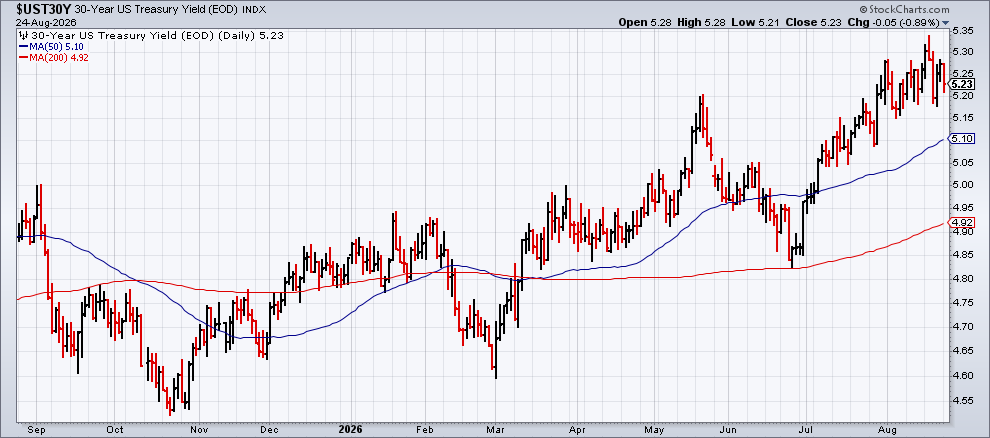
Inflation worries weighed on markets last week. Not exactly news at this late date, but the better‑than‑expected US payrolls data for May highlighted that the world’s biggest economy remains resilient in the face of an energy crisis. Treasury yields, unsurprisingly, rose as investors sharpened their focus on the possibility that inflation risk may linger longer than recently expected, supported by a relatively robust economy, which in turn lifts the odds that the Federal Reserve may soon start raising interest rates.

No one should dismiss these concerns, but it’s still early for strategic‑minded investors to assume the worst‑case scenario is baked in. By some measures, a pullback was overdue. The S&P 500 Index had rallied for nine straight weeks, a relatively rare event with only ten prior occurrences to the latest run‑up, according to The Motley Fool. The odds for a pause were high even before Friday’s surprisingly strong jobs report.

Thanks for reading The ETF Portfolio Strategist! Subscribe for free to receive new posts.

Global asset‑allocation strategies suffered on Friday as well. All of our proxy ETFs fell sharply last week. The aggressive strategy (AOA) was especially hard hit, slumping 2.3%.

continue reading at The ETF Portfolio Strategist

Book Bits: 6 June 2026

How to Win a Trade War: An Optimistic Guide to an Anxious Global Economy
Soumaya Keynes and Chad P. Bown
Review via Reason
The ancient Chinese military strategist Sun Tzu advised that “he who wishes to fight must first count the cost.” Joshua, the brilliant (for its time) computer in the 1983 film WarGames, did the counting and concluded that “the only winning move is not to play.”
Both lines find their way into How To Win a Trade War. This is no arid academic analysis, and it does not read like one. Instead, Soumaya Keynes, a journalist at the Financial Times, and Chad Bown, a senior fellow at the Peterson Institute for International Economics, have crafted a witty, fast-paced analysis of how the global trading system has unraveled in the aftermath of COVID, Brexit, and (most importantly) President Donald Trump’s electoral successes.

1873: The Rothschilds, the First Great Depression, and the Making of the Modern World
Liaquat Ahamed
Review via The Wall Street Journal
In one single unforgettable day—Friday, May 9, 1873—prices on the Vienna Stock Exchange plunged by 45%. All at once the world was changed.
“1873,” by Liaquat Ahamed, author of “Lords of Finance: The Bankers Who Broke the World” (2009), is the story of the trans-Atlantic depression that followed the crash. It is the story, too, of a generation-long, befuddling decline in the prices of all kinds of things. In 1878, confronting the lowest prices for pig iron since colonial times, American ironmasters wondered if the smokestacks on their idled blast furnaces might serve a higher use as astronomical observatories.

Lightning Beneath the Sea: The Race to Wire the World and the Dawn of the Information Age
James M. Tabor
Review via The Wall Street Journal
You’ll rarely know for certain, but when you send an email, check your social-media feed or read this newspaper online, you may be sending pulses of light through a conduit the size of a garden hose resting on the floor of the sea. Around 500 fiber-optic cables, not counting those owned by governments, stretch for more than a million total miles beneath the oceans. They provide the physical backbone for the weightless world of the internet. Life without them would be hard to imagine.

Contingent Expectations: Uncertainty, Risk, and Economic Behavior in Historical Perspective
Alexander Nützenadel and Jochen Streb
Summary via publisher (Princeton U. Press)
Expectations play a crucial role in shaping economic behavior. But how are expectations actually formed, and how has this changed over time? The financial crisis of 2007–08 cast doubt on traditional theories of expectation formation, particularly the rational expectations framework. In Contingent Expectations, Alexander Nützenadel and Jochen Streb examine the ways that past experiences influence the economic expectations and decision-making of households, investors, and policymakers through history, and offer an alternative perspective. Combining a comprehensive empirical analysis of expectation formation from the eighteenth century to the present day with an assessment of the relevant economic theory, Nützenadel and Streb present a new theoretical framework, contingent expectations, for understanding economic expectation.

Please note that the links to books above are affiliate links with Amazon.com and James Picerno (a.k.a. The Capital Spectator) earns money if you buy one of the titles listed. Also note that you will not pay extra for a book even though it generates revenue for The Capital Spectator. By purchasing books through this site, you provide support for The Capital Spectator’s free content. Thank you!

Research Review | 5 June 2026 | Risk Management

Measuring Bubbles via Put-Call Disparity: A Model-Free Approach
Robert A. Jarrow (Cornell U.) and Simon Kwok (U. of Sydney)
May 2026
This paper introduces simple, model-free lower and upper bounds for measuring the size of asset price bubbles. Assuming only that the market satisfies no-free-lunch-with-vanishing-risk and that all trading strategies are admissible, our framework avoids restrictive parametric models and the no-dominance assumption. We demonstrate that put-call disparity provides an observable lower bound, and is economically justified by short-sale constraints. Additionally, the lowest price of an out-of-the-money (OTM) call option determines the upper bound. To ensure empirical reliability, we modify these bounds using data-driven regularization and bootstrap methods to disentangle genuine bubble signals from market microstructure noise and to reduce reliance on thinly traded deep OTM options. Using S&P 500 index option prices from 1996 to 2025, we document a sustained bubble during the COVID-19 era and capture market exuberance preceding the 2000 dot-com and 2008 financial crashes. In addition, the empirical study suggests that the market violates no-dominance and is incomplete.

How Fear Beats Greed: The Impact of Positive and Negative Sentiment on Global Stock Markets
Jiye Ryu (Hongik University), et al.
February 2026
This paper investigates the impact of positive and negative sentiment on stock returns and volatilities across developed and emerging markets using the consumer confidence index as a proxy for sentiment. We conduct a comparative study of developed and emerging markets to assess whether sentiment-driven mispricing is due to overpricing or underpricing and to examine the effect of sentiment on return and risk dynamics.

Diversification Under Stress: Empirical Evidence of Correlation Breakdown Across Sectors and International Markets
Fabio Trachsler (ETH Zürich)
May 2026
We investigate whether portfolio diversification across U.S. sectors and international equity markets retains its risk-reducing properties under stress. Using daily return data from 1999 to 2025 spanning ten sector ETFs and eight international equity indices, we document a systematic correlation breakdown: mean pairwise correlations rise significantly during crisis episodes, precisely when diversification would be most valuable. Across nine crisis periods and 59 systematically identified stress events, correlations increase in 71.2 % of all cases, with a mean ∆ρ = 0.094 that is statistically highly significant (p < 0.0001). We show that the nature of a shock matters more than its magnitude: idiosyncratic events leave correlations intact, while systemic shocks produce strong co-movement across all sectors simultaneously. Sector and international diversification fail together in systemic crises but diverge in idiosyncratic ones, a distinction that, to our knowledge, has not been systematically documented across this breadth of episodes. We introduce the Trachsler Resilience Score, a formal criterion for selecting sectors that are robust to correlation breakdown under stress, and validate it out-of-sample: the Resilience Portfolio reduces maximum drawdown in 83 % of independent stress events (p = 0.003). Our findings suggest that naive diversification offers substantially less protection than classical portfolio theory implies, and that crisis-conditional correlation structure should be an explicit input to portfolio construction.

Industry Rotation Using Market-State Similarity
Valeriy Zakamulin (University of Agde)
May 2026
This paper studies whether lagged market returns contain useful information about subsequent industry returns and whether this information can be used for active industry rotation. Using monthly Kenneth French industry portfolios, we first show that conventional mean predictability is weak. Quantile predictive regressions, however, reveal that market-to-industry predictability is concentrated mainly in the tails of the conditional return distribution, especially in downside states. Motivated by this evidence, we propose a non-parametric strategy based on market-state similarity. At each portfolio-formation date, the strategy identifies historical months in which the standardized market excess return was closest to its current value, measures subsequent industry performance after those similar states, and goes long industries with positive historical subsequent returns and short industries with negative historical subsequent returns. Out-of-sample simulations show that the active strategy delivers a higher Sharpe ratio, lower volatility, and substantially smaller drawdowns than the passive equal-weighted industry benchmark. The results are robust to industry classification and model-parameter choices.

When Sector ETFs Pull Apart
Jackson Wang (independent)
May 2026
The SPDR Select-Sector ETFs are usually treated as positively correlated slices of one underlying market. Across the full 1999-2026 sample of daily returns the average pairwise correlation among the 11 sectors is well above 0.5, and almost no two sectors have ever been unconditionally negatively correlated. Conditioning on a rolling 60-day window, however, surfaces narrow but recurring divergence regimes: episodes in which the cross-sectional spread between the best-and worst-performing sector explodes, and pairs that are usually mildly positive flip to outright negative correlation. The XLK-XLE pair, for example, has a long-run average rolling correlation of 0.41 but reached-0.43 on 2000-10-17 during the dot-com unwind. We build a long history of these regimes and find that the most recent example-the post-ChatGPT AI boom from 2022-11-30 through 2026-05-08-is one of the largest in the sample: SMH returned 410.1% and XLK 164.9% while XLE managed 37.6% and XLP only 19.8%. During this window the average rolling 60-day correlation between XLK and XLE collapsed to 0.15. A naive cross-sectional sector momentum long/short (top-2 long, bottom-2 short, monthly rebalanced, three-month lookback) does not earn a positive risk premium over the full sample (Sharpe-0.14), but a long-only top-2 momentum sleeve captures most of the AI-boom rotation, returning 68.8% over the window vs SPY’s 95.0%. The lesson is that sector ETF divergence is real, identifiable, and useful for tilting equity exposure, but generic mean-reversion or momentum strategies do not naturally monetize it.

Regime-Based Portfolio Allocation Using Hidden Markov Models and Reinforcement Learning
Ajay Kumar Verma (independent), et al.
November 2025
This study develops a regime-aware portfolio allocation framework that integrates Markov switching models with Reinforcement Learning (RL) to dynamically allocate across equities (SPY), long-term Treasuries (TLT), and gold (GLD). Using daily ETF data from 2004-2025, we first characterize market behavior through a discrete Markov chain and then estimate a three-state Gaussian Hidden Markov Model (HMM) selected by the Bayesian Information Criterion (BIC). The estimated regimes-low-volatility, transitional, and high-volatility-exhibit strong persistence and state-dependent return dynamics consistent with recent findings on nonlinear market states (Ardia et al., 2024; Gupta & Pierdzioch, 2023). State-conditional analysis shows that SPY dominates in stable regimes, while TLT and GLD provide protection during stressed periods, motivating regime-conditioned allocation rules.

Learn To Use R For Portfolio Analysis
Quantitative Investment Portfolio Analytics In R:
An Introduction To R For Modeling Portfolio Risk and Return

By James Picerno

Trailing Yields: Major Asset Classes | 4 June 2026

US junk bonds continue to post the highest trailing one‑year yields for the major asset classes, based on a set of ETFs through June 3. Roughly half of the funds are reporting payout rates above the current pace of annual consumer inflation.

The 6.59% trailing yield for the SPDR High Yield Bond ETF (JNK) remains the payout leader. On the opposite end of the spectrum, US stocks (VTI) are posting the lowest yield at 1.06%.

The highest‑yielding asset classes offer trailing yields above Treasuries, which top out at 4.99% for the 30‑year maturity.

For comparison, consumer inflation is running at 3.80% on an annual basis through April. Using that benchmark, about half of the major asset classes are generating positive real yields. The average trailing yield across all asset classes is 3.95%, slightly above the current inflation rate.

For readers eyeing these yields as a basis for asset allocation, the usual caveats apply. Trailing payout rates may or may not persist. Unlike the ability to lock in current yields on government bonds through a buy‑and‑hold strategy, historical payout rates for risk assets—such as those delivered via ETFs—can be misleading in real time because both payout amounts and share prices fluctuate. The table above is presented as a first step for comparing yields and considering how to structure a portfolio when the goal focuses on generating income.

One reason to be cautious when reviewing trailing yield is the ever‑present risk that whatever you earn in payouts from ETFs could be offset—or more than offset—by declining share prices. That’s why it’s essential to consider total‑return expectations when evaluating yield opportunities. For perspective on forward‑looking performance, you can start with the monthly updates of CapitalSpectator.com’s long‑term outlook for major asset classes.

The opportunity to earn yields above the “risk‑free” payout rates on US Treasuries may look appealing, but relatively high yields generally signal higher risks. That doesn’t mean it’s misguided to build a portfolio designed to maximize yield, but it’s rarely, if ever, a free lunch.

Learn To Use R For Portfolio Analysis
Quantitative Investment Portfolio Analytics In R:
An Introduction To R For Modeling Portfolio Risk and Return

By James Picerno

Energy Shock Looms, but Q2 GDP Still Looks Surprisingly Strong

The US economy isn’t immune to the energy shock continuing to reverberate from the Middle East, but the fallout may be hard to spot in the upcoming second‑quarter GDP report. That, at least, is the message in current nowcasts.

Output is projected to rise 2.5% in Q2, based on the median nowcast from a set of estimates compiled by CapitalSpectator.com. If correct, the Q2 report (scheduled for July 30) will mark a moderately stronger gain than the 1.6% increase in Q1.

Recent Q2 nowcasts have been stable, holding in the 2%-plus range. Today’s 2.5% estimate is up slightly from the previous 2.4% nowcast on May 21.

The concern is that deeper economic pain for the US has only been delayed rather than avoided. A prominent economic bear—Moody’s chief economist Mark Zandi—says the spike in oil prices has raised recession risk. Without a deal with Iran to reopen energy exports through the Strait of Hormuz, gas prices could soon top $5 a gallon, which he predicts would lead to lower consumer spending and an economic downturn. Writing on social media last week, he said:

Consumers are running out of financial resources to maintain their spending, which stalled out last month. And then, of course, there is the surge in inflation, which is closing in on 4%, double the Federal Reserve’s target. And all of this comes after massive deficit‑financed tax cuts, which are now fading fast. The Iran war needs to end, and the Strait of Hormuz needs to be reopened soon, or recession will become more likely than not.

HFI Research, an energy research firm, predicts: “By the end of June, if the Strait of Hormuz is still closed, global oil inventory operational minimum is guaranteed.”

The latest news from the Gulf isn’t encouraging. The US and Iran have launched new strikes, raising fresh uncertainty about the prospects for peace talks.

When and how the ongoing conflict and disruption to energy supplies will affect the US economy remains unclear. For now, at least, the effects on GDP nowcasts appear minimal. US growth is probably slower than it otherwise would have been absent the war, but recession risk remains low for the moment. The next move—up or down— in the nowcasts may depend on how long the energy bottleneck lasts.


Total Return Forecasts: Major Asset Classes | 2 June 2026

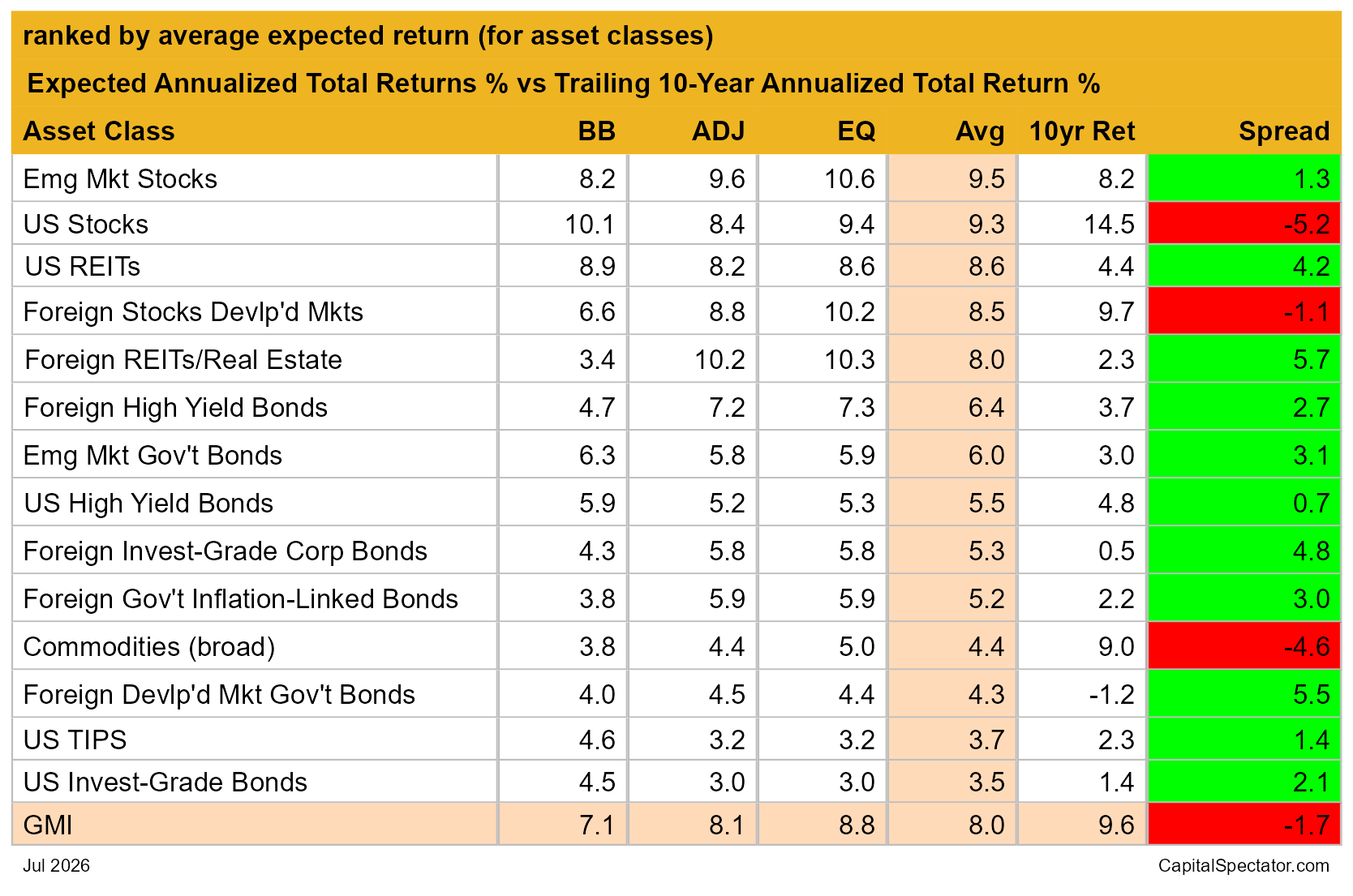
The expected long-term total return for the Global Market Index (GMI) continued to tick higher in May, rising to the highest level in recent history. Although the annualized performance outlook has edged up to a mid-7% forecast, the current outlook remains well below GMI’s realized return over the trailing ten-year window.

GMI is a market-value-weighted mix of the major asset classes (excluding cash) via ETF proxies. Today’s long-run outlook is calculated as the average of three models (defined below). The current 7.6% annualized estimate for GMI ticked up from last month’s estimate, but is still substantially below the trailing 10.1% annualized return that GMI has generated over the past decade.

In line with recent history, about a third of GMI’s components are projected to generate returns below their respective results over the past ten years (indicated by the red boxes in the far-right column below). GMI expected performance is also subpar vs. its trailing ten-year history through May: 7.6% vs. 10.1%.

GMI represents a theoretical benchmark for the “optimal” portfolio that’s suited for the average investor with an infinite time horizon. Accordingly, GMI is useful as a starting point for customizing asset allocation and portfolio design to match a particular investor’s expectations, objectives, risk tolerance, etc. GMI’s history suggests that this passive benchmark’s performance will be competitive with most active asset-allocation strategies, especially after adjusting for risk, trading costs and taxes.

It’s likely that some, most or possibly all of the forecasts above will be wide of the mark in some degree. GMI’s projections, however, are expected to be somewhat more reliable vs. the estimates for its  components. Predictions for the specific markets (US stocks, commodities, etc.) are subject to greater variability compared with aggregating the forecasts into the GMI estimate, a process that may reduce some of the errors through time.

Another way to view the projections above is to use the estimates as a baseline for refining expectations. For instance, the point forecasts above can be adjusted with additional modeling that accounts for other factors and assumptions not used here. Customizing portfolios for a specfic investor, to reflect risk tolerance, time horizon, and so on, is also recommended.

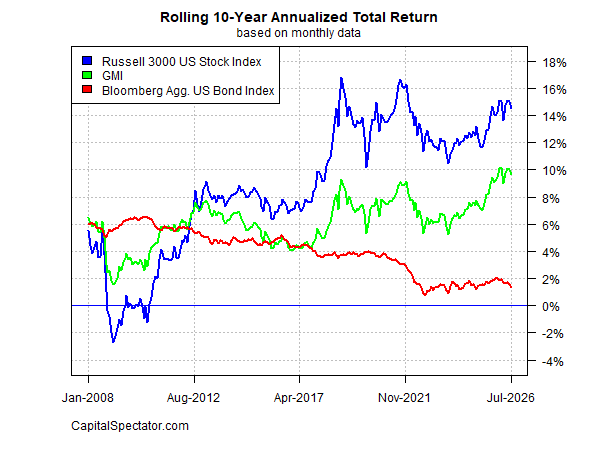
For perspective on how GMI’s realized total return has evolved through time, consider the benchmark’s track record on a rolling 10-year annualized basis. The chart below compares GMI’s performance vs. ETFs tracking US stocks and US bonds through last month. GMI’s current return for the past ten years is a robust annualized 10.1%.

Here’s a brief summary of how the forecasts are generated and definitions of the other metrics in the table above:

BB: The Building Block model uses historical returns as a proxy for estimating the future. The sample period used starts in January 1998 (the earliest available date for all the asset classes listed above). The procedure is to calculate the risk premium for each asset class, compute the annualized return and then add an expected risk-free rate to generate a total return forecast. For the expected risk-free rate, we’re using the latest yield on the 10-year Treasury Inflation Protected Security (TIPS). This yield is considered a market estimate of a risk-free, real (inflation-adjusted) return for a “safe” asset — this “risk-free” rate is also used for all the models outlined below. Note that the BB model used here is (loosely) based on a methodology originally outlined by Ibbotson Associates (a division of Morningstar).

EQ: The Equilibrium model reverse engineers expected return by way of risk. Rather than trying to predict return directly, this model relies on the somewhat more reliable framework of using risk metrics to estimate future performance. The process is relatively robust in the sense that forecasting risk is slightly easier than projecting return. The three inputs:

* An estimate of the overall portfolio’s expected market price of risk, defined as the Sharpe ratio, which is the ratio of risk premia to volatility (standard deviation). Note: the “portfolio” here and throughout is defined as GMI

* The expected volatility (standard deviation) of each asset (GMI’s market components)

* The expected correlation for each asset relative to the portfolio (GMI)

This model for estimating equilibrium returns was initially outlined in a 1974 paper by Professor Bill Sharpe. For a summary, see Gary Brinson’s explanation in Chapter 3 of The Portable MBA in Investment. I also review the model in my book Dynamic Asset Allocation. Note that this methodology initially estimates a risk premium and then adds an expected risk-free rate to arrive at total return forecasts. The expected risk-free rate is outlined in BB above.

ADJ: This methodology is identical to the Equilibrium model (EQ) outlined above with one exception: the forecasts are adjusted based on short-term momentum and longer-term mean reversion factors. Momentum is defined as the current price relative to the trailing 12-month moving average. The mean reversion factor is estimated as the current price relative to the trailing 60-month (5-year) moving average. The equilibrium forecasts are adjusted based on current prices relative to the 12-month and 60-month moving averages. If current prices are above (below) the moving averages, the unadjusted risk premia estimates are decreased (increased). The formula for adjustment is simply taking the inverse of the average of the current price to the two moving averages. For example: if an asset class’s current price is 10% above its 12-month moving average and 20% over its 60-month moving average, the unadjusted forecast is reduced by 15% (the average of 10% and 20%). The logic here is that when prices are relatively high vs. recent history, the equilibrium forecasts are reduced. On the flip side, when prices are relatively low vs. recent history, the equilibrium forecasts are increased.

Avg: This column is a simple average of the three forecasts for each row (asset class)

10yr Ret: For perspective on actual returns, this column shows the trailing 10-year annualized total return for the asset classes through the current target month.

Spread: Average-model forecast less trailing 10-year return.


Major Asset Classes | May 2026 | Performance Review

Most markets continued to rise in May, extending April’s bounce-back after March’s broad and deep selloff, based on a set of ETFs. The main exception among the major asset classes: commodities, which fell sharply, posting the first monthly decline this year.

US stocks led the rally in May: Vanguard Total US Stock Market ETF (VTI) rose 5.2%, the fund’s strongest monthly gain in a year. Developed-market equities ex-US (VEA) posted a solid second-place performance, advancing 4.3% and marking a second-straight monthly increase.

US bonds (BND) edged higher for a second month. Inflation-indexed Treasuries (TIP) also moved higher again in May. Notably, TIP is outperforming the broad US fixed-income benchmark (BND) so far in 2026 by more than a percentage point: 1.7% vs. 0.5%.

The main loser last month: a broad measure of commodities (GSG), which fell 7.5%. Despite the setback, commodities are still the leading performer for the major asset classes, clocking in with a near-38% rally in 2026.

All but one of the major asset classes are posting year-to-date gains. The only red ink on the ledger for 2026: governments bonds in developed markets ex-US (BWX) are off 0.9% for the year.

The Global Market Index (GMI) rallied again in May, rising 4.1% and extending its winning streak to 13 of the past 14 months.  GMI is an unmanaged benchmark (maintained by The Capital Spectator) that holds all the major asset classes (except cash) in market-value weights via ETFs and serves as a competitive benchmark for globally diversified, multi-asset-class portfolio strategies.


Off the Grid, Italy Edition…

The Capital Spectator is taking an extended Memorial Day holiday and trading NJ for Italy for the week ahead. Postings will be light to (probably) non-existent during the interim. The US-based routine resumes again on June 2. Ciao!

Book Bits: 23 May 2026

Yuppies: The Bankers, Lawyers, Joggers, and Gourmands Who Conquered New York
Dylan Gottlieb
Review via The Wall Street Journal
“Violent gentrification” is an eye-catching phrase akin to “Canadian depravity” or “Luxembourgish aggression.” If it exists, it isn’t obvious. In “Yuppies: The Bankers, Lawyers, Joggers, and Gourmands Who Conquered New York,” Dylan Gottlieb does his best to alarm readers about his subject and their nefarious doings, such as moving into dicey neighborhoods and turning them into havens for fragrant bakeries and adorable cafes.
The term “yuppie” is as closely tied to the 1980s as “hippie” is to the ’60s. Young urban professionals have usually been discussed in comic terms, by such writers as Tom Wolfe and P.J. O’Rourke, with gentle mockery or even wry affection. Mr. Gottlieb, a professor of history at Bentley University, produces nearly 300 pages on the topic without a trace of humor, except in quotation.

The Almighty Dollar: 500 Years of the World’s Most Powerful Money
Brendan Greeley
Interview with author via Marketplace.org
When it comes to the global financial system, you can’t really beat the dollar. It’s the dominant global reserve currency, making up over half of the foreign reserves held by central banks around the world. But how did the dollar become so important?
While you could say it goes back to the 1944 Bretton Woods Conference, the answer might predate that. In his new book, “The Almighty Dollar: 500 Years of the World’s Most Powerful Money,” journalist and financial history academic Brendan Greely suggests the dollar’s rise is partially due to the philosophy of money and also the history of the American banking system.
“To understand why American bank dollars had value, we have to go back a little farther [than Bretton Woods],” said Greeley. “We had banking panics every 15 years or so in the 19th century. After each one of these banking panics, we end up with regulation.”

How to Rule the World: An Education in Power at Stanford University
Theo Baker
Summary via publisher (Penguin Press)
From Theo Baker, winner of the George Polk Award for his investigation that brought down Stanford’s president, comes a revelatory and gripping account of Silicon Valley hubris. Slush funds. Shell companies. Yacht parties. This is life for Silicon Valley’s favored teenagers. Seventeen-year-old Theo Baker showed up for freshman year at Stanford University as a tech-obsessed coder. It seemed like paradise. There were Rodin sculptures next to nuclear laboratories and inventors lounging with Olympians. But Baker soon discovered a culture that embraced corner-cutting, that vested infinite excess and access in the hands of kids with few safeguards to catch bad behavior. Stanford, he realized, was less a school than a business.

Steve Jobs in Exile: The Untold Story of NeXT and the Remaking of an American Visionary
Geoffrey Cain
Excerpt via Vanity Fair
“I’m asking Steve to step down,” Apple CEO John Sculley told the company’s board of directors, “and you can back me on it . . . or you’re going to have to find yourselves a new CEO.”
It was April 11, 1985, and long-simmering tensions between John Sculley and Steve Jobs had finally erupted. It marked a stunning reversal. Just two years earlier, Steve had handpicked and personally recruited John from PepsiCo. Apple had grown into a billion-dollar company, and Steve, along with the board, felt that John would be the right person to provide the company with “adult supervision” as its CEO. After John joined, Steve remained chairman of the board and head of the Macintosh unit, where he led the development of the company’s flag- ship personal computer.

Please note that the links to books above are affiliate links with Amazon.com and James Picerno (a.k.a. The Capital Spectator) earns money if you buy one of the titles listed. Also note that you will not pay extra for a book even though it generates revenue for The Capital Spectator. By purchasing books through this site, you provide support for The Capital Spectator’s free content. Thank you!

Headline Inflation Surges, but Core Measures Keep the Fed on Hold

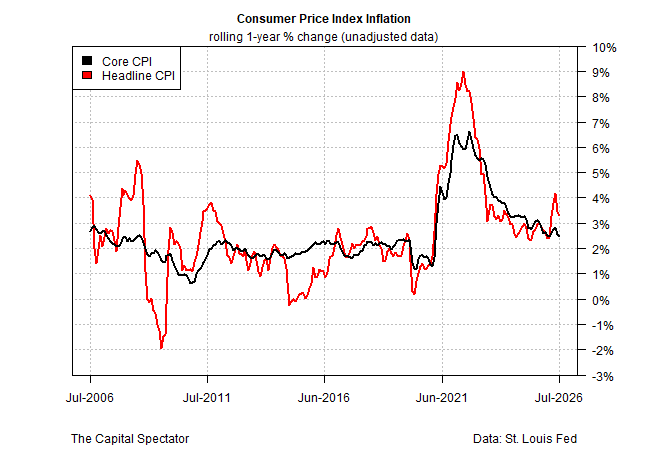
Inflation has climbed in the wake of the energy shock stemming from the Middle East, and economists expect the upward pressure to persist in the months ahead. The Federal Reserve is monitoring the data closely, but it left interest rates unchanged at its most recent policy meeting late last month. The Fed funds futures market is still assigning high odds to the Fed holding steady at the next several meetings. The question now is how high inflation will rise before the central bank feels compelled to resume rate hikes.

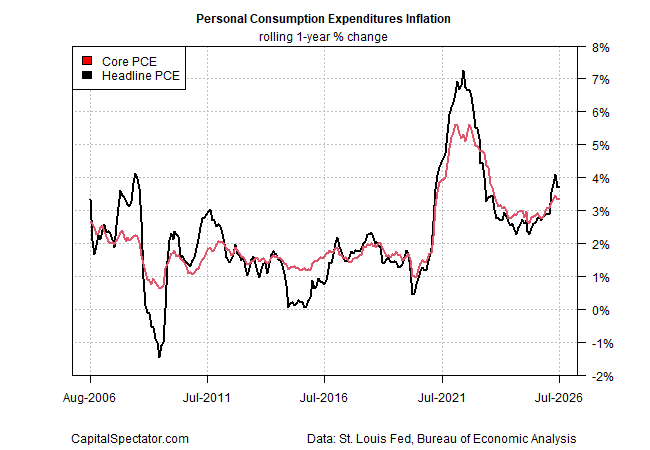
One reason the Fed prefers to wait before tightening policy is the relatively stable pace of inflation in the so‑called core measures of pricing pressure. Although headline inflation—which includes food and energy—has turned sharply higher since the war began, core measures have remained comparatively steady.

The case for central banks focusing on core inflation is that these measures provide a more reliable read on underlying trends, offering a more practical benchmark for setting monetary policy. Not everyone agrees with this approach, but as long as core inflation remains stable, the Fed can argue that additional rate hikes aren’t yet warranted.

The Fed reportedly emphasizes the core Personal Consumption Expenditures (PCE) Price Index, which tracks changes in the price of goods and services purchased by households, excluding the more volatile categories of food and energy. But several variations of core inflation exist, and monitoring a range of alternatives can provide a clearer sense of how conditions are evolving—and how those changes may influence the timing of future rate increases.

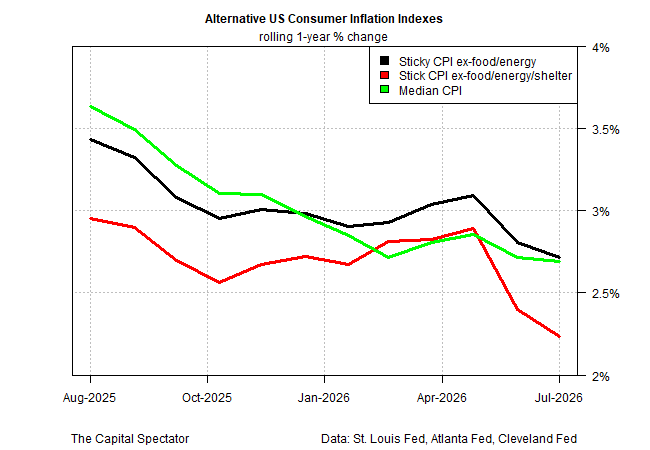
For context, the chart below highlights the median year‑over‑year change for six core inflation indexes. Each index has its own strengths and weaknesses—see the links at the end of this article for details. It’s debatable whether any single measure is superior, so tracking the median is a useful starting point. In April, the median rose to 2.82% from a year earlier, still close to the softest pace in recent history.

The main takeaway is that while core inflation edged higher in April, the broader trend has yet to flash a warning—unlike the sharper increases seen in headline inflation.

It remains unclear when, or if, the Fed will begin raising interest rates in response to the ongoing energy shock from the Middle East. But if the core measures shown above continue to drift higher, pressure for tighter policy will almost certainly grow.

Sticky Price Consumer Price Index less Food and Energy

Median Consumer Price Index 

Trimmed Mean PCE Inflation Rate

16% Trimmed-Mean Consumer Price Index

Consumer Price Index less Food and Energy

PCE less Food and Energy


US Growth Nowcast for Q2 Holds Firm as Inflation Risks Mount

US economic growth remains on track to post a modestly stronger increase in the second quarter compared with Q1, according to the median nowcast from a set of estimates compiled by CapitalSpectator.com. Despite heightened inflation risks stemming from the Middle East energy shock, output appears relatively resilient so far for GDP in the current quarter.

Today’s update of the median Q2 nowcast indicates real (inflation-adjusted) growth of 2.4%, moderately above Q1’s 2.0% advance. If accurate, the Q2 report (scheduled for July) will reflect a continued, albeit modest, recovery following the weak gain in Q4.

Today’s estimate is slightly above the previous median nowast: 2.2%, published on May 11.

Economists at the Royal Bank of Canada write: “The energy shock isn’t likely to trigger a US recession in 2026,” noting that “the set of indicators used by the National Bureau of Economic Research to identify recessions is not flashing red. Yes, some segments suggest caution, but more recent data—including payroll growth, industrial production, and retail sales—are accelerating, while the unemployment rate is holding steady.”

The main caveat is that it is still early to fully assess the inflation risk from the supply‑side energy shock, which continues to reverberate across the global and US economies.

Minutes from the most recent Federal Reserve policy meeting reveal that a majority of Fed officials discussed the possibility of interest rate hikes if the Iran war continued to raise inflation. Although members of the Federal Open Market Committee differed on how long the conflict might last and how much inflation risk it could pose, “a majority of participants highlighted, however, that some policy firming would likely become appropriate if inflation were to continue to run persistently above 2 percent.”

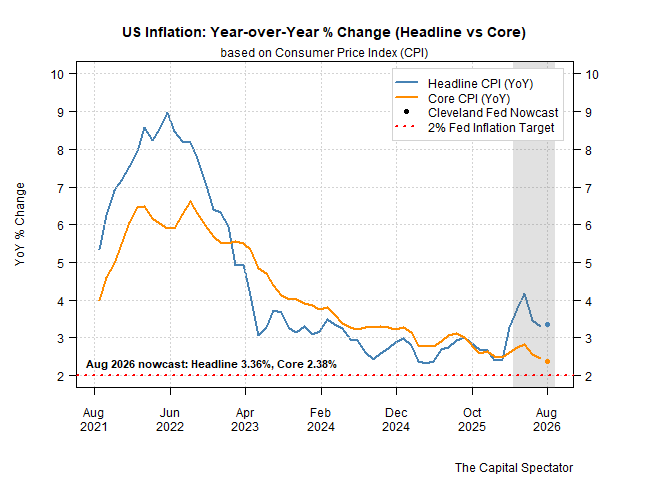
Last week’s consumer inflation report for April showed a second consecutive month of hotter pricing pressure. Headline CPI’s year‑over‑year increase accelerated to 3.8%, a three‑year high and further above the Fed’s 2% inflation target.

Inflation is expected to rise further, according to a survey of economists published by the Philadelphia Fed last week. Headline CPI is projected to briefly spike to 6.0% in the second quarter before easing later in the year.

If the Fed raises interest rates to combat inflation, the policy shift could create a new headwind for the economy. So far, those headwinds appear mild, based on cuerrent headline GDP estimates for Q2. But with Gulf energy exports still blocked, and no resolution expected in the immediate future, the extent of inflation risk—and how the economic effects will unfold in the months ahead—remains uncertain.

Is Recession Risk Rising? Monitor the outlook with a subscription to:
The US Business Cycle Risk Report
Real Yields Near 20-Year Highs As Energy Shock Continues

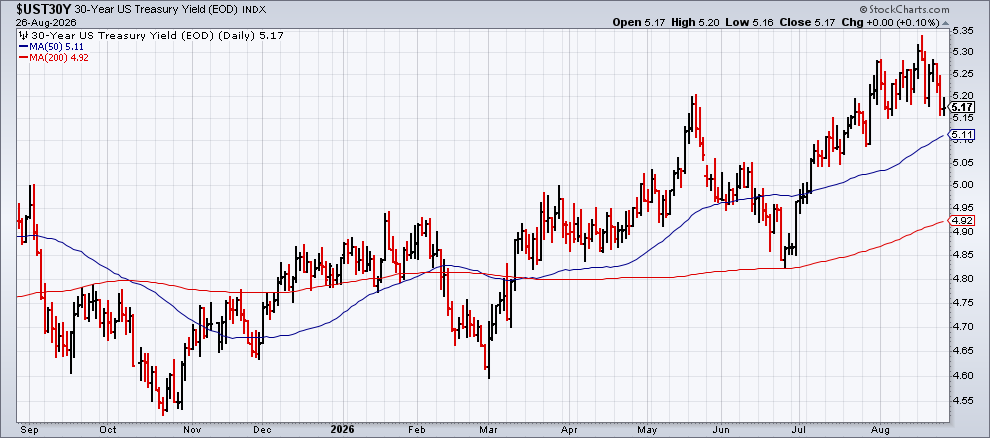
The 10‑year real US Treasury yield is hovering near a 20‑year high, with the 5‑year not far behind. Whether this is a good moment to lock in inflation‑indexed yields may hinge on how the Gulf crisis evolves in the months ahead.

The recent surge in Treasury yields has strengthened the case for holding bonds, and real yields are no exception. After years of volatility—including a plunge into negative territory during the pandemic followed by a sharp rebound driven by the Federal Reserve’s rate hikes—real yields are now back in ranges last seen two decades ago. The 10‑year TIPS yield stands at 2.18%, offering a guaranteed real return if held to maturity.

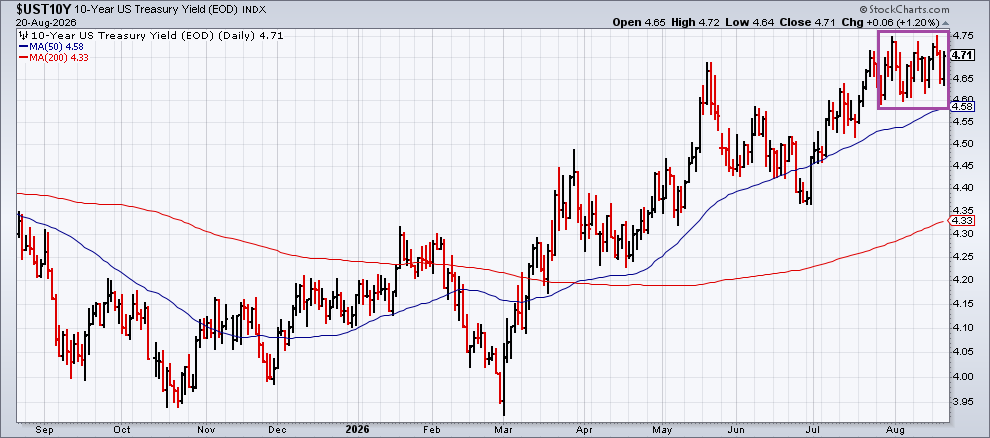
That’s an appealing level by historical standards. For comparison, the nominal 10‑year yield (without inflation protection) reached 4.67% on May 19, implying a market‑based inflation expectation of 2.49%—near a three‑year high, though below the brief 3.0% peak in 2022.

Whether it makes sense to lock in today’s real yields depends on where rates go next, and that path is unusually uncertain. The dominant near‑term driver remains the Middle East crisis.

A rapid resolution that reopens the Strait of Hormuz and restores energy flows would likely ease inflation fears and push yields lower. But that outcome still appears unlikely. Fatih Birol, head of the International Energy Agency, warned Monday that commercial oil inventories are falling quickly, with only weeks of supply left as the Iran war and the Strait’s closure choke shipments. Strategic reserves have helped offset lost exports, but, as he noted, they “are not endless.”

Global inventory data suggests the supply‑demand squeeze will worsen if the stalemate persists, according to a chart from the Financial Times.

Meanwhile, geopolitical tensions remain high. President Trump said Monday he was “an hour away” from ordering new strikes on Iran before Gulf allies urged restraint. Iran’s Revolutionary Guard responded that any renewed attacks by the US or Israel would expand the conflict “beyond the region,” with retaliation in “places you cannot imagine,” according to Mehr News.

In a worst‑case scenario—renewed war, higher energy prices, and rising inflation—the bond market would likely demand an even higher risk premium, pushing yields up further. In a best‑case scenario—de‑escalation and resumed exports—yields could fall.

Given the uncertainty in the current climate, it’s difficult to predict the path ahead with confidence. That argues for a balanced approach: allocating part of a bond portfolio to TIPS to capture elevated real yields while keeping some cash available to respond to further market stress.

Unless one is unusually confident about both the outcome and timing of events in the Middle East, hedging across multiple scenarios has rarely looked more sensible.

Is Recession Risk Rising? Monitor the outlook with a subscription to:
The US Business Cycle Risk Report
Rising Misery Index Signals Mounting Economic Pressure

Economic headwinds continue to reverberate from the conflict in the Middle East, but the US economy has proven relatively resilient in the wake of this macro shock. How long that resilience lasts is unclear, but the pressures are building. That’s a worrisome sign as the stalemate between the US and Iran continues and energy exports from the Gulf remain blocked.

A useful proxy for estimating the potential for economic fallout is the so‑called Misery Index, which combines the inflation rate with the unemployment rate—a measure of the economic well‑being of the average consumer. By this benchmark, the war’s blowback is rising. April’s sum of the one‑year change in the consumer price index and the jobless rate rose to 8.1%, the highest in three years.

All of the recent upturn is due to hotter inflation over the past two months. The unemployment rate, by contrast, has remained steady at a modest 4.4%. Inflation appears likely to trend higher as the supply‑side energy shock continues, and so even a modest increase in the jobless rate could intensify the Misery Index’s increase this summer.

For now, another bullet has been dodged this week. President Trump said Monday that he had canceled what he described as a planned US strike on Iran scheduled for Tuesday. He explained that he halted the operation because “serious negotiations” were underway toward a peace agreement that he claimed would satisfy the United States and its Middle Eastern partners. Yet the very fact that a military attack was being prepared—and called off only at the last moment—underscores how far the two countries remain from any durable resolution.

Unsurprisingly, inflation is expected to trend higher in the upcoming report for May. The Cleveland Fed’s nowcast indicates that headline CPI will top 4% for the annual change for this month. Assuming the jobless rate holds steady, the CPI nowcast points to another rise in the Misery Index for May.

Optimists can point to core CPI, which has increased at a much softer pace, ticking up to 2.7% for the year through last month. The Federal Reserve pays more attention to core inflation metrics, which tend to provide a more robust measure of inflation’s trend compared to noisy headline indexes.

The problem is that while core CPI gives the Fed space to maintain a wait‑and‑see position on whether to tighten monetary policy, consumers are already feeling the pain of the war’s effects. In today’s hyper‑charged political climate, it’s an open question whether central bankers will remain immune to events on Main Street.

The recent history of the Misery Index suggests there are limits to that immunity. In 2021 and 2022, the index was soaring, peaking at 12.6% in May 2022, two months after the Fed started hiking interest rates.

The current Misery Index is still well below the previous peak, but the gap is narrowing, and the geopolitical news from the Gulf suggests more of the same is coming in the near term. History doesn’t repeat, but it’s getting easier to argue that it’s starting to rhyme… again.

Is Recession Risk Rising? Monitor the outlook with a subscription to:
The US Business Cycle Risk Report
As Inflation Heats Up, the Bond Market Loses Its Cool

The bond market will be the center of attention for investors this week as they assess how much inflation risk is lurking. Official reports already highlight accelerating pricing pressures, driven by Middle East turmoil that has lifted energy costs and raised headline measures of inflation. The debate is whether the run‑up in inflation is temporary or reflects a shift that will persist. Bound up with that question is how the Federal Reserve should respond.

The Treasury market has already decided that tighter monetary policy is necessary. The policy‑sensitive 2‑year yield soared last week, rising above 4.0% for the first time in nearly a year. The jump is a sign that the bond market expects a hawkish pivot from the Fed.

For a clearer view of how market conditions have changed, the chart below shows the spread between the 2‑year yield and the effective Fed funds rate (the volume‑weighted median of overnight Federal funds transactions). This gap has increased to a three‑year high—nearly half a percentage point.

The Capital Spectator’s rough estimate of current Fed policy suggests a neutral stance, based on a simple model that compares the target rate to unemployment and inflation—the two components of the central bank’s dual mandate. A month ago, the estimate indicated that policy was slightly tight. The key takeaway: ongoing inflation risk appears set to shift policy into a dovish stance, assuming the Fed continues to leave rates unchanged.

Fed funds futures are still pricing in high odds of no change for the next several policy meetings. The highest confidence for standing pat applies to the upcoming June 17 FOMC meeting—futures are estimating a 99% probability of keeping rates steady. A 90‑plus percent probability of no change is currently assigned to the July meeting.

The tension between the 2‑year yield and expectations for Fed funds will be closely monitored in the days and weeks ahead. A capitulation on one side or the other would be notable, although analysts seem to be leaning toward the view that expectations for a Fed rate hike are building.

“I do think there is a real fear that inflation is kind of embedded in the economy going forward,” said Peter Tuz, president of Chase Investment Counsel in Charlottesville, Virginia.

“A new inflation regime awaits [Kevin] Warsh,” the new Fed chief, writes Joseph Brusuelas, chief economist at RSM US.

“The fact that we are now seeing data backing up inflationary fears that have been in the market since the Middle East conflict started is key,” said Nick Twidale, chief markets analyst at ATFX Global.

A repricing of Fed funds futures to reflect the shift in sentiment may prove to be the decisive factor prompting a capitulation by the doves.


Book Bits: 16 May 2026

The New Money Strategy: The Modern Guide to Rational, Long-Term Investing
Brandon van der Kolk
Summary via publisher (Wiley)
The New Money Strategy: The Modern Guide to Rational, Long-Term Investing is the ultimate strategy guide to help a new generation of investors harness the power of value investing and the stock market. In this book, Brandon van der Kolk, founder of the popular New Money YouTube channel with more than one million dedicated subscribers, reveals the common mistakes people are making in the markets today and the time-tested strategy to build long term wealth.

Moral Economics: From Prostitution to Organ Sales, What Controversial Transactions Reveal About How Markets Work
Alvin E. Roth
Interview with author via Critical Mass podcast
Alvin Roth is a Nobel Prizewinning Economist whose work on designing markets has had real world impacts that may have saved thousands of lives around the world, while arousing strong emotions both for and against the programs he has helped put in place. Clearly not one to shy away from controversy, he represents the best of what The Origins Project is trying to promote: applying science and reason to public policy. In short, connecting science and culture! Roth’s new book, which is fantastic, and comes out the same day this podcast is released deals with issues that often raise the public’s ire, from legalizing prostitution, to assisted suicide, and finally to a rational market for kidney transplants.

Founder’s Fire: From 1776 to the Age of Trump
Arthur Herman
Review via The Wall Street Journal
This year is dedicated to the 250th anniversary of the birth of the United States. Most historians are concentrating on the birth itself, when 13 disparate colonies along the east coast of North America declared their intention to separate from Great Britain. That, to be sure, is quite a story, one without previous precedent. So is the story of the Constitutional Convention a few years later, which produced what is now the world’s oldest constitution of a complex sovereign state, amended only 27 times.
In “Founder’s Fire” Arthur Herman—whose books of popular history include “How the Scots Invented the Modern World” (2001)—gives these stories their due. But Mr. Herman sees a bigger picture here. He argues, in this entertaining and enlightening book, that the spirit—the fire—that drove the Founding Fathers to risk everything to establish something very new has animated this country ever since.

The Art and Business of Professional Trading
Ryan Wright
Summary via publisher (Wiley)
The library of trading literature falls into three largely useless categories. Pop-psychology books focus on mindset and discipline, but psychology is downstream of process. If you lack edge, no amount of mental work saves you. Paint-by-numbers manuals promise certainty through precise setups and mechanical rules, but in an adversarial, reflexive market, widely-known patterns become traps, and the playbook becomes a liability. Academic tomes provide mathematical rigor disconnected from the reality of execution under uncertainty. The Art and Business of Professional Trading occupies the void between them. It is what has been missing for the ambitious trader ready to move beyond hobbyist speculation and think with the rigor of an institutional desk.

Legacy on the Line: Overcome Blind Spots to Grow and Transfer Your Wealth
Andrea Baumann Lustig
Summary via publisher (Wiley)
In Legacy on the Line: Overcome Blind Spots to Grow and Transfer Your Wealth, sixth-generation wealth adviser and Managing Partner of Fischer Stralem Advisors, Andrea Baumann Lustig shares 30 years of insights working with families to help build and transfer wealth. With the largest wealth transfer in history—$124 trillion—underway, many families risk losing their legacy not through lack of resources, but through unexamined beliefs that quietly undermine their financial future. This book reveals 10 common blind spots that sabotage legacy planning—convictions so deeply held they go unchallenged, often leading to missed opportunities, increased risk, and unnecessary costs.

Please note that the links to books above are affiliate links with Amazon.com and James Picerno (a.k.a. The Capital Spectator) earns money if you buy one of the titles listed. Also note that you will not pay extra for a book even though it generates revenue for The Capital Spectator. By purchasing books through this site, you provide support for The Capital Spectator’s free content. Thank you!

Factor Extremes: Momentum Runs Hot as Low-Vol Stumbles

The US stock market surged to yet another record high on Thursday, a new milestone that suggests a rising tide is lifting all equity sectors. Yet reviewing the market through a risk-factor risk lens tells a more nuanced story, revealing a wide dispersion of trends that have emerged since the conflict with Iran began on Feb. 28, based on a set of ETFs through yesterday’s close (May 14).

The results suggest that much of the difference between equity-portfolio strategies during the war-regime period can be traced to factor allocations. For example, among the winning strategies of late there’s a good chance that the portfolios have relatively high allocations to the momentum factor, intentionally or otherwise.

The momentum factor is the clear leader, outperforming the rest of the field by a wide margin. The iShares MSCI USA Momentum Factor ETF (MTUM) has surged 21.6% since the attack started nearly three months ago. The next-strongest performer is large-cap growth (IWV) with a 16.3% rally. Both funds are posting sharply higher gains vs. the market benchmark via SPDR S&P 500 ETF (SPY), which is up 9.4% since Feb. 28.

Most equity factors are trailing the broad market (SPY), including one downside outlier. The low-volatility factor has delivered especially poor results since the start of the conflict, which has shifted to a precarious stalemate that continues to block energy exports from the Gulf. The iShares MSCI Minimum Volatility ETF (USMV) has lost 2.3% since Feb. 28.

Despite the headline strength in equities, the widening gap between factor winners and laggards underscores how uneven the market’s internal dynamics have become. Momentum’s dominance and low volatility’s slump suggest investors are rewarding exposure to persistent trends while shunning defensive positioning, even as geopolitical risk remains elevated. That divergence is a reminder that record highs can mask shifting fault lines beneath the surface—fault lines that may matter far more if the current geopolitical stalemate breaks in either direction.

Learn To Use R For Portfolio Analysis
Quantitative Investment Portfolio Analytics In R:
An Introduction To R For Modeling Portfolio Risk and Return

By James Picerno

Treasury Premium Climbs Again, Fueled by Sticky Inflation

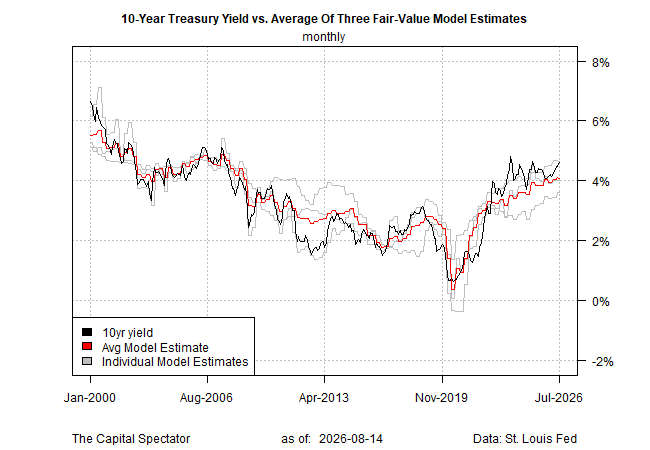
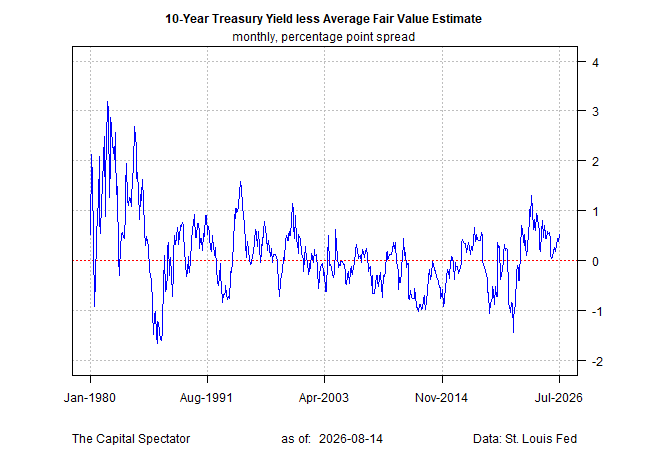
The market premium for the US 10-year Treasury yield over a fair‑value estimate remained modest in April but has been edging higher after falling to a near‑equilibrium level late last year. The threat of higher inflation stemming from the Iran conflict remains a risk factor, though the repricing of the market premium has been modest so far.

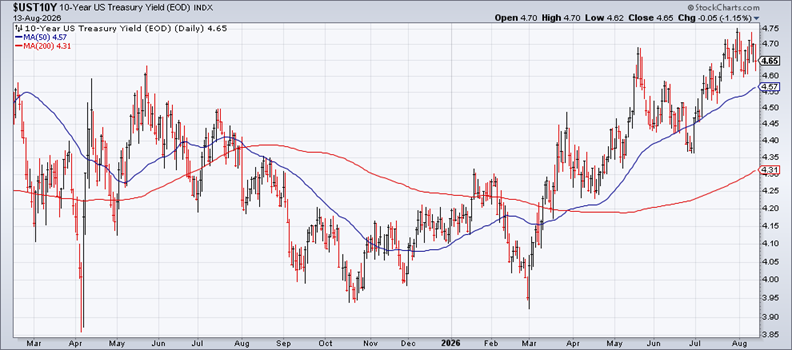
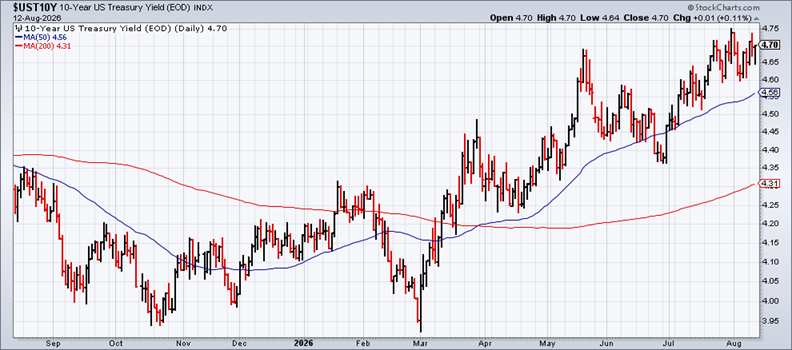
The gradual shift may begin to accelerate in the months ahead as inflation risk moves to center stage in the bond market. The 10‑year yield rose to 4.47% yesterday (May 13), the highest close since last August. The recent upside bias suggests that the pickup in inflation triggered by the Middle East turmoil is starting to alter sentiment for fixed‑income securities.

The Labor Department reported this week that consumer and wholesale inflation continued to post sharp increases in April.

“Inflation is sticky and accelerating. The core reading confirms a deeper structural trend, especially in services,” said David Russell, global head of market strategy at TradeStation. “The Hormuz crisis is aggravating the problem, but this goes way beyond oil.”

The market premium relative to The Capital Spectator’s fair‑value estimate of the 10‑year yield ticked up to 35 basis points last month. That remains modest by historical standards, but if inflation stays elevated—or shows signs of rising further—the premium will likely increase in the months ahead.

What we’ve seen is investors pricing in higher long‑term inflation into what they want to receive from lending to the government,” said Luke Tilley, chief economist at Wilmington Trust.

By late 2025, the surge in the 10‑year premium associated with the 2021–2022 inflation spike had faded to nearly zero. But the calculus is changing as the conflict with Iran continues and threatens to become a protracted affair that keeps Gulf energy exports blocked and inflation elevated.

A quick resolution that allows exports to resume would likely keep the yield premium modest. But with diplomatic efforts at a standstill and US threats to resume military operations if Iran doesn’t compromise, the timeline for an end to the conflict remains unclear. As a result, the yield premium—and interest rates more broadly—appear poised to rise in the near term.

Is Recession Risk Rising? Monitor the outlook with a subscription to:
The US Business Cycle Risk Report
Pages