Feed aggregator

Book Bits: 20 June 2026

The Capital Spectator -

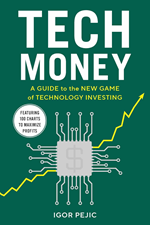
Tech Money: A Guide to the New Game of Technology Investing
Igor Pejic
Summary via publisher (Diversion Books/Simon & Schuster)
A chart-driven, practical guide from award-winning tech-finance expert Igor Pejic that shows investors how to beat the market by mastering the cycles of technology. Technology has redefined the global economy and created trillion-dollar companies at breakneck speed. From AI and blockchain to crypto and Big Tech, fortunes are being made—and lost—every day. But for most investors, figuring out how to ride the next wave remains a mystery. In Tech Money, Igor Pejic—internationally recognized expert on the intersection of technology and finance—provides a clear, evidence-based roadmap. Through 100 carefully curated charts, Pejic explains how to recognize and realize “technology alpha”: the outsized returns generated by tech-driven investments. He demonstrates how to distinguish winners from hype, identify the sweet spot in the technology life cycle, and manage the risks of volatile sectors.

The Financial Revolution: Creating Prosperity with a Cloud-Based Financial System
John C. Edmunds
Summary via publisher (Palgrave Macmillan/Springer)
Ordinary people can now create engaging and remunerative activities on platforms in the cloud. These activities can coexist harmoniously with traditional financial relationships, broadening economic inclusion and fostering upward mobility. The book examines how individuals with minimal computer skills can access financial services and manage money that is both invisible and untraceable. It shows how cloud-based financial platforms can facilitate economic activity in remote areas, boosting employment without attracting regulatory attention. This new, low-profile financial activity weakens the grip of repressive governments over citizens’ lives, opening paths to economic empowerment.

Please note that the links to books above are affiliate links with Amazon.com and James Picerno (a.k.a. The Capital Spectator) earns money if you buy one of the titles listed. Also note that you will not pay extra for a book even though it generates revenue for The Capital Spectator. By purchasing books through this site, you provide support for The Capital Spectator’s free content. Thank you!

Data vs. Debate: Will the Bond Market Embrace Warsh’s New Tone

The Capital Spectator -

Maybe he said it to counter expectations that he would be dovish and follow President Trump’s demands for lower interest rates. Or maybe it was simply a clear‑eyed recognition that inflation has been heating up. Whatever the motivation or strategy, Fed Chair Kevin Warsh, in his public debut on Wednesday, said that “This Committee will deliver price stability,” signaling that a hawkish tilt was possible—perhaps even likely—in the near term.

Warsh hedged a bit later in his prepared remarks, though only slightly. Following the widely expected news that the Fed left its target interest rate unchanged, he announced that one of several task forces he has appointed “will examine the drivers of inflation, first principles, and weigh the full range of ideas for delivering price stability in a changing economy.”

The statement on the inflation task force leaves room for debate about the policy implications, given that the new chair has advocated for using “trimmed mean” inflation metrics over traditional measures like Core Personal Consumption Expenditures (PCE). But for now, at least, Warsh leaned hawkish by emphasizing that price stability would remain a priority at the Fed.

Warsh also noted that “inflation has been running well ahead of the Fed’s long‑stated inflation goal of 2%—that’s been going on for more than five years. Persistently high prices are a burden for the American people.”

The Fed chair, in other words, seemed to be laying the groundwork for downplaying expectations for rate cuts in the near term. The Treasury market, however, delivered a mixed verdict.

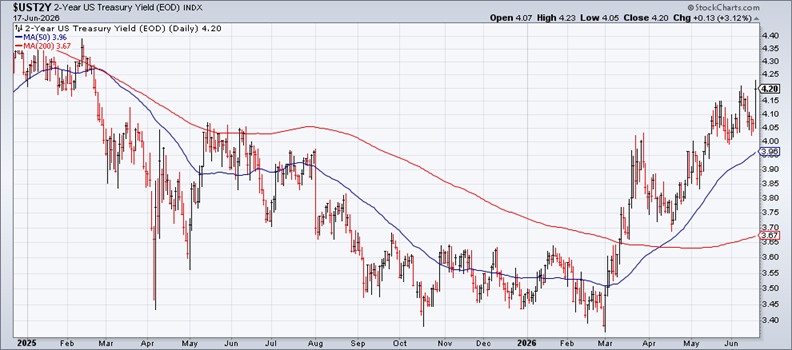
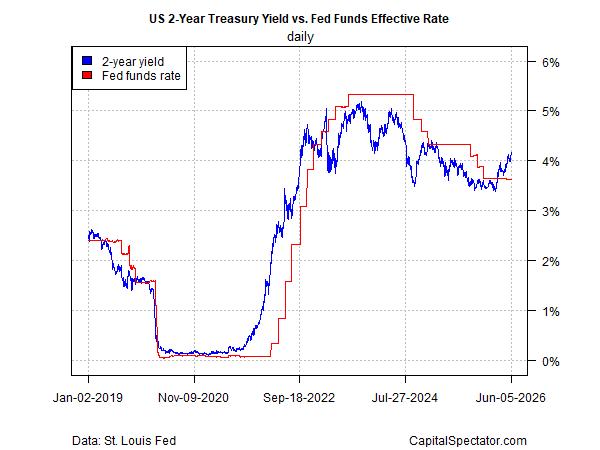
The policy‑sensitive 2‑year yield rose to 4.20% on Wednesday, the highest level in more than two years.

The benchmark 10‑year yield also rose, but at 4.50% remains at a middling level compared with the last several months. Perhaps more crucially, the 30‑year yield—the most inflation‑sensitive maturity—fell, easing to 4.93%, the lowest in over a month.

Fed funds futures are still pricing in odds that favor no change in the Fed’s target rate at the next FOMC meeting on July 29, but they also signal a non‑trivial chance of a 25‑basis‑point rate hike and zero odds of a cut. For the September meeting, the odds skew toward a rate hike.

Regardless of Warsh’s worldview on monetary policy, interest rates are still set by committee. Judging by the new quarterly Summary of Economic Projections (SEP), a hawkish tilt is visible in the updated estimates relative to the March meeting. The committee’s median projection for the Fed funds rate is now 3.8%, up from 3.4% three months ago, and half of FOMC members expect rate hikes at some point this year.

Warsh was careful to avoid outlining where he thought inflation was headed or how the Fed should act. But whatever his leadership style and preferences turn out to be, the FOMC still runs the show.

Yesterday was a triumph for Warsh in that the vote to keep rates steady was unanimous. But the mixed reaction in the Treasury market suggests that navigating the path ahead won’t be easy.

Relief on the inflation front may be coming following the U.S.–Iran peace deal. The question is whether the energy‑fueled surge in headline inflation will continue to spill over into core measures of price indexes.

Warsh may have set a new tone, but the real constraints on policy will come from the incoming inflation data and the bond market’s verdict. No committee, however unified, can force markets to see the world differently. As each data release hits and yields adjust, the Fed will be pushed toward or pulled away from action. In the end, the numbers—not the rhetoric—will decide the path forward.

Is Recession Risk Rising? Monitor the outlook with a subscription to:
The US Business Cycle Risk Report

The Iran Shock Reinvented Tech as the New Safe Haven

The Capital Spectator -

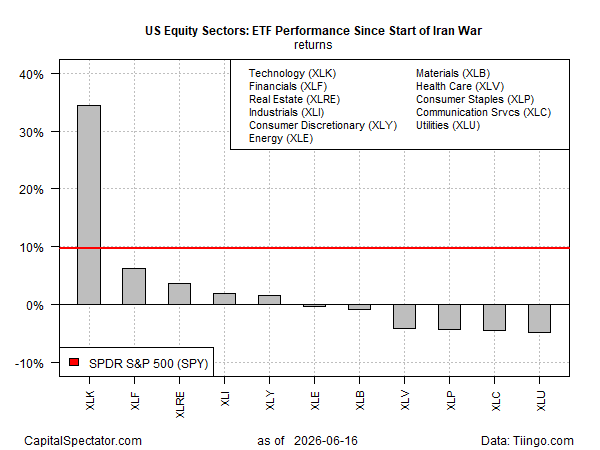
The US–Iran conflict may be over, but the damage to the global economy will linger. For tech investors, however, the war has hardly registered. A review of sector ETFs shows that tech stocks have soared since the attacks on Iran began on Feb. 28, lifting this slice of the US equities market far above the rest of the field.

The SPDR S&P 500 Tech ETF (XLK) has surged nearly 35% during the war through yesterday’s close (June 16), a sharp premium over the broad market’s 9.7% gain over the same period, based on the SPDR S&P 500 (SPY). Notably, every other sector in the S&P 500 has lagged the market since the military strikes commenced. The path to beating the market, in other words, has been all about tech stocks in the extreme during the war.

The results underscore how pre‑war assumptions about defensive strategies have been upended. The idea that tech stocks would offer the safest haven during a spike in geopolitical risk centered on energy and the Middle East is obvious in hindsight, but few investors anticipated it on the eve of the conflict.

Another surprise: the utilities sector (XLU), a traditional safe haven, has suffered the most during the conflict, losing nearly 5%.

The consensus narrative is that tech has outperformed the broader market during the Iran war primarily because investors have treated the sector as a relative safe haven, supported by strong earnings expectations and limited exposure to the spike in energy costs that has been more problematic for other parts of the economy, such as transportation.

Bullish expectations for artificial intelligence have also been a major force behind tech’s resilience, helping the sector outperform even during periods of geopolitical stress. Investors increasingly view AI not just as a long‑term growth theme but as a near‑term earnings engine, and that optimism has supported valuations across hardware, cloud, and semiconductor names.

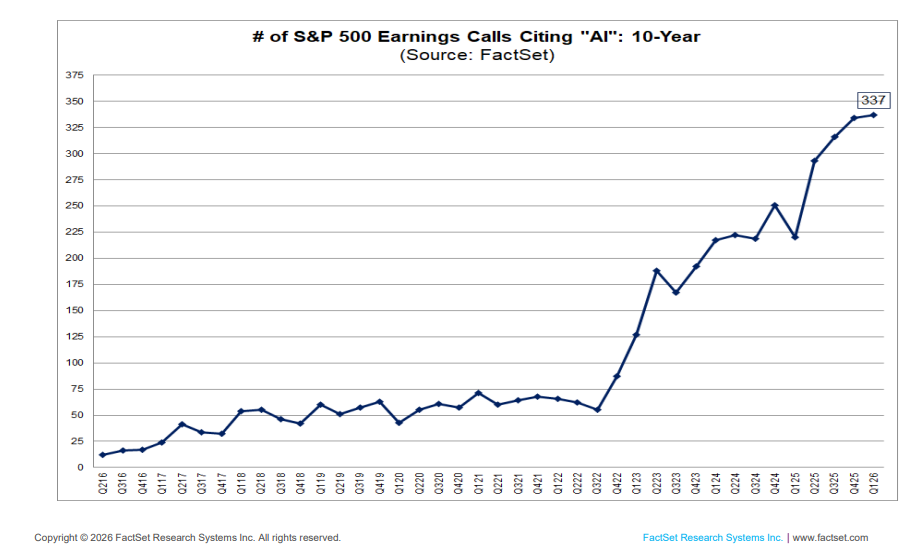
The use of “AI” during recent earnings conference calls highlights the sharp focus on the topic and how it is driving expectations. FactSet reports that “the term ‘AI’ was cited on 337 earnings calls conducted by S&P 500 companies during this period. This number is well above the 5‑year average of 164 and the 10‑year average of 103.”

The sentiment shift is based on fundamentals, the bulls argue. AI‑driven capital spending and cloud demand are doing the heavy lifting for S&P 500 earnings growth, with the technology sector contributing the overwhelming majority of that strength.

Analysts at LPL Research recently wrote: “As investment in AI ramps up and the market’s confidence in technology’s value increases… the outlook for the technology sector improves. The debate about whether AI will fulfill its promise as a productivity enhancer won’t be settled for quite some time. But what we do know is that massive spending is going to continue.”

Citi’s Scott Chronert agrees, predicting that AI‑driven earnings momentum will continue:

The underlying earnings trajectory for the S&P 500 is moving down a path that is way beyond what we expected headed into this year. Q1 results have set the stage, which should drive further momentum for the remainder of this year and into next… Traditional macro models for projecting earnings seem increasingly misplaced as the AI‑inspired spending surge is manifesting across many sectors.

Skeptics counter that whatever the business merits of AI, expectations have run too hot too fast. “Artificial intelligence may transform the economy over the long term, but investors betting on today’s AI boom should remember the lessons of railways, dot‑coms and every great technological mania before them,” writes Toby Walsh, professor of AI at UNSW Sydney and chief scientist of their AI Institute. “There’s only one way this ends. With the AI bubble bursting.”

Perhaps, but whatever the merits of staying cautious, such advice remains an outlier on Wall Street.

Learn To Use R For Portfolio Analysis
Quantitative Investment Portfolio Analytics In R:
An Introduction To R For Modeling Portfolio Risk and Return

By James Picerno

How to Prepare Financially for Unexpected Expenses

Money Under 30 -

Unexpected expenses rarely arrive at a convenient time. A car can fail before payday. A medical bill can appear after insurance has already paid its part. A water heater can stop working on a weekend, when replacement costs feel even harder to absorb. These moments test more than a budget. They test how much room […]

Warsh’s First Test: Steering the Fed Through a Geopolitical Fog

The Capital Spectator -

The newly minted US–Iran ceasefire is only a day old, but markets reacted positively. Oil prices and Treasury yields fell, and stock prices surged in Monday’s trading. It’s encouraging early vote of confidence, although the economic effects of the war will linger and any rebound in energy exports from the Middle East will be gradual. That’s the best‑case scenario, which assumes that the US–Iran deal holds and inflation starts to ease.

The macro outlook may still be precarious, but the Federal Reserve is expected to leave its target rate unchanged at tomorrow’s policy announcement. The new Fed Chair, Kevin Warsh, will preside over his first FOMC meeting and press conference, where he’ll have a chance to reset the tone for expectations—for good or ill.

“Just given the novelty of the moment, because it’s Warsh’s first press conference, there’s really a lot of scope for what you might call a ‘market misinterpretation’ of his message,” says Kris Dawsey, head of economic research at the D.E. Shaw Group, a hedge fund. “It’s going to take some time for the market to really get calibrated on his communications.”

The Warsh era begins during an unsettled period for central banks. Several of the Fed’s counterparts have started raising interest rates, citing inflation as the catalyst.

The Bank of Japan today lifted its main interest rate to a 31‑year high. “After twenty years of deflation, Japan is now in an inflationary upcycle,” says Japan economist Jesper Koll. The European Central Bank raised interest rates last week for the first time since 2023. “We are beginning to see a broadening of inflation throughout the economy,” ECB President Christine Lagarde said, explaining that a “major energy shock” forced its hand.

The Fed, by contrast, is expected to maintain its wait‑and‑see strategy, effectively betting that the recent run‑up in US inflation will be temporary and begin to recede. Fed funds futures are pricing in near‑certainty that the bank will leave its target rate unchanged tomorrow at a 3.50%–3.75% range. Standing pat is also expected to prevail for the next several FOMC meetings.

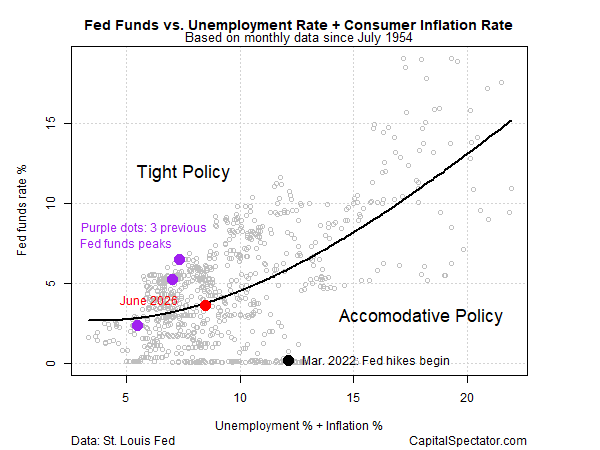
The Fed’s current policy stance is neutral, based on a simple model using inflation and unemployment. That’s a reasonable posture if inflation has peaked and will start to ease in the months ahead. The risk is that the Fed repeats the mistake of 2021–2022, when inflation surged and the central bank was slow to react.

The doves argue that core inflation remains relatively tame and well below the worrisome jump in headline measures, which reflect the sharp increase in energy prices.

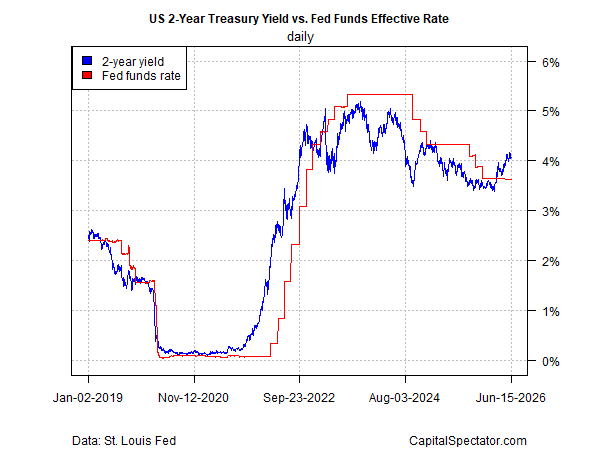
The Treasury market is effectively signaling that the Fed’s cautious approach to rate hikes is wrong. The policy‑sensitive 2‑year yield has climbed far above the median Fed funds rate, which implies expectations for near‑term rate hikes.

Chair Warsh will need to persuade markets that leaving policy steady is still a reasonable course. By contrast, the case for cutting rates—which President Trump has demanded—is far less defensible, if not reckless, at the moment.

The main challenge is that the macro dynamics likely to drive the direction of inflation in the months ahead are beyond the Fed’s power to influence through policy decisions. The key variable is the US–Iran peace deal, which will determine the pace of energy exports through the Strait of Hormuz.

The head of the world’s biggest tanker company says a rebound in shipping through the strait will take weeks at the earliest, as firms decide whether the US–Iran deal is “material,” says Jotaro Tamura, chief executive of Mitsui OSK Lines. Speaking with the FT, he advises:

“What will have to come in place is not just a simple agreement between the relevant countries, but it has to be material and translated into the real situations in the Strait of Hormuz, so that shipping lines can make themselves comfortable to go through.”

By leaving interest rates unchanged at tomorrow’s policy meeting, the Fed is essentially signaling that the Iran conflict is over, energy prices will continue to ease, and the inflationary threat has ended.

Tomorrow’s decision won’t settle the inflation debate, but it will set the tone. The Fed is betting on stability—now the world has to deliver it.


The Real Cost of Divorce for Young Couples: What to Budget Before You File

Money Under 30 -

Divorce is rarely just emotional. For many young couples, it’s also the first major financial disruption they’ve had to navigate as adults. You may already expect legal costs, even if you and your former spouse agree. What catches many people off guard are the extra expenses that show up during the process. Setting up a […]

How to Help Your Parents Plan for Long-Term Care Without Going Broke

Money Under 30 -

Watching your parents age is hard enough without worrying about paying for their care. Long-term care can drain a family’s savings in months. Planning now can protect your parents’ financial security and give you peace of mind when you need to make decisions quickly. Start Discussing a Long-Term Care Plan Ignoring the financial reality of […]

The Strait Reopens: A Turning Point or a Temporary Truce?

The Capital Spectator -

A newly extended U.S.–Iran ceasefire and the reopening of the Strait of Hormuz are fueling cautious speculation that the conflict may be entering its final phase. The news will likely give financial markets a boost in the near term, assuming the agreement that the U.S. and Iran announced on Sunday holds.

Oil prices are already reflecting optimism. The U.S. benchmark is trading under $80 a barrel today for the first time in three months after President Trump and Iran’s Supreme National Security Council said a deal was reached to end the fighting and lift the blockades of the Strait of Hormuz that have prevented energy exports from the Gulf.

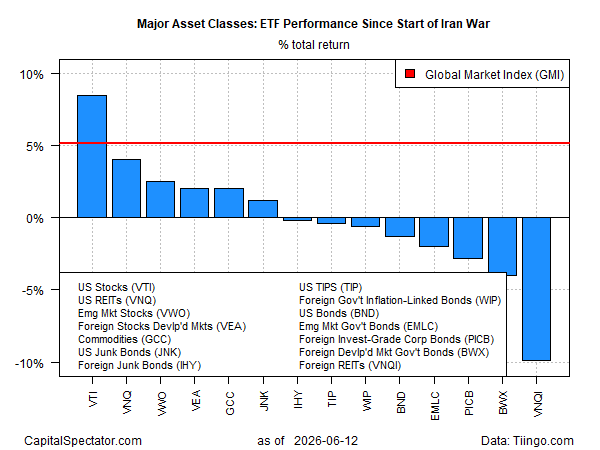
The major asset classes begin trading today with a wide range of performance results since the war started on Feb. 28. Using a set of ETFs highlights that U.S. equities (VTI) have been the performance leader, jumping nearly 8% since the conflict began. Global property shares ex‑U.S. (VNQI) have suffered the most among the major asset classes, slumping 10%.

The Capital Spectator’s Global Market Index (GMI) took a hit early in the war but began recovering in early April and has extended the rally to post a 5.2% gain over the course of the conflict. GMI is an unmanaged, market‑value‑weighted mix of the major asset classes (excluding cash) via ETF proxies and represents a competitive benchmark for globally diversified, multi‑asset‑class portfolio strategies.

A potential end to the U.S.–Iran conflict offers opportunity wrapped in uncertainty. If the war is over, the arrival of peace could unlock meaningful economic tailwinds. A durable ceasefire and a reopened Strait of Hormuz would reduce geopolitical risk in one of the world’s most critical energy corridors, easing pressure on oil prices, stabilizing shipping routes, and lowering volatility premiums across global markets. At the same time, the situation remains fragile: past de‑escalations between Washington and Tehran have unraveled quickly, and markets know that a single misstep can reverse gains overnight. It only takes one missile launch or drone attack to shatter expectations.

That combination of possible scenarios — real upside if calm holds, real downside if it doesn’t — is exactly why this moment feels like a rare but risky inflection point. One reason for caution is that the details of the peace deal have not yet been published. “Pre‑implementation discussions” are set for this week, followed by 60 days of technical talks on the thorny issue of Iran’s nuclear program.

Markets will be watching President Trump’s comments — and the reactions — at the G7 summit that starts today in France. For the moment, a new round of cautious optimism gives fresh hope that the biggest energy crisis in decades is now on track to wind down. But the multiple false dawns over the past several months suggest that time will be the ultimate arbiter of whether today’s headlines represent real progress or another display of fool’s gold.

“The global economy has experienced too much whipsawing in the past 100+ days of war to breathe easy based on a deal with no details,” advises Josh Lipsky, vice president and chair of international economics at the Atlantic Council and the senior director of the GeoEconomics Center. “The first test of those details will come as Trump is pressed by French President Emmanuel Macron and others gathered for the [G7] summit. Trump likely wanted to come to the meeting with a deal in place. Now he has set the terms for the leaders meeting — and they will be reacting to him.”

Is Recession Risk Rising? Monitor the outlook with a subscription to:
The US Business Cycle Risk Report

Book Bits: 13 June 2026

The Capital Spectator -

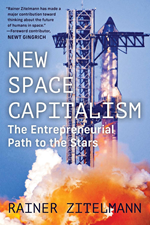
New Space Capitalism: The Entrepreneurial Path to the Stars
Rainer Zitelmann
Review via Real Clear Markets
“Space Economics” has only recently become a thing. Economics is the science of scarcity. Where there is scarcity, there is economics. “Scarcity,” in an economic sense, means that a resource satisfies a human want, but there is not enough of it to satisfy all of those potential wants. So we need to figure out a way to allocate ownership and/or usage rights over the resource. Who gets to use it, how much of it, and in what way?
What counts as a “scarce resource,” in an economic sense, changes over time. It depends, among other things, on our technological possibilities. Oil was not a scarce resource until we figured out how to make use of it: it was just a black liquid which nobody wanted, so the question of how we should allocate property rights over oil wells was not especially relevant. Then oil became “black gold,” and all of a sudden, it mattered hugely.

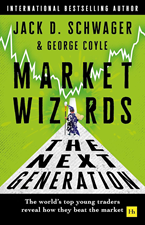
Market Wizards: The Next Generation: The world’s top young traders reveal how they beat the market
Jack D. Schwager and George F. Coyle
Summary via publisher (Harriman House)
Market Wizards: The Next Generation continues in the three-decade tradition of the hugely popular Market Wizards series, interviewing exceptionally successful traders to learn how they achieved their extraordinary performance results. The twist in this latest instalment is that the featured traders have the youngest average age of any book in the series. Despite their relative youth, these traders have achieved performance records that rank among the very best Market Wizards of all time.

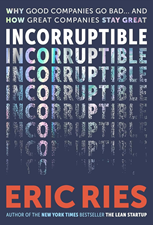
Incorruptible: Why Good Companies Go Bad… and How Great Companies Stay Great
Eric Ries
Interview with author via GeekWire
Eric Ries wants to retire the word “profit,” or at least the way we usually define it.
In his new book, “Incorruptible: Why Good Companies Go Bad and How Great Companies Stay Great,” the “Lean Startup” author redefines profit as the maximization of human flourishing. He argues that a lot of what passes for profit in today’s economy is actually a form of corruption.
“We’re supposed to all pretend that we think all the ways of making money are equally good,” Ries told a room of startup founders at Seattle Flow Startup Day in Seattle. “But nobody actually thinks that.”

The Human Edge: Smarter Decisions in the Age of AI
Cheryl Strauss Einhorn
Summary via publisher (Cornell U. Press)
The Human Edge is a call to action for anyone who wants to lead—and not merely follow—using artificial intelligence (AI) to transform the way we make decisions. But as Cheryl Strauss Einhorn shows, AI can either simplify complex problems or obscure them, expand your thinking or constrain it. With AI becoming more embedded in our work and personal lives, the challenge we face is no longer about using AI—it is about leading AI with clarity, discernment, and a commitment to human agency. This approachable guide for professionals, leaders, and teams who want to make better, more confident choices when using AI systems, offers practical tools to help frame problems and surface solutions, using AI to augment—not replace—your judgment. Urgent, empowering, and grounded in real-world examples, The Human Edge will show you and your organization how to confidently make use of AI’s vast capabilities for smart decision-making by emphasizing the importance of human curiosity, perspectives, values and the courage to define and achieve success.

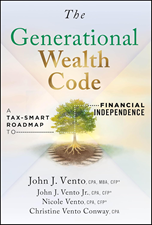
The Generational Wealth Code: A Tax-Smart Roadmap to Financial Independence
John J. Vento, et al.
Summary via publisher (Wiley)
In The Generational Wealth Code: A Tax-Smart Roadmap to Financial Independence, four financial professionals, each with a distinct perspective shaped by their own stage of life and area of expertise, provide actionable guidance that helps you and your family create a legacy of wealth, stability, and opportunity. Stagnant wages, crushing student loan debt, rising housing costs, and record levels of consumer debt have made it harder than ever for families to get ahead—this book helps readers become financially independent so that they can make the most informed decisions in all facets of their lives, and thrive at a time when many are simply trying to survive.

Please note that the links to books above are affiliate links with Amazon.com and James Picerno (a.k.a. The Capital Spectator) earns money if you buy one of the titles listed. Also note that you will not pay extra for a book even though it generates revenue for The Capital Spectator. By purchasing books through this site, you provide support for The Capital Spectator’s free content. Thank you!
Markets Stay Risk‑On Despite Alarming Headlines

The Capital Spectator -

Maintaining a bullish outlook on markets has become an emotionally challenging affair in recent history, but the crowd continues to look through the constant flow of troubling news and concludes that it’s still reasonable to stay the course. Informed or not, that sentiment has been a winning strategy so far, and remains on display in several sets of ETF pairs that track key market segments through yesterday’s close (June 11).

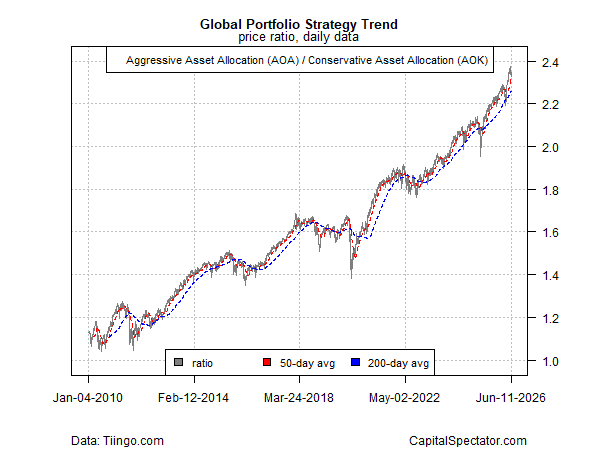
From a global asset‑allocation perspective, an aggressive strategy (AOA) relative to its conservative counterpart (AOK) offers a useful starting point. This broad-based measure of sentiment weakened in the early weeks of the war with Iran but has since recovered and continues to point to a risk‑on bias.

Using the 50‑day/200‑day moving averages as a guide for the AOA:AOK ratio has successfully minimized much of the noise in recent years, albeit with some glaring exceptions. During the correction associated with the tariff tantrum in the spring of 2025, for example, a risk‑off signal was triggered, which ultimately proved to be a false alarm. Since then, this indicator has remained risk‑on as a big‑picture guide, supporting the case for looking through the recent chaotic news flow.

The key takeaway: monitoring metrics such as AOA:AOK, while hardly flawless, are useful starting point for evaluating sentiment, and asking the question: Is there a strong case for betting against the crowd?

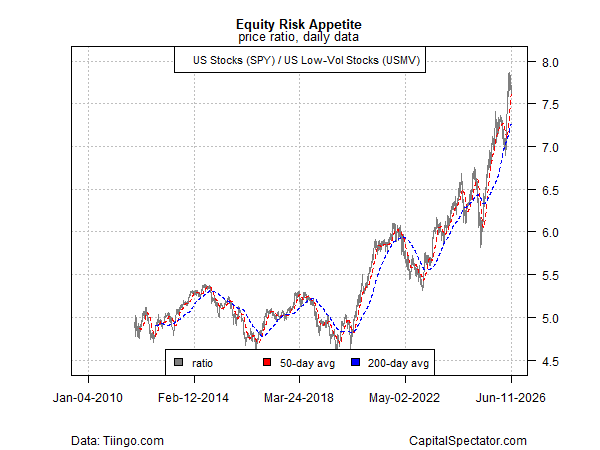
Similarly, monitoring a broad measure of U.S. stocks (SPY) versus a low‑volatility counterpart (USMV)—a proxy for a relatively conservative equity portfolio—shows a continued risk‑on posture this year via the 50‑/200‑day ratio, albeit one that has pulled back from its recent peak.

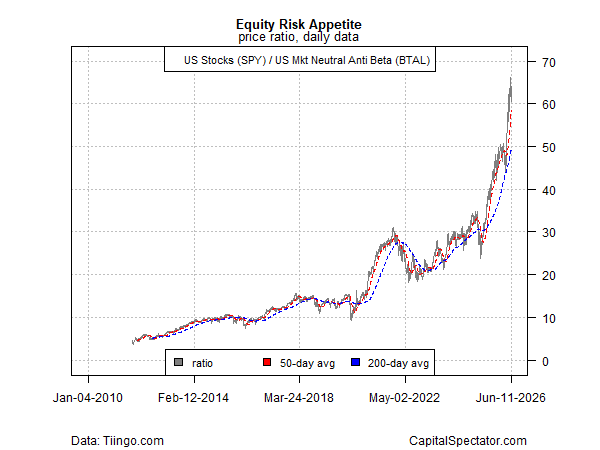
Several other measures of the U.S. equity market reflect even stronger risk‑on signaling, including the comparison between the broad equities market (SPY) and a defensive strategy based on a so‑called market‑neutral anti‑beta fund (BTAL).

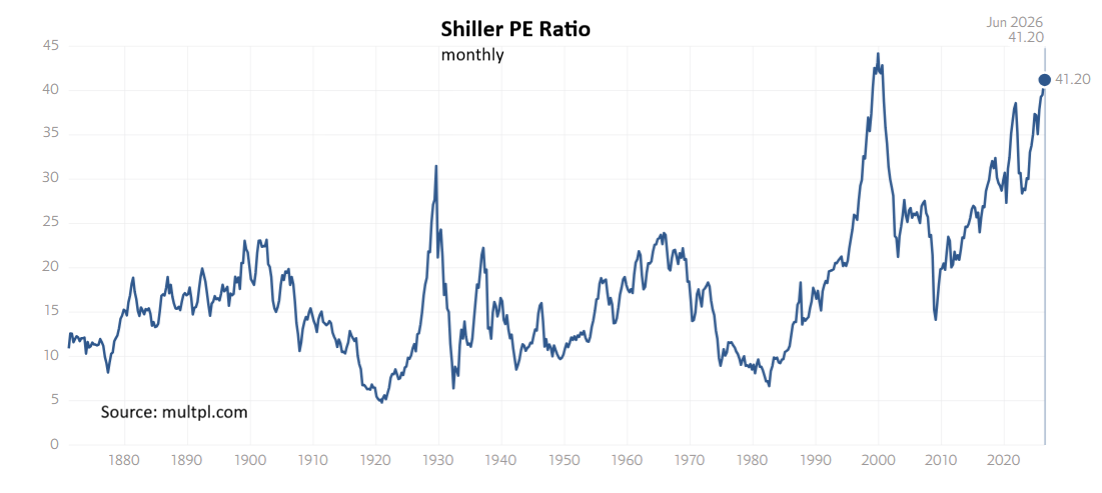
Skeptics of the risk‑on environment can rightly point to several reasons for caution, including high valuations. The Shiller PE ratio, for example, is approaching a record high, implying that the expected return for the U.S. stock market is relatively low.

But trend—however irrational it may appear—isn’t easily dismissed as a forward‑looking indicator. Contrarians argue otherwise, but the track record of trend‑based signals continues to compare favorably—by a wide margin—against bearish forecasts from a variety of models. How long this lasts is unknown, but the odds still seem to favor trend.

The Financial Trade-Offs of Relocating for Career Growth

Money Under 30 -

Relocating for a job puts you in a weird headspace. On one side, there’s everything you know: your apartment, your favorite spots, the people you call when life gets messy. On the other hand, there’s this pull toward something bigger. A better title, a higher salary, a city that actually matches where you want to […]

US 10-Year Yield Risk Premium Continues To Rise

The Capital Spectator -

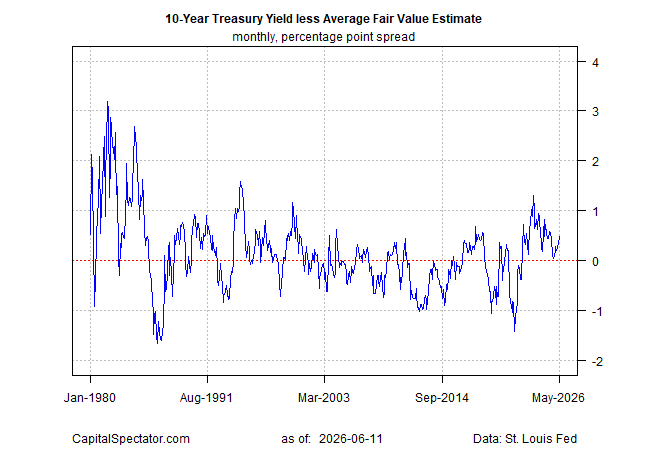
The Iran conflict and rising inflation risk have continued to widen the market premium for the 10‑year yield relative to a fair‑value estimate. As discussed last month, a shift in market sentiment appeared to be unfolding, and today’s update for May underscores the change.

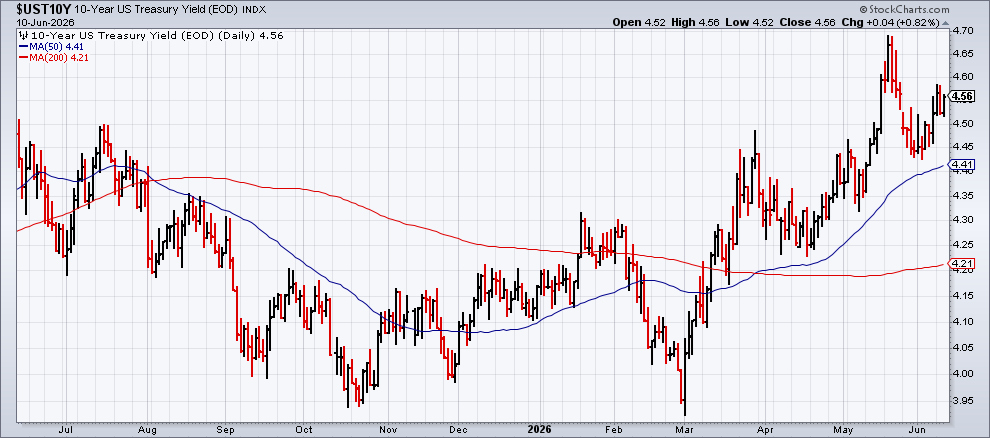
Market conditions have clearly evolved in recent weeks, with the 10‑year yield trending higher and closing at 4.56% in yesterday’s trading (June 10). The current yield is near a 12‑month high.

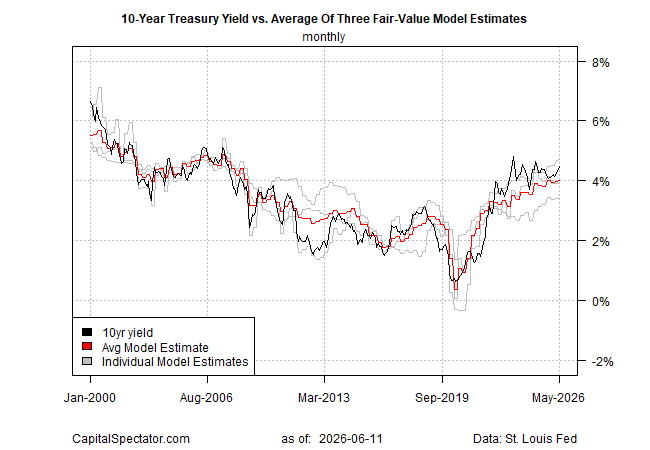
The market premium is also climbing again. The 10‑year yield now stands 48 basis points above a fair‑value estimate, the highest premium since July 2025, based on monthly data through May via The Capital Spectator’s ensemble model.

The reversal in what had been a declining premium is easier to see in the next chart, which tracks the spread for the current 10-year yield less its fair-value estimate.

Before the war began, the market premium had been trending lower, unwinding the surge tied to the pandemic‑era inflation spike. That normalization phase has now reversed as investors reassess the inflation and macro risks associated with the Middle East conflict.

Is Recession Risk Rising? Monitor the outlook with a subscription to:
The US Business Cycle Risk Report

Nowcast Data Suggest US Growth Is Accelerating In Q2

The Capital Spectator -

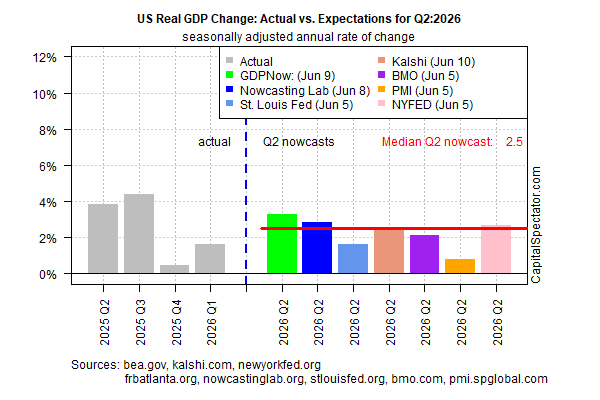
The Middle East crisis appears no closer to resolution, underscored by Tuesday’s US military strikes on Iran. If recent history is a guide, the effects on the U.S. economy will be minimal, as today’s update on nowcasts for second‑quarter GDP suggests.

Growth for the April‑through‑June period continues to track at a 2.5% annualized rate, based on the median nowcast from several sources compiled by CapitalSpectator.com. The estimate points to a pickup in output over Q1’s modest 1.6% increase.

Today’s update is unchanged from last week’s estimate and suggests that the economy continues to accelerate following stall‑speed conditions in Q4, when GDP rose just 0.5%.

The history of the US economy since the war started on Feb. 28 has been a study in resilience. Over the past three months, economic activity has been largely unaffected by the Middle East conflict, with one glaring exception: inflation. It’s unclear whether rising pricing pressure will begin to unleash a deeper round of demand destruction, particularly in the consumer sector, but the effects so far have been modest.

One of the clearest signs of the economy’s strength: US payrolls rose at a robust pace for a third straight month in May.

“I think the job market, for the first time in a while, is moving in the right direction,” says Guy Berger, chief economist at small‑business payroll firm Homebase. “I wouldn’t call this a job market that’s quite ‘booming’—it’s certainly not as hot as the job market in ’21 and ’22—but it’s warming.”

The question is whether inflation will spoil the party in the second half of the year, forcing the Federal Reserve to raise interest rates and take initial steps toward removing the proverbial punch bowl, per the famous analogy by former Federal Reserve Chair William McChesney Martin to describe the central bank’s role in the economy.

Goldman Sachs reports: this week: “Our economists have not yet seen signs that the inflation shock from the war is broadening out — their composite indicator of the risk of more persistent inflation is still at a low level, although a jump in University of Michigan long‑term inflation expectations has pushed it slightly higher.”

The Fed is expected to leave its target rate unchanged at the upcoming meeting later this month, and again in July, based on Fed funds futures. Looking further out is as cloudy as ever and will remain so until something approximating a resolution to the Middle East crisis emerges.

For now, the numbers tell a story of an economy that refuses to flinch. The Q2 nowcast holds firm, signaling renewed momentum even as geopolitical risks swirl. Whether that strength endures into the second half will hinge on inflation’s next move — and on how long global tensions keep the outlook shrouded in fog.


How Economic Calendars Present Inflation and Employment Data

Money Under 30 -

The economic calendar is widely used to track important global financial events that influence economic conditions and market behavior. Among the most significant data presented in such calendars are inflation and employment indicators, and the economic calendar this week highlights how these updates are scheduled and organized in real time. These two categories are essential […]

Safe Havens No More? Treasuries Sink While Riskier Debt Rallies

The Capital Spectator -

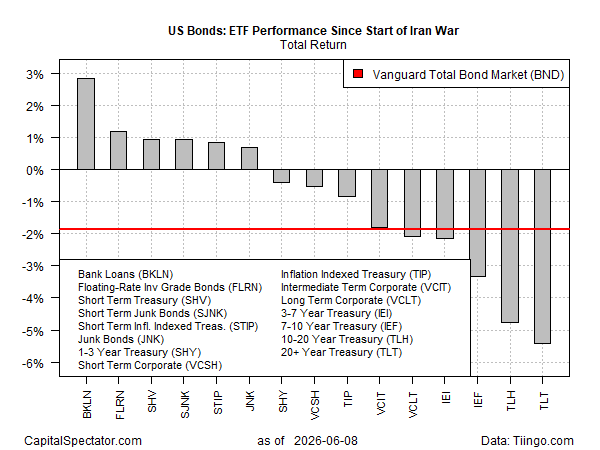
The search for higher yields continues to elevate the riskier facets of the bond market since the Iran conflict started. By contrast, most slices of the Treasury market remain underwater, based on a set of ETFs.

The leading performer by far since the crisis started on Feb. 28 is bank loans. The Invesco Senior Loan ETF (BKLN) is up 2.8% during this period, well ahead of the rest of the field.

The rest of the winners since Feb. 28: floating-rate securities (FLRN), a cash proxy (SHV), standard “junk” bonds (SJNK and JNK), and short-term inflation-indexed Treasuries (STIP). The remainder of the market is nursing losses, led by long Treasuries (TLT), which are currently posting a loss in excess of 5%.

What explains the performance divide? Treasuries are under pressure as inflation concerns lurk due to the run-up in the cost of energy. This spike has raised headline measures of prices and prompted forecasts that the Federal Reserve will be forced to raise interest rates later this year.

That’s hardly a bullish backdrop for fixed-income securities, yet bank loans and junk bonds have managed to post gains. One reason: private credit fundamentals remain strong despite recent market stress, according to Goldman Sachs. Defaults have been low and borrower performance solid. “The fundamentals of private credit still appear strong,” says Vivek Bantwal, global co-head of private credit at Goldman Sachs Asset Management.

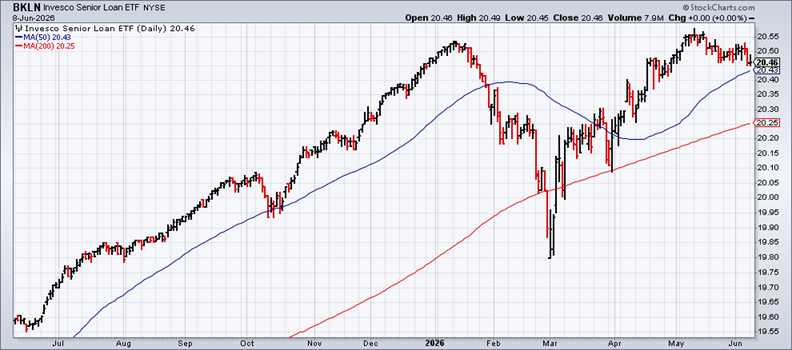
Add in the higher yields and the package has been too good to ignore for investors. BKLN’s distribution yield is 6.61% (as of June 9), or nearly two percentage points above the long-bond’s current yield.

But the easy gains may be in the rearview mirror as the lingering inflationary effects of the Iran conflict continue to resonate. With no easy solutions on the horizon for a crisis that continues to keep Gulf energy exports low, the odds still look slim for a return to pre-war pricing pressure in the near term.

BKLN appears to be pricing in the shifting sentiment, driven by fading optimism for a quick end to the conflict and the macro blowback. The ETF is still comfortably ahead of the field since Feb. 28, but the recent peak looks like a ceiling for the foreseeable future without a material change in the outlook for a resumption in shipping through the Strait of Hormuz.

While markets are currently betting against a prolonged conflict, the latest news flow continues to challenge this forecast for the near term. Despite former President Trump’s calls for restraint, Israel and Iran’s recent strikes suggest that a resolution is still nowhere on the horizon.


Is a Prolonged Middle East Conflict Becoming the Base Case?

The Capital Spectator -

Starting a war is easy; ending one is hard. That simple calculus is increasingly resonating in financial markets as the backlash from the Middle East conflict persists and evolves. The economic effects have varied, but the recent optimism that the US would remain largely insulated is fading. Markets are beginning to demand higher risk premia as compensation.

The latest sign that ending the conflict will be messy and take longer than expected came on Sunday, when Iran and Israel resumed fighting—exchanging missile strikes for the first time since the April cease-fire. President Trump said he would demand that Israel not retaliate, but that effort has failed as renewed fighting continues into Monday. As the Times of Israel reports: “The Israeli military says it is prepared for at least a few more days of fighting against Iran, and potentially a full resumption of the war.”

Unsurprisingly, oil prices spiked, rising 4% in early Monday trading. Crude remains below its peak since the war began on Feb. 28, but a return to pre-war prices looks unlikely anytime soon.

The renewed conflict between Iran and Israel may not be shocking, nor is it likely to radically shift expectations relative to recent history. But this hydra-headed conflict has momentum on multiple fronts, suggesting that the crisis, even if it doesn’t deepen, will endure in one form or another. The macro risk, as a result, is becoming chronic rather than actute.

Depending on one’s view, markets have developed either a degree of acceptance or complacency about the conflict and its macroeconomic implications. Christopher Smart, a former trade adviser and Treasury official in the Obama administration, noted: last week: “With every passing day, the world is learning to live without the Gulf’s seaborne exports.”

True—but that tolerance has always been precarious, built on the assumption that normalcy in the Middle East would soon return. As the crisis drags on, the logic behind that assumption weakens, and the fallout is increasingly spilling into the U.S. economy.

Friday’s upbeat payrolls report is a case in point. In ordinary times, news of solid hiring for a third consecutive month would be celebrated on Wall Street. But in the current climate, good economic news is bad news for the bond market: a robust labor market suggests the Federal Reserve will face growing pressure to raise interest rates to offset the supply‑side energy shock pushing headline inflation higher.

Fed funds futures still price in no change at the next several policy meetings, including the June 17 FOMC gathering, when new Fed Chair Kevin Warsh makes his public debut at the post‑meeting press conference. But the Treasury market is becoming increasingly anxious—the policy‑sensitive two‑year yield continues to climb well above the median Fed funds rate, underscoring the bond market’s expectation that a rate hike is near.

The conflict is becoming harder to end because violence is spreading across multiple fronts, major powers’ goals are diverging, and the political conditions needed for de‑escalation are eroding rather than improving. A key factor that will be difficult to minimize: Iran has discovered that controlling the world’s most important energy chokepoint gives it strategic leverage that even great‑power military pressure cannot fully neutralize. This has emboldened Tehran and reshaped regional deterrence dynamics.

Markets have only partially priced in this risk, assuming that a return to normal was close at hand. Facts on the ground suggest otherwise—a reality that has yet to be fully reflected in asset prices or monetary policy.

Is Recession Risk Rising? Monitor the outlook with a subscription to:
The US Business Cycle Risk Report

The ETF Portfolio Strategist: 07 JUN 2026

The Capital Spectator -

Trend Watch: Global Markets & Portfolio Strategy Benchmarks

Inflation worries weighed on markets last week. Not exactly news at this late date, but the better‑than‑expected US payrolls data for May highlighted that the world’s biggest economy remains resilient in the face of an energy crisis. Treasury yields, unsurprisingly, rose as investors sharpened their focus on the possibility that inflation risk may linger longer than recently expected, supported by a relatively robust economy, which in turn lifts the odds that the Federal Reserve may soon start raising interest rates.

No one should dismiss these concerns, but it’s still early for strategic‑minded investors to assume the worst‑case scenario is baked in. By some measures, a pullback was overdue. The S&P 500 Index had rallied for nine straight weeks, a relatively rare event with only ten prior occurrences to the latest run‑up, according to The Motley Fool. The odds for a pause were high even before Friday’s surprisingly strong jobs report.

Thanks for reading The ETF Portfolio Strategist! Subscribe for free to receive new posts.

Global asset‑allocation strategies suffered on Friday as well. All of our proxy ETFs fell sharply last week. The aggressive strategy (AOA) was especially hard hit, slumping 2.3%.

continue reading at The ETF Portfolio Strategist

Book Bits: 6 June 2026

The Capital Spectator -

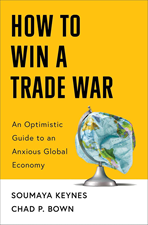
How to Win a Trade War: An Optimistic Guide to an Anxious Global Economy
Soumaya Keynes and Chad P. Bown
Review via Reason
The ancient Chinese military strategist Sun Tzu advised that “he who wishes to fight must first count the cost.” Joshua, the brilliant (for its time) computer in the 1983 film WarGames, did the counting and concluded that “the only winning move is not to play.”
Both lines find their way into How To Win a Trade War. This is no arid academic analysis, and it does not read like one. Instead, Soumaya Keynes, a journalist at the Financial Times, and Chad Bown, a senior fellow at the Peterson Institute for International Economics, have crafted a witty, fast-paced analysis of how the global trading system has unraveled in the aftermath of COVID, Brexit, and (most importantly) President Donald Trump’s electoral successes.

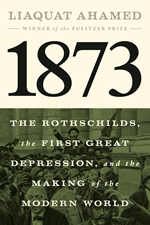
1873: The Rothschilds, the First Great Depression, and the Making of the Modern World
Liaquat Ahamed
Review via The Wall Street Journal
In one single unforgettable day—Friday, May 9, 1873—prices on the Vienna Stock Exchange plunged by 45%. All at once the world was changed.
“1873,” by Liaquat Ahamed, author of “Lords of Finance: The Bankers Who Broke the World” (2009), is the story of the trans-Atlantic depression that followed the crash. It is the story, too, of a generation-long, befuddling decline in the prices of all kinds of things. In 1878, confronting the lowest prices for pig iron since colonial times, American ironmasters wondered if the smokestacks on their idled blast furnaces might serve a higher use as astronomical observatories.

Lightning Beneath the Sea: The Race to Wire the World and the Dawn of the Information Age
James M. Tabor
Review via The Wall Street Journal
You’ll rarely know for certain, but when you send an email, check your social-media feed or read this newspaper online, you may be sending pulses of light through a conduit the size of a garden hose resting on the floor of the sea. Around 500 fiber-optic cables, not counting those owned by governments, stretch for more than a million total miles beneath the oceans. They provide the physical backbone for the weightless world of the internet. Life without them would be hard to imagine.

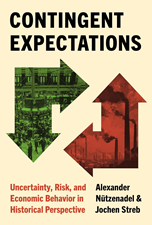
Contingent Expectations: Uncertainty, Risk, and Economic Behavior in Historical Perspective
Alexander Nützenadel and Jochen Streb
Summary via publisher (Princeton U. Press)
Expectations play a crucial role in shaping economic behavior. But how are expectations actually formed, and how has this changed over time? The financial crisis of 2007–08 cast doubt on traditional theories of expectation formation, particularly the rational expectations framework. In Contingent Expectations, Alexander Nützenadel and Jochen Streb examine the ways that past experiences influence the economic expectations and decision-making of households, investors, and policymakers through history, and offer an alternative perspective. Combining a comprehensive empirical analysis of expectation formation from the eighteenth century to the present day with an assessment of the relevant economic theory, Nützenadel and Streb present a new theoretical framework, contingent expectations, for understanding economic expectation.

Please note that the links to books above are affiliate links with Amazon.com and James Picerno (a.k.a. The Capital Spectator) earns money if you buy one of the titles listed. Also note that you will not pay extra for a book even though it generates revenue for The Capital Spectator. By purchasing books through this site, you provide support for The Capital Spectator’s free content. Thank you!

Research Review | 5 June 2026 | Risk Management

The Capital Spectator -

Measuring Bubbles via Put-Call Disparity: A Model-Free Approach
Robert A. Jarrow (Cornell U.) and Simon Kwok (U. of Sydney)
May 2026
This paper introduces simple, model-free lower and upper bounds for measuring the size of asset price bubbles. Assuming only that the market satisfies no-free-lunch-with-vanishing-risk and that all trading strategies are admissible, our framework avoids restrictive parametric models and the no-dominance assumption. We demonstrate that put-call disparity provides an observable lower bound, and is economically justified by short-sale constraints. Additionally, the lowest price of an out-of-the-money (OTM) call option determines the upper bound. To ensure empirical reliability, we modify these bounds using data-driven regularization and bootstrap methods to disentangle genuine bubble signals from market microstructure noise and to reduce reliance on thinly traded deep OTM options. Using S&P 500 index option prices from 1996 to 2025, we document a sustained bubble during the COVID-19 era and capture market exuberance preceding the 2000 dot-com and 2008 financial crashes. In addition, the empirical study suggests that the market violates no-dominance and is incomplete.

How Fear Beats Greed: The Impact of Positive and Negative Sentiment on Global Stock Markets
Jiye Ryu (Hongik University), et al.
February 2026
This paper investigates the impact of positive and negative sentiment on stock returns and volatilities across developed and emerging markets using the consumer confidence index as a proxy for sentiment. We conduct a comparative study of developed and emerging markets to assess whether sentiment-driven mispricing is due to overpricing or underpricing and to examine the effect of sentiment on return and risk dynamics.

Diversification Under Stress: Empirical Evidence of Correlation Breakdown Across Sectors and International Markets
Fabio Trachsler (ETH Zürich)
May 2026
We investigate whether portfolio diversification across U.S. sectors and international equity markets retains its risk-reducing properties under stress. Using daily return data from 1999 to 2025 spanning ten sector ETFs and eight international equity indices, we document a systematic correlation breakdown: mean pairwise correlations rise significantly during crisis episodes, precisely when diversification would be most valuable. Across nine crisis periods and 59 systematically identified stress events, correlations increase in 71.2 % of all cases, with a mean ∆ρ = 0.094 that is statistically highly significant (p < 0.0001). We show that the nature of a shock matters more than its magnitude: idiosyncratic events leave correlations intact, while systemic shocks produce strong co-movement across all sectors simultaneously. Sector and international diversification fail together in systemic crises but diverge in idiosyncratic ones, a distinction that, to our knowledge, has not been systematically documented across this breadth of episodes. We introduce the Trachsler Resilience Score, a formal criterion for selecting sectors that are robust to correlation breakdown under stress, and validate it out-of-sample: the Resilience Portfolio reduces maximum drawdown in 83 % of independent stress events (p = 0.003). Our findings suggest that naive diversification offers substantially less protection than classical portfolio theory implies, and that crisis-conditional correlation structure should be an explicit input to portfolio construction.

Industry Rotation Using Market-State Similarity
Valeriy Zakamulin (University of Agde)
May 2026
This paper studies whether lagged market returns contain useful information about subsequent industry returns and whether this information can be used for active industry rotation. Using monthly Kenneth French industry portfolios, we first show that conventional mean predictability is weak. Quantile predictive regressions, however, reveal that market-to-industry predictability is concentrated mainly in the tails of the conditional return distribution, especially in downside states. Motivated by this evidence, we propose a non-parametric strategy based on market-state similarity. At each portfolio-formation date, the strategy identifies historical months in which the standardized market excess return was closest to its current value, measures subsequent industry performance after those similar states, and goes long industries with positive historical subsequent returns and short industries with negative historical subsequent returns. Out-of-sample simulations show that the active strategy delivers a higher Sharpe ratio, lower volatility, and substantially smaller drawdowns than the passive equal-weighted industry benchmark. The results are robust to industry classification and model-parameter choices.

When Sector ETFs Pull Apart
Jackson Wang (independent)
May 2026
The SPDR Select-Sector ETFs are usually treated as positively correlated slices of one underlying market. Across the full 1999-2026 sample of daily returns the average pairwise correlation among the 11 sectors is well above 0.5, and almost no two sectors have ever been unconditionally negatively correlated. Conditioning on a rolling 60-day window, however, surfaces narrow but recurring divergence regimes: episodes in which the cross-sectional spread between the best-and worst-performing sector explodes, and pairs that are usually mildly positive flip to outright negative correlation. The XLK-XLE pair, for example, has a long-run average rolling correlation of 0.41 but reached-0.43 on 2000-10-17 during the dot-com unwind. We build a long history of these regimes and find that the most recent example-the post-ChatGPT AI boom from 2022-11-30 through 2026-05-08-is one of the largest in the sample: SMH returned 410.1% and XLK 164.9% while XLE managed 37.6% and XLP only 19.8%. During this window the average rolling 60-day correlation between XLK and XLE collapsed to 0.15. A naive cross-sectional sector momentum long/short (top-2 long, bottom-2 short, monthly rebalanced, three-month lookback) does not earn a positive risk premium over the full sample (Sharpe-0.14), but a long-only top-2 momentum sleeve captures most of the AI-boom rotation, returning 68.8% over the window vs SPY’s 95.0%. The lesson is that sector ETF divergence is real, identifiable, and useful for tilting equity exposure, but generic mean-reversion or momentum strategies do not naturally monetize it.

Regime-Based Portfolio Allocation Using Hidden Markov Models and Reinforcement Learning
Ajay Kumar Verma (independent), et al.
November 2025
This study develops a regime-aware portfolio allocation framework that integrates Markov switching models with Reinforcement Learning (RL) to dynamically allocate across equities (SPY), long-term Treasuries (TLT), and gold (GLD). Using daily ETF data from 2004-2025, we first characterize market behavior through a discrete Markov chain and then estimate a three-state Gaussian Hidden Markov Model (HMM) selected by the Bayesian Information Criterion (BIC). The estimated regimes-low-volatility, transitional, and high-volatility-exhibit strong persistence and state-dependent return dynamics consistent with recent findings on nonlinear market states (Ardia et al., 2024; Gupta & Pierdzioch, 2023). State-conditional analysis shows that SPY dominates in stable regimes, while TLT and GLD provide protection during stressed periods, motivating regime-conditioned allocation rules.

Learn To Use R For Portfolio Analysis
Quantitative Investment Portfolio Analytics In R:
An Introduction To R For Modeling Portfolio Risk and Return

By James Picerno

Pages